How to Troll for Salmon on Lake Michigan
There’s nothing quite like the immense challenge and incredible reward of chasing salmon on the vast waters of Lake Michigan, especially when you’re right here along Indiana’s shoreline. It can feel overwhelming, like trying to find a needle in a haystack, especially if you’re new to the game or just haven't quite cracked the code. This guide is here to break down the art and science of trolling for salmon on Lake Michigan, giving you the practical strategies and gear knowledge you need to turn those frustrating days into memorable catches.
Understanding Lake Michigan Salmon Trolling
Lake Michigan isn't your average fishing hole; it's an inland sea, and fishing its depths for salmon requires a specialized approach. Trolling is by far the most effective method, allowing you to cover vast amounts of water and present your lures to fish that are often scattered and suspended in the water column.
Why Trolling is Key for Salmon
Salmon, whether they're mighty Chinook or energetic Coho, are pelagic fish for much of their lives in Lake Michigan. This means they spend their time cruising in open water, often following baitfish schools like alewives or rainbow smelt. They aren't hanging out on structure in the same way a largemouth bass might, nor are they always schooling tightly in easily locatable spots. The sheer size of Lake Michigan means that waiting for them to come to you is often a futile effort.
Trolling allows your boat to slowly move multiple lines through the water at various depths and distances behind the boat. This creates a wide, tantalizing spread of lures, increasing your chances of intercepting these cruising predators. It's an active, patient approach that mimics baitfish movements, making your presentation irresistible to hungry salmon as you search out their feeding zones. Without covering ground and presenting multiple offerings, finding these fish would be incredibly difficult.
Key Species You'll Target
When you're out trolling on Lake Michigan from Indiana, you're primarily aiming for a few prized species, each with its own fight and flavor profile. Knowing what you're after can help you fine-tune your techniques.
The kings of the lake are the Chinook Salmon, also known as King Salmon. These fish are powerful, often growing to impressive sizes, and they offer a truly epic battle when hooked. They're known for their strong runs and deep dives. You'll often find them deeper in the water column, especially during the warmer summer months. Another fantastic target is the Coho Salmon, or Silver Salmon. Cohos are generally smaller than Chinooks but are incredibly aggressive and put up a spectacular fight with acrobatic jumps and head shakes. They tend to prefer slightly warmer water than Chinooks and can often be found higher in the water column.
Beyond salmon, you'll also frequently encounter Steelhead (rainbow trout) and Brown Trout while trolling for salmon. Steelhead are famous for their aerial displays and blistering runs, especially when hooked on lighter tackle. Brown Trout are more reserved fighters but can grow to considerable sizes and are often found closer to shore or around structure. While your primary focus might be salmon, don't be surprised to find one of these fantastic bonus fish on your line, especially during certain times of the year or in particular temperature bands. For more details on the specific species available, check out our guide on Indiana's Lake Michigan Fishery: Species You Can't Catch Anywhere Else.
Essential Gear for Lake Michigan Salmon Trolling
Trolling for salmon on Lake Michigan isn't just about throwing a line in the water; it requires a specific arsenal of gear to be successful and safe on such a large body of water. Investing in the right equipment makes all the difference.
The Right Boat and Power
The size and type of boat you use for Lake Michigan trolling are paramount for both safety and effectiveness. This isn't the place for a small johnboat or a tiny fishing kayak, unless you're sticking very close to shore on calm days, which are rare. The big lake can turn from glass to washing machine in a matter of minutes, so you need a vessel that can handle variable conditions.
Most successful Lake Michigan salmon anglers opt for boats typically ranging from 18 to 30 feet, often cuddy cabins, walkarounds, or dedicated fishing boats designed for big water. A deeper V-hull will cut through waves better, providing a more comfortable and safer ride. You'll need ample deck space for managing multiple lines, downriggers, and other trolling gear. Equally important is adequate horsepower; you need enough power to get to your spots quickly, but also to maintain precise trolling speeds, even against wind and current. A reliable main engine and a sturdy, fuel-efficient kicker motor (auxiliary engine) are often essential for slow trolling and as a safety backup. For insights on what kind of vessel might be best, take a look at How Big of a Boat Do You Need for Lake Michigan Salmon Fishing.
Rods, Reels, and Line for the Big Lake
Your rod and reel setup needs to be robust enough to handle the powerful runs of a Chinook salmon and the sustained pressure of trolling with heavy gear. You'll typically be running multiple setups, each rigged for a different depth or presentation.
For rods, think medium-heavy to heavy action with a flexible tip, usually around 7 to 10 feet long. These longer rods help spread your lines out and absorb the shock of a strike without tearing the hook out. Fiberglass or composite rods are popular for their durability and parabolic bend. Reels are almost universally baitcasting or conventional reels, often with a line counter feature, which is crucial for replicating successful depths. They need strong drags and high line capacity. Many anglers prefer reels made by Okuma, Daiwa, or Penn for their reliability in saltwater-grade environments.
When it comes to line, you'll use a variety depending on your trolling method. Main lines can be monofilament, braided line, or even wire line. Monofilament offers stretch, which can be forgiving, while braid offers incredible strength and sensitivity with minimal stretch. Wire line is primarily used with specific divers to get lures deeper. Leaders are typically fluorocarbon, known for its low visibility and abrasion resistance. Remember, you'll be running a lot of line, so ensure your reels can hold plenty. You can find a wide selection of these specialized rods, reels, and lines on reputable online retailers like Amazon. For more detailed recommendations on tackle, consider our article on Best Rods for Trolling Lake Michigan Salmon.
Downriggers and Planer Boards
These are the unsung heroes of Lake Michigan salmon trolling, allowing you to present lures precisely where the fish are feeding – often deep below the surface or far away from the boat's disturbance.
Downriggers are mechanical devices that use a heavy cannonball weight (typically 8-12 pounds) to carry your fishing line down to a specific depth. Your fishing line is attached to the downrigger wire via a release clip. When a fish strikes, the line pops out of the clip, allowing you to fight the fish directly without the weight. This precise depth control is absolutely critical, as salmon often feed in narrow temperature bands (the "thermocline") or at very specific depths where baitfish are concentrated. Without downriggers, getting lures consistently deep enough and keeping them there would be nearly impossible. Learning Downrigger Basics for Indiana Lake Michigan Anglers is a must for serious salmon fishing.
Planer boards are devices that tow your fishing lines out to the sides of the boat, away from the prop wash and engine noise. This allows you to create a much wider spread of lures than you could with just rods extending from the boat's sides. They're particularly effective for running lines closer to the surface or at shallow depths, covering more water laterally. There are various types of planer boards, from large inline boards to mast-and-board systems. Utilizing both downriggers and planer boards allows you to cover a comprehensive spread, targeting multiple depths and distances from your boat simultaneously. For a deeper dive into these, check out Planer Boards for Indiana Salmon and Steelhead Trolling.
Electronics: Fish Finders and GPS
On a body of water the size of Lake Michigan, good electronics aren't a luxury; they're an absolute necessity. They provide the eyes and memory you need to locate fish and navigate effectively.
A high-quality fish finder (sonar unit) is your most important tool for locating salmon and understanding the underwater environment. You'll use it to mark baitfish schools, identify individual fish, and most importantly, pinpoint the thermocline – the layer of water where temperatures rapidly change, which often holds the most active fish. Look for units with clear, high-resolution screens and powerful transducers that can give you good readings at depth. Features like side-imaging or down-imaging can also be incredibly useful for locating fish away from directly under your boat.
A reliable GPS unit (often integrated into modern fish finders) is crucial for navigation and for recording successful fishing spots. Lake Michigan can be disorienting, and a GPS allows you to safely navigate, especially in fog or low light conditions. More importantly, it lets you mark "waypoints" where you've had strikes, allowing you to return to productive areas and troll the exact same path. The ability to track your trolling speed and direction precisely is also vital for consistent success. You can find many excellent fish finder and GPS combos from brands like Humminbird, Lowrance, and Garmin on retailers like Amazon, offering a range of features for different budgets. For tips on maximizing your sonar, refer to Best Fish Finders for Deep Water on Lake Michigan.
Mastering Trolling Techniques and Strategies
Once you have your gear sorted, the real magic happens in how you deploy and manage it. Trolling for salmon is a delicate balance of art and science, requiring constant adjustment and keen observation.
Depth Control Is Everything
Salmon in Lake Michigan are incredibly sensitive to water temperature and light conditions. They will often congregate in a specific temperature band, typically the thermocline, or at depths where baitfish are present. Your ability to consistently present your lures at these precise depths is the single most critical factor in your success.
Downriggers are your primary tool for pinpoint depth control. You'll typically set multiple downriggers at varying depths to "fish the water column" until you find where the fish are active. Pay close attention to your fish finder to identify the thermocline and any marks of baitfish or gamefish. Adjust your downrigger depths based on these readings, as well as on where you're getting bites. Lead core line, a specialized line with a lead core to make it sink, is another method to achieve depth, often used with planer boards for a wide, shallow spread. Dipsy divers and jet divers are also common, using water pressure to dive lures to a set depth. Learning to combine these tools effectively allows you to present lures at anywhere from 10 feet to over 100 feet deep. Always be ready to make small adjustments, as even a 5-foot change in depth can make a huge difference in strike rates.
Lure Selection and Presentation
The vast world of Lake Michigan salmon lures can feel overwhelming, but understanding the basics of what works and why will help you make informed choices. Salmon are opportunistic predators, and their preferences can change daily based on water clarity, light conditions, and the prevalent baitfish.
Spoons are arguably the most popular and versatile lure for Lake Michigan salmon. They come in a dazzling array of colors, patterns, and sizes, mimicking wounded baitfish. Experiment with different colors, paying attention to what's working on a given day. Bright, fluorescent colors often work well on cloudy days or in deeper, darker water, while natural baitfish patterns are excellent in clear water and brighter conditions. Brands like Michigan Stinger, Dreamweaver, and Silver Streak are perennial favorites.
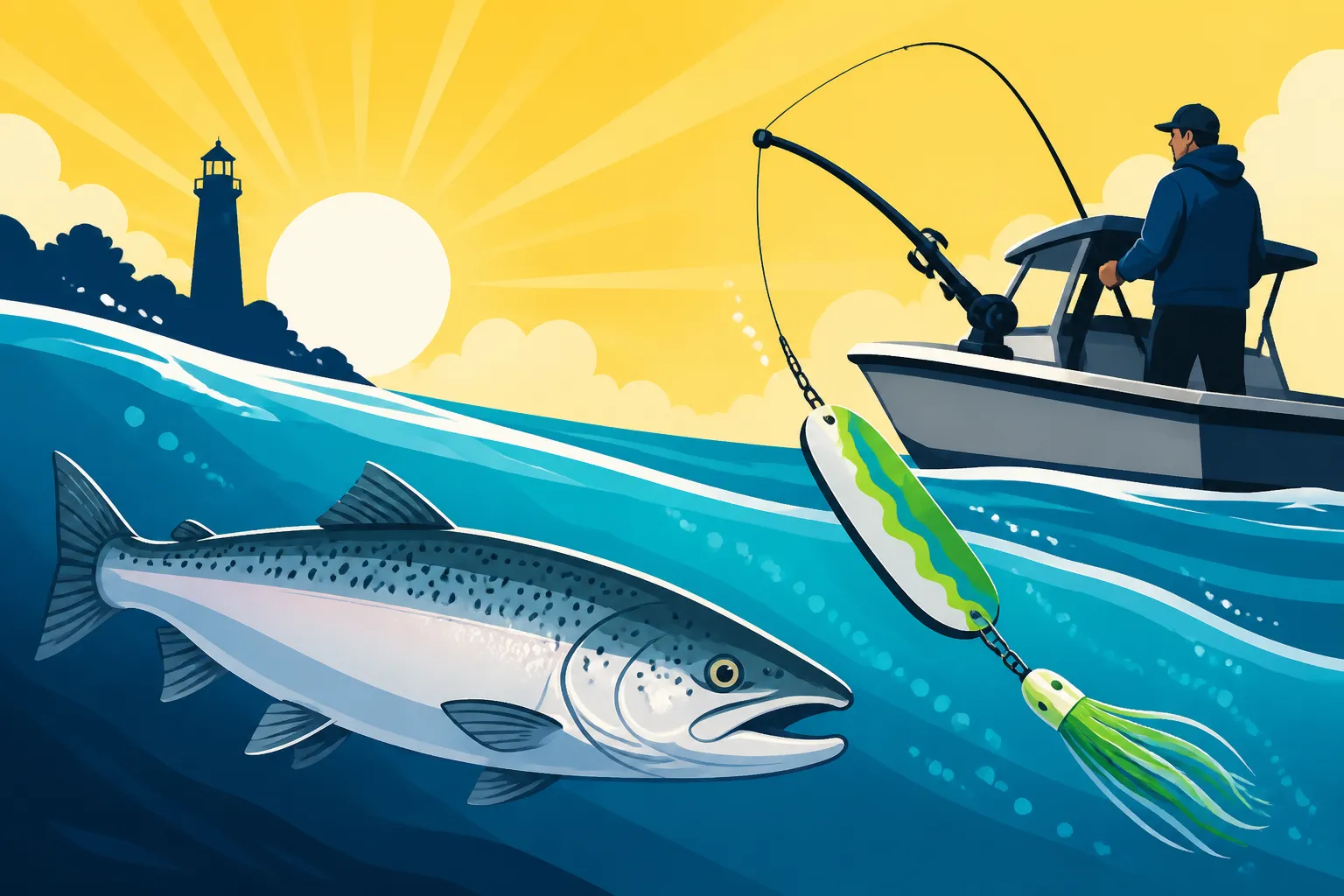
Beyond spoons, dodgers and flies (or "meat rigs" with real bait) are incredibly effective, particularly for Chinook salmon. The dodger is a large, flashy attractor that creates a darting, wounded-fish action, while the short leader behind it presents a small fly or bait. Crankbaits and plugs are also productive, especially for Coho salmon or when fish are higher in the water column. Always ensure your lures are running true; a poorly tuned lure won't get bites. Varying your lure selection and spread until you find what the fish are keying on is part of the challenge and fun.
Speed and Direction Considerations
Trolling speed is not a one-size-fits-all parameter; it's a critical variable that needs constant adjustment based on lure type, target species, and fish activity. Generally, salmon trolling speeds on Lake Michigan range from 1.8 to 3.5 miles per hour, but this can vary.
Slower speeds (1.8-2.5 mph) are often effective for presenting spoons with a subtle wobble or for dodger/fly combos that need to perform their characteristic darting action. Faster speeds (2.5-3.5+ mph) can trigger aggressive strikes, especially from Coho, and are suitable for running crankbaits. The key is to observe how your lures are performing at different speeds in the water.
Your trolling direction also plays a significant role. Rather than just going in a straight line, experienced anglers often employ "S-turns" or subtle zig-zags. This causes your outside lures to speed up and rise in the water column, while inside lures slow down and drop. This change in speed and depth can often trigger a strike from following fish. Pay attention to how the current affects your boat speed over ground versus your speed through the water, and adjust accordingly. Even a slight change in direction can present a lure differently and entice a bite.
Reading the Water and Conditions
Successful Lake Michigan salmon trolling isn't just about deploying gear; it's about becoming a student of the lake. Learning to read the water and adapt to changing conditions is paramount.
Water temperature is perhaps the most critical factor. Salmon actively feed in a relatively narrow range of temperatures, often between 45-55°F for Chinook and 50-60°F for Coho. Your fish finder's temperature gauge is invaluable here. Look for the thermocline and target those temperature breaks. On bright sunny days, fish might go deeper to escape the light, while on cloudy days or at dawn/dusk, they might move higher in the water column.
Water clarity also influences lure choice. In stained or cloudy water, brighter, flashier lures or those with rattles can be more effective. In clear water, more natural patterns and less flash might be preferred. Wind and waves dictate not only safety but also your trolling strategy. Rougher water often means fish are deeper or closer to structure, and maintaining a consistent speed becomes harder. Adjust your speed to keep your lures performing optimally despite boat movement. Always check the marine forecast before heading out, especially for Lake Michigan, which can change rapidly. For more on how these conditions impact your chances, read How Water Temperature Triggers the Fall Salmon Push Toward Shore.
Timing Your Lake Michigan Salmon Trolling Trips
Timing is everything when it comes to Lake Michigan salmon. While you can catch fish throughout the open water season, certain periods offer peak opportunities for different species and types of fishing.
Seasonal Patterns for Salmon
The Lake Michigan salmon fishery changes dramatically with the seasons.
- Spring (April-May): As ice recedes and nearshore waters begin to warm, Coho salmon often become very active close to shore. They're often found in the top 30 feet of the water column, making them accessible to shallower trolling methods and even pier fishing. Chinook will also start to spread out from their wintering grounds.
- Summer (June-August): This is prime time for deep-water trolling. Chinook salmon will be out in the main basin, often following the thermocline. Coho, Steelhead, and Brown Trout will also be active, with anglers targeting various depths with downriggers, divers, and lead core lines. The sheer abundance of baitfish makes this a productive period, but locating the scattered fish can be a challenge.
- Fall (September-November): This is perhaps the most anticipated time for many Indiana anglers, as it marks the famous Lake Michigan's Salmon Run: Indiana's Fall Fishing Season. Mature Chinook and Coho salmon begin their migration back towards river mouths to spawn. They congregate in shallower waters near harbors and tributaries, becoming highly aggressive. This is an excellent time for targeting fish that are still actively feeding before their full spawning transformation. The bite can be incredible, but weather can be highly variable.
Best Time of Day
Like most predatory fish, salmon are often most active during periods of low light. This typically means dawn and dusk are prime fishing windows for trolling on Lake Michigan. As the sun rises or sets, the lower light levels give salmon a predatory advantage over their prey, making them more willing to chase and strike lures.
Many dedicated salmon anglers will launch their boats well before sunrise to be on their chosen trolling grounds as the first light breaks the horizon. Fishing into the morning can remain productive, especially on cloudy days. Similarly, the late afternoon and evening hours as the sun dips below the horizon can ignite a hot bite. While low light periods are generally best, salmon can certainly be caught throughout the day, especially if you're effectively tracking the thermocline and baitfish schools. On bright, sunny days, you might find fish deeper, requiring more precise depth control. For a deeper discussion, consider our post on Best Time of Day to Catch Salmon on Lake Michigan in Indiana.
Understanding the Indiana Fishing License and Trout Stamp
Before you even think about dropping a line in Lake Michigan, you absolutely need to make sure your paperwork is in order. Fishing without the proper license and stamps in Indiana can lead to fines and a ruined day on the water.
All anglers aged 18 and older must possess a valid Indiana fishing license. Beyond the general fishing license, if you plan to target trout or salmon in Lake Michigan or its tributaries, you will also need to purchase an Indiana Trout and Salmon Stamp. This stamp is an additional endorsement required specifically for fishing these species in designated waters. This includes not just Lake Michigan itself, but also the St. Joseph River, Trail Creek, Salt Creek, and other streams where these species run. Even if you're just targeting salmon, if there's a chance you might catch a trout or if you're fishing in waters managed for these species, the stamp is a must-have. You can usually purchase both your annual fishing license and the Trout and Salmon Stamp online, at bait shops, or through authorized retailers. Always carry proof of your license and stamp with you while fishing. For comprehensive information on what you need, check out Indiana Trout and Salmon Stamp Requirements.
Trolling Method Comparison
To help visualize the different ways you can present your lures while trolling for salmon on Lake Michigan, here's a quick comparison of popular methods:
| Method | Primary Purpose | Typical Depth Range | Pros | Cons | Ideal Scenario |
|---|---|---|---|---|---|
| Downrigger | Precise depth control for deep, suspended fish | 20-150+ feet | Extremely accurate, allows fighting fish directly, versatile | Requires dedicated equipment, can be complex to set up initially | Targeting thermocline, deep-holding fish, active baitfish schools |
| Planer Board | Spreads lures wide to cover more water, avoids prop wash | 0-40 feet (surface to shallow) | Covers wide area, reduces boat spook, good for shallow fish | Less precise depth control, can be affected by boat turns | Scattered fish, calm conditions, shallower presentations |
| Lead Core Line | Achieves depth without weights, wide spread with boards | 10-60 feet (depth varies by color segment) | Simple depth control by letting out specific colors, effective | Bulky line on reel, less direct fight with fish, depth estimate only | Fish scattered at medium depths, running multiple lines off boards |
| Dipsy Diver | Self-diving disc that takes lures to specific depths | 10-70 feet | No external weight needed, provides extra action to lure | Can be tricky to set release tension, adds drag on fight | Fish at various depths, needing an aggressive lure action |
| Copper Line | Very heavy sinking line for deep, wide presentations | 50-150+ feet | Gets very deep without external weight, effective long lines | Very heavy, requires specialized large reels, difficult to handle | Deepest presentations, long leads for wary fish |
This article is for general informational purposes only and does not constitute professional advice. Laws, prices and regulations vary by location and change over time. Consult a qualified professional for guidance on your specific situation.