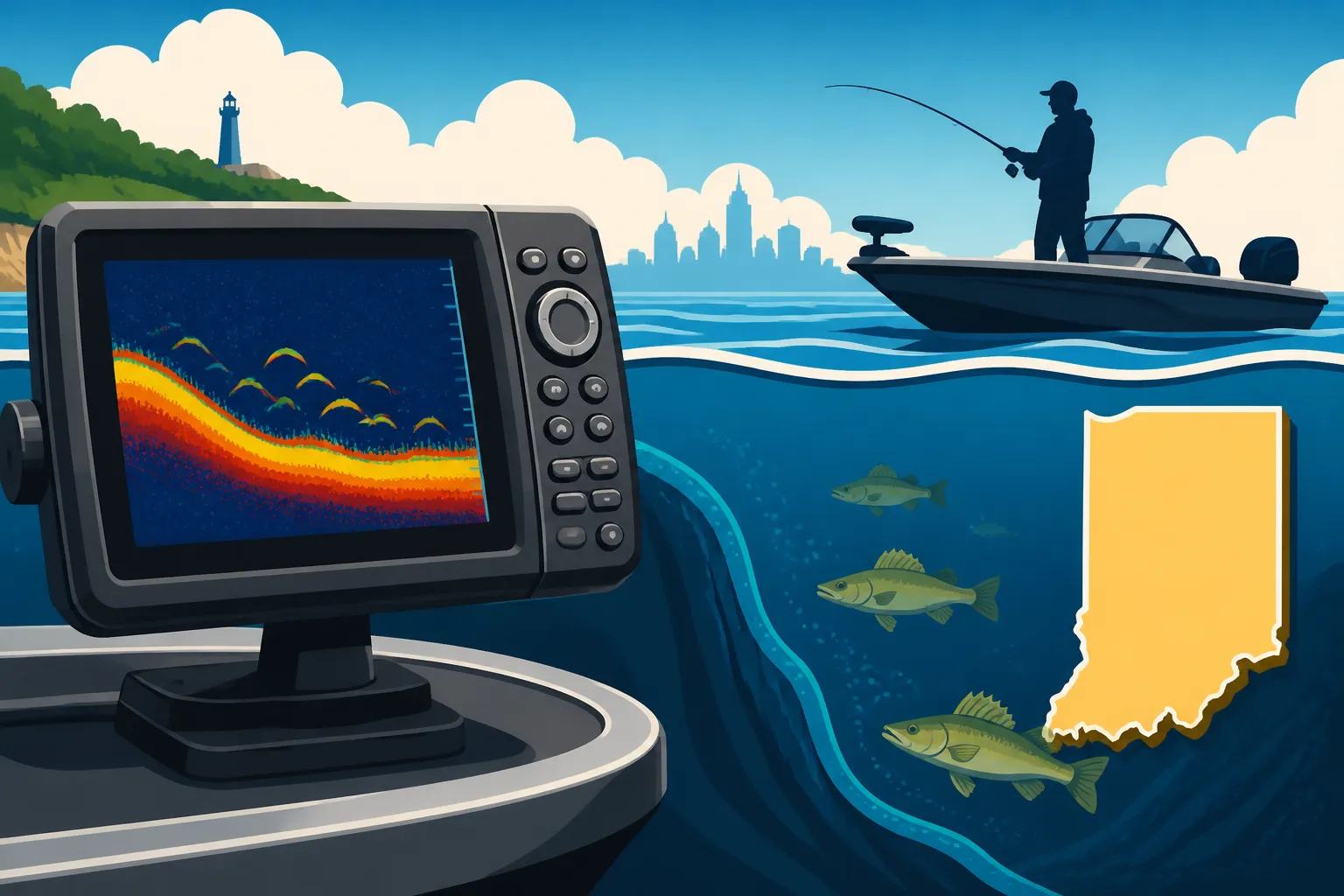
Best Fish Finders for Deep Water on Lake Michigan
For any angler who has ever gazed out across the vast, deep expanse of Lake Michigan, you know it's a world unto itself. Those enormous, often turbulent waters present a unique set of challenges when you're trying to pinpoint schools of salmon, trout, or even baitfish that might be suspended hundreds of feet down. This guide is all about cutting through the confusion and helping you choose the best fish finder to conquer the deep, dynamic environment of Lake Michigan, ensuring your time on the water is more about catching and less about searching.
Understanding Lake Michigan's Unique Challenges for Fish Finders
Fishing on Lake Michigan isn't like casting into a local farm pond or even a smaller inland lake. It's a truly massive body of water, and that scale brings with it specific hurdles that a standard, off-the-shelf fish finder simply isn't equipped to handle effectively. If you've ever felt frustrated by a screen showing nothing but a flat line or murky blobs, it's likely because your equipment wasn't designed for the depths and conditions you're facing.
The Sheer Depth and Size
When you're out on Lake Michigan, you're not just dealing with wide-open spaces; you're contending with incredible depths. Many parts of the lake can easily exceed several hundred feet, and even nearer to shore, you'll find depths that far outstrip most inland fishing spots. A typical fish finder designed for shallower water, say 50-100 feet, simply doesn't have the power or the transducer capability to send a strong enough signal down to the bottom and receive a clear echo back from those depths. You need serious penetration power to get a reliable reading, not just of the bottom but of any fish or bait suspended far above it. Without that power, you'll be fishing blind in many key areas, which is a major disservice to your time and effort.
Thermoclines and Water Clarity Variations
One of the most fascinating and challenging aspects of Lake Michigan fishing is the presence of thermoclines. These are distinct layers of water with different temperatures, and they often hold the key to finding salmon and trout. Fish will frequently congregate just above or within these cooler layers, seeking optimal comfort and feeding opportunities. A basic fish finder might just show a vague line, if anything at all, making it incredibly difficult to identify these crucial zones. Beyond temperature layers, Lake Michigan's water clarity can vary significantly, from crystal clear near the dunes to more turbid near river mouths or after heavy storms. This variability directly impacts how sonar signals travel and how clearly your fish finder can "see" underwater. You need technology that can punch through these different water conditions and accurately depict thermoclines and suspended targets, rather than just guessing.
Targeting Pelagic Species in the Open Water
Unlike bass or crappie that often relate tightly to structure or the bottom in shallower lakes, many of Lake Michigan's prized species, like Chinook salmon, Coho salmon, and steelhead, are pelagic. This means they spend much of their lives suspended in the open water column, often far from the bottom or any obvious structure. They follow baitfish, which also roam freely. Your fish finder needs to be capable of not just marking the bottom, but of effectively scanning vast expanses of open water for these suspended schools and individual fish. Traditional, narrow-cone transducers might miss them entirely, giving you a false sense of empty water. To truly succeed, especially when you're Fishing Lake Michigan's Indiana Shoreline or out in the deeper basins, you need a system that offers wide coverage and excellent target separation to pick out those elusive, fast-moving targets.
Key Fish Finder Technologies for Deepwater Lake Michigan Fishing
Navigating the depths of Lake Michigan effectively requires more than just pointing a sonar beam downwards. Modern fish finders leverage advanced technologies that are specifically designed to overcome the challenges posed by vastness, depth, and the behavior of pelagic species. If you're serious about your Lake Michigan fishing, understanding these technologies is crucial.
CHIRP Sonar: The Game Changer for Depth and Detail
If there's one technology that has revolutionized deepwater fishing, it's CHIRP (Compressed High-Intensity Radiated Pulse) sonar. Unlike traditional sonar, which sends out a single frequency pulse, CHIRP technology broadcasts a continuous sweep of frequencies, from low to high, during each pulse. When these signals return, the system processes the full range of frequencies, rather than just one. What does this mean for you on Lake Michigan?
- Superior Target Separation: You can distinguish individual fish within a tight school, or even tell the difference between a fish and a nearby submerged branch. This is invaluable when you're seeing marks hundreds of feet down.
- Clearer, Sharper Images: The wider bandwidth of information provides a much clearer, higher-resolution picture of what's beneath your boat. No more guessing if that faint mark is a fish or just noise.
- Greater Depth Penetration: Because the system is processing a range of frequencies, it can penetrate deeper with more reliable returns, essential for those deep thermal breaks or bottom-hugging lakers.
- Reduced Noise: CHIRP is much better at filtering out unwanted clutter and interference, giving you a cleaner, more accurate display.
This technology isn't just a luxury; it's practically a necessity for anyone serious about deepwater fishing on Lake Michigan. It allows you to confidently identify the size and density of bait balls and differentiate them from predator fish, even at impressive depths.
Dual/Multiple Frequency Transducers: Versatility for Varying Conditions
While CHIRP provides incredible clarity, the ability to select or utilize multiple frequencies simultaneously from your transducer adds another layer of versatility crucial for Lake Michigan's varied conditions. Most high-end fish finders designed for this environment will feature dual or even multiple frequency capabilities, often combining a lower frequency with a higher one.
- Low Frequencies (e.g., 50 kHz): These frequencies offer excellent depth penetration. They're your workhorse for reaching the deepest parts of Lake Michigan and for getting a broad, general overview of the water column. The trade-off is often less detail, but for initial scans and deep water, they are unbeatable.
- High Frequencies (e.g., 200 kHz): These provide much finer detail and better target separation. While they don't penetrate as deep, they are fantastic for clearly identifying structure, baitfish, and individual game fish when they are within their effective range, or for fishing in shallower areas.
The best systems will often run these simultaneously or allow you to switch between them quickly, giving you the best of both worlds. Some transducers also offer wide-angle cones, which cast a broader net beneath your boat, helping you locate those dispersed pelagic fish more effectively across a larger area.
Side-Imaging and Down-Imaging: Expanding Your Underwater View
Imagine having X-ray vision that extends not just directly beneath your boat, but also out to the sides. That's essentially what Side-Imaging and Down-Imaging technologies offer, and they are absolute game-changers for large bodies of water like Lake Michigan.
- Side-Imaging (or SideScan/SideVu): This technology sends very thin, high-frequency beams out to the sides of your boat, often hundreds of feet in each direction. It creates a photographic-like image of the bottom structure, baitfish, and even individual fish located to your port and starboard.
- Why it's Crucial for Lake Michigan: Think about how vast Lake Michigan is. Side-imaging allows you to scan an incredibly wide swath of water with each pass. Instead of driving directly over a small piece of structure or a bait school, you can see it from a distance, allowing you to quickly identify productive areas, especially when Check Lake Michigan Fishing Rules Before You Cast. This is invaluable for finding submerged humps, rock piles, or even wrecks that might be off your main path, without having to drive directly over them.
- Down-Imaging (or DownScan/ClearVu): This gives you a photo-like view of what's directly beneath your boat, eliminating much of the traditional sonar clutter. It excels at showing detailed images of structure, individual fish, and even how fish relate to that structure.
- Why it's Crucial for Lake Michigan: When you do find a promising area with Side-Imaging, Down-Imaging helps you confirm what you're seeing with remarkable clarity. You can easily distinguish a school of bait from a tangled mess of debris, or see individual salmon cruising near a submerged ledge.
Together, these technologies provide an unparalleled underwater picture, transforming your understanding of the Lake Michigan environment and dramatically improving your chances of success. They turn the guesswork into informed decisions, allowing you to spend more time fishing where the fish actually are.
- Why it's Crucial for Lake Michigan: When you do find a promising area with Side-Imaging, Down-Imaging helps you confirm what you're seeing with remarkable clarity. You can easily distinguish a school of bait from a tangled mess of debris, or see individual salmon cruising near a submerged ledge.
Essential Features and Considerations for Lake Michigan Anglers
Choosing the right fish finder for the deep waters of Lake Michigan goes beyond just the core sonar technology. Several other features and design considerations play a pivotal role in usability, effectiveness, and overall satisfaction on the water. These are the details that separate a good unit from a truly great one, especially when you're battling the elements and the vastness of one of the Great Lakes.
Screen Size and Resolution: Clarity is King
When you're trying to interpret complex sonar data, often split-screening multiple views like CHIRP, Side-Imaging, and your chartplotter, screen real estate and clarity are paramount. A larger screen, ideally 9 inches or more, makes a world of difference. It allows you to see more detail without constantly zooming in and out, reducing eye strain and helping you make quicker, more accurate decisions.
- High Resolution: Just as important as size is the screen's resolution. A higher pixel count means a sharper, clearer image, which is vital for distinguishing subtle marks like individual fish or fine bottom contours hundreds of feet down. Trying to discern details on a small, low-resolution screen in bright sunlight or choppy conditions can be incredibly frustrating.
- Display Type: Look for bright, sunlight-readable displays that offer good contrast, even when wearing polarized sunglasses. Glare can be a real issue on open water, so a quality screen is a must. Whether you're glancing at it while trolling for Lake Michigan's Salmon Run: Indiana's Fall Fishing Season or meticulously scanning for structure, a clear display is your window to the underwater world.
GPS Chartplotter Integration: Navigation and Waypointing
In a body of water the size of Lake Michigan, losing your bearings or struggling to return to a productive spot can be a major headache. That's why integrated GPS chartplotter capabilities are absolutely non-negotiable for deepwater angling.
- Accurate GPS: A reliable GPS receiver, ideally internal for a cleaner setup or an external antenna for maximum accuracy, is essential for precise navigation. It helps you stay on course, avoid hazards, and understand your position relative to shore or key fishing grounds.
- Waypointing: The ability to mark waypoints for productive fishing spots, bait schools, or unique pieces of structure is invaluable. Found a thermocline holding fish? Mark it. Hit a specific depth that produced a strike? Mark it. Over time, your collection of waypoints becomes your personalized map of Lake Michigan's best fishing areas.
- Pre-loaded Maps and Mapping Capabilities: Many units come with pre-loaded base maps, but look for systems that allow for detailed marine charts (like Navionics or LakeMaster) which provide intricate contours, navigation aids, and other critical information. Some advanced systems even allow you to create your own custom high-definition bathymetric maps in real-time as you troll, mapping out previously uncharted bottom features. This is especially useful for understanding the complex bottom structure needed to target many species. Best Boats for Rough Water on Lake Michigan often include advanced GPS units as standard.
Power (RMS Wattage) and Transducer Quality
Think of your fish finder's power (measured in RMS wattage) as its lung capacity and your transducer as its vocal cords and ears. The more RMS wattage, the stronger the sonar signal that can be sent and received, leading to greater depth penetration and more reliable returns from deep water. For Lake Michigan, you generally want a unit with higher RMS power, especially if you're consistently fishing beyond 100-200 feet.
- Transducer Matters: The transducer is perhaps the most critical component. A cheap, low-quality transducer will limit even the most powerful head unit. Look for high-quality, name-brand transducers that are designed for deep water.
- Mounting Options: For deepwater use, a through-hull transducer often provides the cleanest signal by avoiding turbulence, but requires careful installation. Transom-mount transducers are easier to install but can be affected by turbulence at higher speeds. Selecting the right transducer type and ensuring proper installation is crucial for optimal performance, particularly when you're deep trolling. Consider consulting with a specialist at a marine store or Bass Pro Shops for advice.
Networking Capabilities and Future Expansion
Modern fish finders aren't just standalone units anymore; they're often part of a larger marine electronics network. Investing in a unit with strong networking capabilities ensures your system can grow and adapt to your future needs.
- Integration: Can it connect to other displays on your boat? Can it integrate with your trolling motor for spot-lock or automated trolling patterns? What about radar, autopilot, or even engine data?
- Future Proofing: By choosing a system that allows for easy expansion, you're making a long-term investment. You might start with a single unit, but later decide to add a second display, a live-scanning sonar module like Garmin's LiveScope, or a radar system for added safety on those foggy Lake Michigan mornings. This flexibility prevents you from having to replace your entire system down the road simply to add a new feature. Many advanced anglers will research Trolling Gear Setup for Indiana's Lake Michigan Salmon to ensure their electronics are fully integrated.
Top Fish Finder Brands and What to Look For
When it comes to outfitting your boat for serious Lake Michigan fishing, a few brands consistently rise to the top, offering robust features and advanced technologies specifically designed for the challenges of deep, open water. While the exact models and features might change, the core strengths of these manufacturers remain consistent. You'll find a wide array of options from these brands, available through various retailers, including larger outdoor stores like Bass Pro Shops or convenient online marketplaces such as Amazon.
Humminbird: Imaging Specialists
Humminbird has carved out a strong reputation for its exceptional imaging technologies, particularly with their MEGA Imaging suite. If seeing structure and fish with near photo-like clarity is your top priority, Humminbird units are definitely worth a close look.
- MEGA Imaging (Down, Side, and 360): This proprietary technology provides incredibly detailed images up to 200 feet deep and hundreds of feet to the side. For Lake Michigan, their MEGA Side Imaging is phenomenal for scanning vast areas quickly, identifying drop-offs, rock piles, or baitfish schools far from your boat's path. MEGA Down Imaging gives you crystal-clear views directly beneath.
- Dual Spectrum CHIRP: Humminbird's CHIRP sonar offers fantastic target separation and depth capability, crucial for marking those suspended salmon and trout.
- LakeMaster Charts: Many Humminbird units come pre-loaded with or are compatible with LakeMaster maps, offering highly detailed contours, depth highlighting, and even follow-the-contour features for integrated trolling motors.
Anglers looking to visually map the huge underwater landscape of Lake Michigan, find subtle structure, and precisely identify bait and game fish will find Humminbird a very compelling choice. You can explore their extensive range of fish finders on Amazon to compare models.
Lowrance: User-Friendly and Feature-Rich
Lowrance has a long history in marine electronics and is known for combining powerful sonar with intuitive, user-friendly interfaces. They offer a broad range of units that appeal to both seasoned pros and those looking for advanced features without a steep learning curve.
- Active Imaging and ActiveTarget: Lowrance's Active Imaging provides excellent SideScan and DownScan, comparable to Humminbird's offerings in terms of clarity and detail. Their ActiveTarget Live Sonar offers real-time, live views of fish movements around your lure, which can be a game-changer for active fishing, though perhaps less critical for pure deep trolling across vast expanses.
- High-Performance CHIRP: Lowrance units boast powerful CHIRP sonar, providing excellent depth penetration and target separation for Lake Michigan's deep water.
- C-MAP Charts: Compatibility with C-MAP charting offers detailed hydrographic data, custom shading, and fishing hot spots, which is invaluable for navigation and finding productive areas on such a large lake.
- Touchscreen Interfaces: Many Lowrance units feature responsive touchscreen displays that make navigating menus and customizing views quick and easy, even with wet hands. Whether you're targeting big kings during the Fall Salmon Run Timing on Lake Michigan in Indiana or chasing Lakers deep, Lowrance offers reliable tools.
Garmin: Speed and Clarity
Garmin, a titan in GPS and navigation, brings its expertise to marine electronics with a focus on speed, clarity, and highly advanced real-time sonar options. Their units are celebrated for their fast processors and bright, easy-to-read displays.
- UHD Scanning Sonar: Garmin's Ultra High-Definition (UHD) scanning sonar delivers incredibly sharp images of structure and fish with both ClearVü (Down Imaging) and SideVü (Side-Imaging) technologies.
- Panoptix LiveScope: For those who want to see what's happening live underwater, Garmin's Panoptix LiveScope (an add-on module for most units) provides real-time, video-like sonar images, allowing you to watch fish react to your bait. While it's a significant investment, its capability to show suspended fish and bait in real-time is unparalleled and can be incredibly effective in certain Lake Michigan scenarios.
- ClearVü/SideVü CHIRP: Garmin's traditional CHIRP sonar offers excellent deepwater performance, marking fish and structure with precision.
- Garmin Navionics+ Charts: Garmin units often come with pre-loaded or compatible with their own highly detailed Navionics+ charts, offering comprehensive coverage, auto-guidance technology, and user-generated Quickdraw Contours mapping.
If you value quick, responsive performance and potentially leading-edge live sonar technology for your Lake Michigan adventures, Garmin offers powerful solutions. Check out their offerings at Bass Pro Shops or through online retailers.
Here's a comparison of crucial fish finder features for deep water Lake Michigan fishing:
| Feature | Importance for Lake Michigan | Why it Matters |
|---|---|---|
| CHIRP Sonar | High | Provides superior target separation and clarity, essential for distinguishing individual fish within schools or near structure at great depths, and for cutting through thermoclines. |
| Side Imaging (SideVü) | High | Scans wide areas (hundreds of feet to each side), allowing you to quickly locate baitfish schools, structure, or drop-offs that you might otherwise troll right past. Increases search efficiency dramatically on such a large lake. |
| Down Imaging (ClearVü) | High | Offers a photo-like view directly beneath the boat, making it much easier to differentiate between fish, bait, and various types of bottom structure with remarkable detail, even in deep water. |
| High RMS Power | High | Directly correlates with depth penetration and signal reliability. Higher RMS wattage ensures your fish finder can send strong signals to the deepest parts of Lake Michigan and receive clear echoes back, reducing lost readings. |
| Large, High-Res Screen | High | Essential for viewing and interpreting multiple sonar and chartplotter displays simultaneously. A clear, large screen reduces eye strain and allows for quicker, more accurate identification of targets and navigation data. |
| GPS Chartplotter | High | Provides critical navigation, allows you to mark and return to productive waypoints (fish schools, thermoclines, structure), and helps you understand the complex contours and features of Lake Michigan's vast underwater terrain. Essential for safety and efficiency. |
Remember, your choice will ultimately depend on your budget, your preferred fishing style (e.g., whether you prioritize scanning wide areas or seeing live fish reactions), and what other marine electronics you might already have or plan to integrate. But by understanding these core technologies and features, you'll be well on your way to making an informed decision that enhances your Lake Michigan fishing experience. Don't forget to consider Lake Michigan Fishing Regulations Are Different From the Rest of the State when planning your trips.
Disclaimer
This article is for general informational purposes only and does not constitute professional advice. Laws, prices and regulations vary by location and change over time. Consult a qualified professional for guidance on your specific situation.