Planer Boards for Indiana Salmon and Steelhead Trolling
One of the biggest headaches for any angler serious about salmon and steelhead on Lake Michigan is trying to run a wide spread of lines without getting them tangled or limiting your presentation. It feels like you're constantly fighting against yourself, especially when you know those fish are out there, just beyond your boat's wake. This guide is all about mastering planer boards, a game-changing tool that lets you cover more water and present your lures effectively to those elusive Lake Michigan giants.
Understanding the Power of Planer Boards for Offshore Trolling
If you've ever spent a day trolling for salmon or steelhead on Lake Michigan, you know that getting your lures away from the boat's prop wash and spread out over a wide area is absolutely crucial. These fish are often boat-shy, and the wider your spread, the more ground you cover, increasing your chances of finding actively feeding fish. This is where planer boards truly shine, acting as your silent, wide-reaching allies on the water.
What Planer Boards Are and Why They're Essential
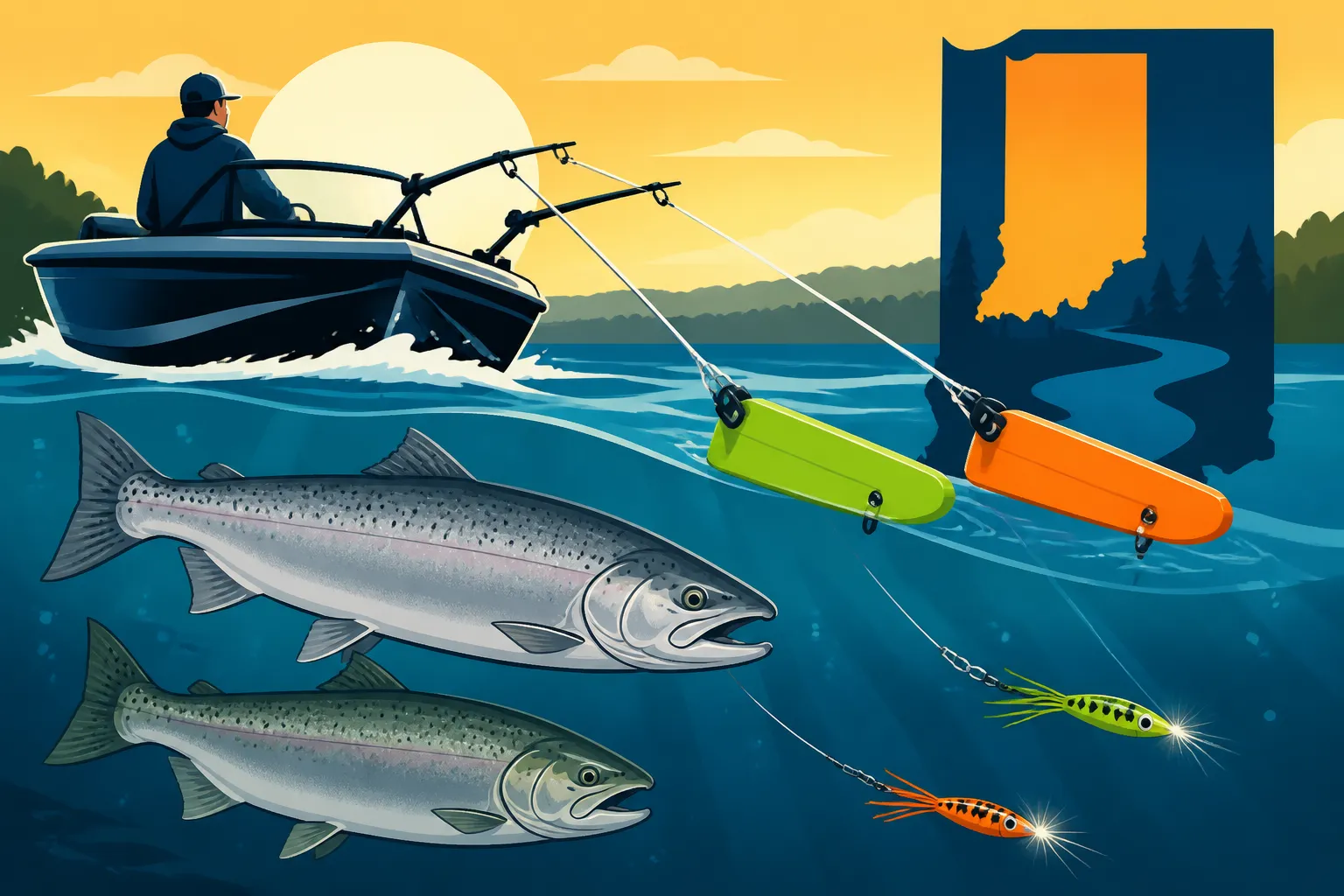
At its core, a planer board is a device designed to pull your fishing line away from the side of your boat while trolling. Imagine casting a dozen lines directly behind your boat; they'd all quickly tangle in the prop wash, or worse, with each other. Planer boards create a system that allows you to present multiple lures simultaneously at varying distances and depths, forming a wide, enticing "net" for fish. They use water resistance to glide out to the side, taking your fishing lines with them. This isn't just about covering more water; it's about presenting your bait in a much more natural and less intimidating way to wary game fish like Chinook salmon, Coho salmon, and steelhead. The ability to run lines far from the boat also reduces the disturbance caused by your motor and hull, making your presentation more subtle and effective.
Think of it this way: instead of just a narrow path directly behind your boat, you're now fishing a path that's sometimes 50, 100, or even more feet wide on each side. This broad coverage dramatically increases the likelihood of intersecting with schools of baitfish or passing salmon and steelhead. Without them, you're severely limited in how many lines you can effectively deploy and how widely you can spread them, significantly hindering your success on vast bodies of water like Lake Michigan. Especially when fishing for migratory species that might be spread out, maximum coverage is key.
The Advantage of a Wide Lure Spread
The primary advantage of using planer boards is undoubtedly the ability to achieve a wide lure spread. This spread isn't just for show; it's a strategic maneuver that directly impacts your catch rates. Many species, including salmon and steelhead, tend to shy away from the boat itself, especially in clear water or during bright conditions. By getting your lures out to the sides, you're presenting them in areas where fish feel more comfortable and are less likely to be spooked.
Furthermore, a wide spread allows you to experiment with different depths and lure colors simultaneously without interference. You can stagger your lines, setting some closer to the boat at one depth, others further out at another, and so on. This becomes incredibly valuable when trying to pinpoint the fish's preferred depth and feeding patterns on a given day. Instead of guessing, you're essentially conducting a broad search, increasing your chances of hitting that sweet spot. It’s an efficient way to cover the water column and maximize your fishing time, especially when you're targeting fish that might be scattered across various depths and locations. You can literally create a wall of lures moving through the water, intercepting any fish that happens to be in the vicinity.
Types of Planer Boards: Inline vs. Mast Systems
When you first start looking into planer boards, you'll quickly realize there are two main categories: inline boards and mast systems. Each has its own set of advantages, disadvantages, and ideal fishing scenarios. Understanding these differences is key to choosing the right setup for your Indiana salmon and steelhead trolling adventures.
Inline Planer Boards: Simplicity and Portability
Inline planer boards are perhaps the most common and user-friendly option, especially for anglers just getting started or those with smaller boats. These boards attach directly to your fishing line via a release clip, and the line runs through a guide on the board itself. When a fish strikes, the board either trips (releases from the main line, sliding down to a swivel above the lure) or stays on the line, acting as a direct indicator of the strike. Their popularity stems from their simplicity, ease of deployment, and minimal setup requirements. You don't need any complex boat modifications to use them; just clip them on and let them out.
One of the biggest benefits of inline boards is their portability. You can store them easily and deploy them from almost any boat, from smaller utility boats to larger vessels. They are fantastic for running a few extra lines or for anglers who only occasionally troll a wider spread. Brands offer various sizes, from compact models perfect for lighter tackle to larger ones that can handle heavier lures and rougher water. However, managing multiple inline boards can sometimes be a bit of a juggling act, especially when reeling in a fish, as the board itself will be coming back to the boat with the fish, requiring careful handling to avoid tangles with other lines. They are an excellent choice for anglers who prefer a more direct connection to their lures and want a straightforward system for expanding their spread. You can often find a good selection of these boards from retailers like Bass Pro Shops or through online stores like Amazon, allowing you to compare features and sizes.
Mast Planer Board Systems: High Capacity and Control
Mast planer board systems are the heavy hitters of the planer board world, designed for serious trolling operations that require running many lines over an extremely wide area. These systems consist of a tall mast mounted to the boat's deck, from which two long lines extend to large planer boards (often called "big boards"). Your individual fishing lines are then attached to these main planer lines using release clips, allowing them to slide down the main line until a fish strikes. When a fish hits, the release clip detaches, and you fight the fish directly on your rod while the big board stays out, holding the other lines.
The significant advantage of a mast system is its capacity and superior control. You can typically run many more lines (often 6-12 per side, sometimes more) off a mast system than with inline boards, creating an incredibly broad and effective fishing zone. The big boards themselves are much larger and more stable, capable of handling rougher water and pulling heavier loads, keeping your entire spread perfectly organized. This control is invaluable on big water like Lake Michigan, where conditions can change rapidly. However, these systems require a more substantial initial investment, permanent or semi-permanent boat mounting, and a bit more setup time. They are generally preferred by charter captains or dedicated tournament anglers who demand maximum coverage and efficiency. While the initial investment might seem daunting, the ability to effortlessly manage a vast spread of lures and precisely target active fish can significantly increase your success rate, especially when chasing trophy salmon or steelhead.
| Feature | Inline Planer Boards | Mast Planer Board Systems |
|---|---|---|
| Attachment | Directly to individual fishing line | Individual lines clip to main planer lines from a mast |
| Capacity | Typically 1-3 lines per side | Often 6-12+ lines per side |
| Complexity | Simple, easy to deploy and store | More complex, requires boat mounting and dedicated lines |
| Portability | Highly portable, no boat mods needed | Less portable, mounted system |
| Strike Indication | Board trips or tugs directly on your rod | Line release, direct rod tip action |
| Fish Handling | Board comes back with the fish, potential tangles | Board stays out, fight fish directly, less tangling |
| Ideal For | Smaller boats, casual anglers, fewer lines | Larger boats, serious anglers, maximum spread, multiple lines |
| Cost | Generally lower initial cost | Higher initial cost, more components |
Setting Up Your Planer Board System for Optimal Performance
Getting your planer board system dialed in correctly is crucial for effective trolling. It's not just about clipping on a board; it's about understanding how to integrate it with your rods, reels, and lures to create a seamless fishing operation. A well-rigged system minimizes tangles, maximizes presentation, and ultimately, boosts your chances of success on the water.
Choosing the Right Gear and Rigging Your Lines
Before you even think about deploying a planer board, you need to ensure you have the right supporting cast of gear. For salmon and steelhead trolling on Lake Michigan, you'll want sturdy rods with a good backbone, capable of handling the drag created by the board and a fighting fish. Medium-heavy to heavy action trolling rods are ideal. Your reels should have ample line capacity, usually holding at least 200-300 yards of monofilament or braided line, with a smooth, reliable drag system. Many anglers opt for line counters on their reels, which are invaluable for consistently reproducing specific lure depths and distances, especially when you find that productive zone. For Lake Michigan Trolling Gear Guide for Indiana Anglers, having appropriately sized gear is key to the entire operation.
When rigging your lines for planer boards, your main line will run from your reel, through your rod guides, and eventually to your lure. If using inline boards, the board will clip directly onto this main line, usually 20-50 feet ahead of your lure. For mast systems, your main line will clip onto the main planer board line, which extends from the mast to the big board. Always use strong, reliable release clips that hold your line firmly but release cleanly when a fish strikes. These clips are a critical component; a clip that releases too easily will lead to false alarms, while one that holds too tightly can prevent a clean release, potentially hindering the fish fight. Make sure your leader material, whether fluorocarbon or monofilament, is abrasion-resistant, as it will be subjected to the force of the fish and potentially the board itself.
Deploying and Spacing Your Planer Boards
The art of planer board fishing really comes down to precise deployment and spacing. For inline boards, the process is straightforward: let out your lure to its desired distance behind the boat, then clip on the planer board and allow it to pull your line out to the side as you move forward. The further you let out line after clipping the board, the further out it will run from the boat. To create an organized spread, you'll want to stagger your lines both horizontally and vertically. Horizontally, this means letting some boards out further than others, creating distinct lanes. Vertically, this means varying the depth of your lures using weights, diving devices like Dipsy Divers or slide divers, or even downriggers. Downrigger Basics for Indiana Lake Michigan Anglers explains another key component of vertical separation.
With a mast system, deployment is a bit more involved but offers superior organization. Once your main planer boards are deployed and pulling wide, you'll clip your individual fishing lines onto the main planer lines. The trick here is to space your clips evenly along the main planer line, creating distinct "lanes" for each fishing line. This prevents tangles and allows you to easily identify which line has a fish on. Many experienced anglers will run their "outside" lines (the ones furthest from the boat) with heavier weights or diving devices to get deeper, while "inside" lines run shallower or with less weight. This staggering maximizes your coverage across the water column and reduces the chance of lines crossing, especially during turns. Always keep an eye on your board's performance; a board that's acting erratically or not pulling true might indicate a fouled lure or a small fish. For Trolling Gear Setup for Indiana's Lake Michigan Salmon, proper spacing ensures each lure has its own clear path through the water.
Effective Trolling Techniques with Planer Boards
Once your planer boards are deployed and your lines are spread wide, the real fun begins: actively trolling for salmon and steelhead. It's more than just driving in a straight line; it involves nuanced boat control, understanding your lure's action, and constantly observing your spread for any signs of fish activity. The goal is to make your presentation as natural and enticing as possible, drawing those big Lake Michigan fish to your offerings.
Mastering Boat Speed and Direction
The speed and direction of your boat are paramount to successful planer board trolling. Different lures have optimal trolling speeds at which they exhibit their best action, whether it's the wobble of a spoon, the dive of a crankbait, or the flutter of a flasher and fly. Generally, trolling speeds for salmon and steelhead on Lake Michigan range from 1.8 to 3.5 miles per hour, but this can vary depending on water temperature, species targeted, and even specific lure types. You'll need to experiment to find what the fish are responding to on any given day. A GPS speed indicator is invaluable for maintaining consistent speeds. Trolling Techniques for Salmon and Steelhead dives deeper into this.
Beyond speed, subtle changes in boat direction can be incredibly effective. Instead of driving in perfectly straight lines, making gentle, sweeping S-turns or large circles can make your lures "speed up" on the outside of the turn and "slow down" on the inside. This change in retrieve speed and action can often trigger strikes from fish that might have ignored a monotonous, straight-line presentation. Many experienced anglers report that a significant percentage of their strikes occur during or immediately after a turn. However, be mindful of how aggressive your turns are; too sharp a turn can cause your outside planer boards to stall or even overtake your inside lines, leading to a tangled mess. It's a delicate balance that comes with practice and observation.
Adjusting Lure Depth and Presentation
With a wide planer board spread, you have an incredible opportunity to fine-tune your lure depth and presentation. Salmon and steelhead often suspend at very specific depths, sometimes only a few feet within a much larger water column. To find these fish, you'll need to use various methods to get your lures down. Downriggers are excellent for precise depth control, but you can also use diving planers like Dipsy Divers, Jet Divers, or simply snap weights to get your lures into the strike zone. The key is to run a variety of depths across your spread. For example, your furthest out boards might have lures running deeper with Dipsy Divers, while your inner boards might have lighter weights or just spoons running near the surface.
Beyond depth, consider your lure selection and color. On any given day, fish might prefer a specific color pattern, size, or action. With multiple lines out on planer boards, you can test different variables simultaneously. Try various spoon patterns, different sizes of crankbaits, or various colored flasher and fly combinations. Keep a mental note or even a log of which setups are getting bites. If one rod starts producing consistently, you can then switch other lines to that successful combination. This systematic approach to presentation, coupled with the wide coverage of planer boards, allows you to quickly identify and capitalize on productive patterns. Don't be afraid to experiment; sometimes the most unexpected lure or depth will be the one that produces. This detailed approach is central to Best Bait and Lures for Fall Fishing and other seasonal guides.
Troubleshooting and Maintenance for Planer Boards
Even the most seasoned angler encounters issues with their gear, and planer boards are no exception. From tangles to boards that just won't run true, understanding common problems and how to maintain your equipment will save you frustration and keep you fishing effectively. A little proactive care goes a long way in ensuring your planer board system is always ready for action.
Common Problems and Quick Fixes
One of the most common and frustrating problems with planer boards, especially for newcomers, is lines tangling. This often occurs when making sharp turns, if your trolling speed is too slow, or if your lines aren't properly staggered. If lines are tangling on turns, try making wider, gentler turns, or briefly speed up slightly on the outside of the turn to keep those boards pulling away. Ensure your divers or weights are heavy enough to get your lures to the intended depth without excessive blowback, which can cause lines to rise and cross. Another common issue is a board that's not pulling true – it might be running behind the others or dipping erratically. Check your lure first; sometimes a piece of weed or debris on a treble hook can completely throw off its action, which in turn affects the planer board. Also, inspect the board itself for any damage or waterlogging, especially with wooden boards, as this can affect its buoyancy and tracking.
Another vexing problem can be false releases or lines constantly popping out of the clips without a fish. This usually points to clips that are either too worn out or not suited for the line diameter you're using. Over time, plastic clips can lose their gripping power. If you suspect this, it's time to replace them. Many anglers carry a variety of clip strengths or adjustable clips to match different line types and conditions. Conversely, clips that are too tight can prevent a proper release when a fish actually strikes, leading to a long, hard fight with the board still attached to your line, which isn't ideal for the fish or your gear. Regularly inspect your clips for wear and tear, and don't hesitate to replace them if they're not performing reliably.
Proper Care and Storage
Just like any other piece of fishing gear, planer boards and their associated components will last longer and perform better with proper care and storage. After each trip, especially when fishing in Lake Michigan's sometimes murky or silty waters, it's a good idea to rinse your planer boards, clips, and any lines that come into contact with the water with fresh water. This helps remove salt, dirt, and any fish slime that can degrade materials over time. Pay particular attention to the release clips, ensuring there's no debris lodged in the mechanism that could affect their performance.
When it comes to storage, avoid leaving your planer boards baking in direct sunlight for extended periods, as UV rays can degrade plastic components and fade colors. Store them in a cool, dry place where they won't be crushed or damaged. If you're using a mast system, make sure the mast is securely covered or stored to protect its lines and components. Some anglers will even remove the big boards from the main lines and store them separately to prevent warping or damage. Taking these small steps in care and storage will ensure your planer boards are in prime condition for your next outing, ready to help you land those magnificent Lake Michigan salmon and steelhead. A bit of preventative maintenance goes a long way to avoid frustrating breakdowns when you're out on the water. For more general advice, consider reading Best Boater Safety Gear Checklist.
Maximizing Your Success on Lake Michigan
Fishing Lake Michigan for salmon and steelhead is an exhilarating experience, but it’s also a challenging one that rewards preparation and a willingness to adapt. Planer boards are undeniably one of the most effective tools in your arsenal, allowing you to cover vast amounts of water and present your lures with precision. To truly maximize your success, it's about combining your planer board strategy with a deeper understanding of the fish and the environment.
Integrating Planer Boards with Other Trolling Gear
While planer boards are powerful on their own, their effectiveness multiplies when integrated thoughtfully with other trolling gear. The most common companions for planer boards are downriggers and diving planers. Downriggers allow you to precisely control the depth of your deepest lures, often placing them within a foot or two of a target depth. You can run downrigger lines directly behind the boat, or, for an even wider spread, attach your downrigger release clips to an inline planer board line to get that deep bait out to the side. This creates incredible depth control and horizontal separation.
Diving planers, such as Dipsy Divers or Jet Divers, are another excellent way to add depth to your planer board spread. These devices, when attached to your main line ahead of your lure, dive to specific depths based on speed and line out. By using different sizes and settings on your divers, you can achieve multiple depths across your planer board lines, allowing you to effectively "stack" your lures at various levels in the water column. Imagine having lures running at 20, 40, 60, and 80 feet deep, all fanned out wide from your boat – that's the kind of comprehensive coverage that catches fish. Always ensure you match the diving device's size and action to the speed you're trolling and the size of the lure you're using to ensure a proper presentation. For deeper dives or for Budgeting for License Plus Stamp Before a Salmon Trip, understanding the full range of gear you might need is critical.
Reading the Water and Adapting Your Strategy
Beyond the gear, the true key to success on Lake Michigan is learning to read the water and adapt your strategy. Water temperature is perhaps the most critical factor for salmon and steelhead, as they often seek out specific temperature bands where baitfish congregate. Investing in a good temperature gauge that measures surface and subsurface temperatures will give you a significant advantage. Look for temperature breaks, currents, and areas where baitfish are visible on your fish finder. These are prime locations to deploy your planer board spread. Water Temperature and Fish Feeding Patterns often dictate where the fish will be.
Don't be afraid to experiment with your spread, even if you found a pattern that worked last week. Lake Michigan is a dynamic environment, and what worked yesterday might not work today. This means changing lure colors, trying different depths, varying your trolling speed, or even switching up your lure types (spoons, flies, plugs). Observe other successful boats in the area, but also trust your instincts and your electronics. If you're marking fish at a certain depth but not getting bites, try adjusting your lures to precisely that depth. The beauty of a well-designed planer board system is its versatility – it allows you to make these crucial adjustments efficiently, covering a lot of water while simultaneously fine-tuning your presentation to entice those Lake Michigan beauties. For more on what to target, see Lake Michigan's Salmon Run: Indiana's Fall Fishing Season and Best Salmon Fishing Spots on Lake Michigan in Indiana.
Disclaimer
This article is for general informational purposes only and does not constitute professional advice. Laws, prices and regulations vary by location and change over time. Consult a qualified professional for guidance on your specific situation.