Bluegill Identification: A Beginner’s Guide
There's nothing quite like the excitement of feeling a tug on your line, reeling it in, and seeing a flash of vibrant color beneath the water. But then the question hits: what exactly did I just catch? For many anglers, especially those just starting out or folks bringing their kids along, distinguishing between the various panfish species can be a real head-scratcher. It's easy to mistake a bluegill for a redear sunfish, or even a green sunfish, and knowing the difference isn't just about bragging rights – it can impact your adherence to local regulations and help you refine your fishing techniques. This guide is here to unravel the mystery, providing a clear, friendly, and practical breakdown of how to confidently identify a bluegill in Indiana waters, helping you spend less time wondering and more time enjoying your catch.
The Distinctive Features of Indiana Bluegill
Bluegill are arguably the quintessential panfish of Indiana, beloved by anglers of all ages for their feisty fight and delicious taste. But what makes a bluegill a bluegill? While they might vary slightly in color depending on water clarity, diet, and even their mood, there are some classic characteristics that, once you know them, will make identification much easier.
Classic Coloration and Body Shape
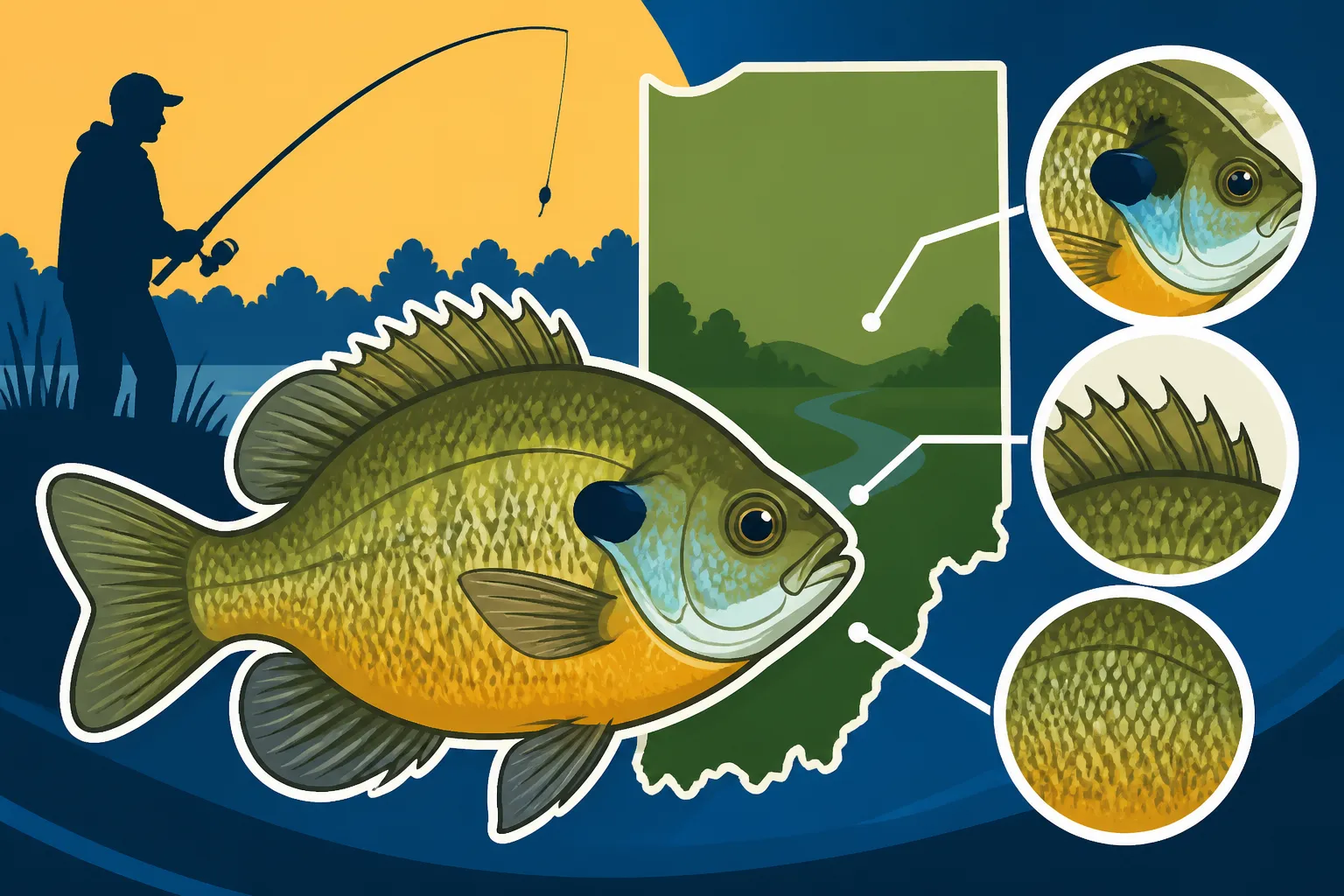
When you pull a bluegill from the water, the first thing you'll often notice is its overall shape and hue. Bluegill have a distinctly round, disc-like body that is heavily compressed laterally, almost like a pancake with fins. It's part of what gives them that satisfying "thump" when they hit your lure. Their backs are usually an olive-green to brownish shade, which fades into lighter, sometimes almost yellowish or orange, flanks. These sides often boast a beautiful, iridescent bluish-purple sheen, especially on larger, healthier specimens, which is where they get their name!
Running vertically down their sides, you'll typically see several dark, faint bars or stripes. These can be more pronounced or almost invisible, again, depending on the individual fish and its environment. Think of them like subtle tiger stripes that blend into their surroundings. The belly, especially on males during spawning season, can range from a pale white to a brilliant yellow or even a fiery orange. This vibrant belly is a dead giveaway that you've got a healthy, active bluegill on your hands. But perhaps the most iconic feature, and the one you should always look for, is that unmistakable dark, velvety spot on the posterior edge of the gill cover, often called the "ear flap" or opercular flap. This spot is usually solid black and runs right to the edge of the flap, without any distinct colored margin. It's like their signature mark, a little ink blot that says, "Yup, I'm a bluegill!"
Fin and Mouth Characteristics
Beyond the body shape and coloration, paying attention to the fins and mouth can really seal the deal on bluegill identification. These small details are often overlooked but are incredibly helpful when you're trying to differentiate them from similar species.
Let's start with the fins. Bluegill possess a single dorsal fin, but it's actually two parts – a spiny, rigid front section and a softer, rayed back section – that are connected. On the soft-rayed part of the dorsal fin, you'll often find a faint but noticeable dark spot. It's usually small and round, located near the rear end of the fin. This isn't as prominent as the gill flap spot, but it's another good indicator. Their pectoral fins, located just behind the gills, are relatively long and pointed, and they'll often extend past their eye if you were to press them forward. This length is a helpful differentiating factor from some other sunfish species that have shorter, more rounded pectorals.
Now, let's talk about the mouth – a crucial, yet often underestimated, identification marker. Bluegill have a surprisingly small mouth. It's what we call a "terminal" mouth, meaning it's located right at the very front of their head and doesn't extend back very far. If you gently feel the corner of their mouth, you'll notice it doesn't reach past the front edge of their eye. This small mouth is why bluegill often strike at tiny baits and lures, and it's a key feature that helps distinguish them from their more predatory cousins, like largemouth bass, which have mouths that extend well beyond the eye. When you're trying to figure out what you've caught, remember: if the mouth is small and doesn't reach the eye, you're likely holding a bluegill.
Common Lookalikes and How to Tell Them Apart
Indiana waters are teeming with various sunfish species, many of which share a similar "panfish" appearance. This can make identification tricky, even for seasoned anglers. It's incredibly frustrating when you're trying to explain your catch to a buddy, and you're not even sure yourself! Let's clear up some of the most common confusions and give you the tools to tell a bluegill from its frequent dopplegangers.
Bluegill vs. Redear Sunfish
The redear sunfish, often affectionately called a "shellcracker" because of its diet of snails and mussels, is perhaps the most commonly confused panfish with the bluegill. They both have that round, disc-like body shape, and they can be found in similar habitats. So, how do you tell them apart? The trick is in the "ear" and sometimes the overall color.
Remember that distinctive solid black spot on the bluegill's gill flap? Well, the redear sunfish has a similar flap, but it's typically tipped with a bright red or orange margin. Imagine a tiny ear adorned with a splash of fiery color – that's your redear. This red or orange edge is usually quite vibrant, especially in healthy, mature males. You might also notice that redear sunfish tend to have a slightly more muted, brassy green or olive coloration overall, without the strong iridescent blue hue you often see on bluegill. Their bellies are usually pale, not typically bright yellow or orange like a spawning bluegill male. Their scales can also appear a bit coarser, and they often have faint longitudinal rows of dark spots on their sides rather than vertical bars.
Another subtle difference is their mouth. While still relatively small like a bluegill's, the redear's mouth is positioned a little more downwards, making it ideal for grubbing along the bottom for those snails. When you're fishing a spot known for big panfish, it's worth taking a moment to check for that red "ear" before calling it a bluegill, especially since Redear Sunfish vs Bluegill: How to Tell Them Apart can be a common query for many anglers.
Bluegill vs. Green Sunfish
Green sunfish are another prevalent panfish in Indiana and can often be found alongside bluegill. While they share some similarities, a closer look reveals several key distinctions that make them easier to identify once you know what to look for. Green sunfish are often described as having a slightly more elongated, robust body compared to the bluegill's nearly perfect circle. They're not as "pancake-flat" as a bluegill, and their overall impression is more stout.
Their coloration is typically a darker olive-green, often with iridescent blue or emerald green spots and streaks on their cheeks and gill covers. The vertical bars common on bluegill are usually absent or extremely faint on green sunfish. Instead, you might see irregular dark blotches along their sides. The gill flap on a green sunfish is also dark, similar to a bluegill, but it usually has a distinct light or orange margin around it, not a solid black spot that goes all the way to the edge like a bluegill. It's like a bluegill's ear flap, but with a thin, pale border.
The most telling feature, however, is their mouth. Green sunfish have a surprisingly large mouth for a panfish. If you compare it to a bluegill, the green sunfish's mouth will extend back to at least the middle of its eye, and sometimes even beyond. This larger mouth allows them to eat bigger prey, including small minnows, which also explains why they can be incredibly aggressive feeders. Their pectoral fins are also shorter and more rounded than the bluegill's long, pointed fins. If you're struggling to decide between the two, always check the mouth size and the gill flap's margin!
Bluegill vs. Hybrid Sunfish
Now, this is where things can get truly perplexing for anglers! Hybrid sunfish are exactly what they sound like: a cross between two different sunfish species. The most common hybrid you'll encounter in Indiana is a cross between a bluegill and a green sunfish, often stocked in ponds and lakes because they grow quickly and are quite aggressive, making them a blast to catch. They often exhibit a mix of traits from both parent species, which can make a definitive identification challenging. Understanding Hybrid Sunfish vs Bluegill: What's the Difference? is key for navigating these blended beauties.
Typically, hybrid sunfish will have a body shape that's somewhere between the roundness of a bluegill and the robustness of a green sunfish. They often grow larger than pure bluegill in the same amount of time, which can be exciting for anglers seeking bigger panfish. Their coloration might be a mottled mix of olive-green, blue, and yellow, with irregular dark blotches or faint bars. The "ear flap" can be particularly confusing; it might have a dark spot like a bluegill, but with a faint colored margin like a green sunfish, or it might be a blend of both.
The mouth is often the most reliable clue when dealing with hybrids. They usually inherit the larger mouth of the green sunfish parent, meaning it will extend back to or beyond the middle of the eye. If you catch a panfish that's unusually large for a bluegill, has a somewhat mottled appearance, and a mouth that seems a little too big for a classic bluegill, you're very likely looking at a hybrid. These fish are fantastic sport and table fare, but they definitely keep you on your toes when it comes to identification!
Here's a quick reference table to help visualize the differences:
| Feature | Bluegill | Redear Sunfish | Green Sunfish | Hybrid Sunfish (Bluegill x Green) |
|---|---|---|---|---|
| Body Shape | Very round, disc-like, laterally compressed | Round, disc-like, slightly less compressed | More elongated, robust, less round | Intermediate, often robust |
| Back/Sides | Olive-green to bluish-purple, often vertical bars | Brassy green/olive, often faint dark spots | Dark olive-green, iridescent blue/emerald spots | Muddled olive-green, mottled/irregular markings |
| Belly Color | White to vibrant yellow/orange (especially males) | Pale, sometimes yellowish | Pale to yellowish, often blotchy | Pale to yellowish, sometimes splotchy |
| Gill Flap (Ear) | Solid dark/black spot, no distinct margin | Dark spot with distinct red/orange margin | Dark spot with distinct light/orange margin | Variable; dark spot with or without faint margin |
| Mouth Size | Small, corner doesn't reach front of eye | Small, slightly downward-angled, doesn't reach eye | Large, corner extends to or beyond middle of eye | Large, corner extends to or beyond middle of eye |
| Pectoral Fins | Long and pointed, extends past eye if pressed forward | Medium length, somewhat rounded | Shorter and more rounded | Intermediate length |
Size, Habitat, and Behavior Clues
Beyond physical characteristics, knowing where bluegill like to hang out and how they typically behave can give you extra clues for identification. After all, if you're catching a fish that fits the description and is in classic bluegill territory, you can be pretty confident in your identification!
Typical Size and Growth in Indiana
One of the most appealing aspects of bluegill fishing in Indiana is that you can catch them in such a wide range of sizes. Most anglers will regularly encounter bluegill in the 5-7 inch range – these are your average, feisty panfish that provide consistent action. However, Indiana waters are definitely home to some real slabs! A bluegill between 8 and 10 inches is considered an excellent catch, often referred to as a "hand-sized" or "plate-sized" bluegill. Anything pushing 10 inches or more is truly a trophy.
Their growth rate can vary significantly depending on the lake or pond, the food availability, and the population density. In nutrient-rich waters with plenty of forage and not too many competing fish, bluegill can grow surprisingly fast. On the flip side, overcrowded ponds with limited food can produce stunted bluegill that are numerous but never seem to get beyond 4-5 inches. For those chasing true giants, it's worth exploring What Size Bluegill Is Considered a Trophy? and focusing your efforts on lakes known for producing bigger specimens. Remember, a bluegill that's 10 inches long is a rarity and a testament to good conditions!
Where to Find Bluegill in Indiana Waters
Bluegill are incredibly adaptable and can be found in almost every type of freshwater body across Indiana. From the smallest farm ponds to the largest reservoirs and slow-moving rivers, if there's water, there's a good chance bluegill are calling it home. They absolutely love structure and cover. Think about where you'd hide if you were a small fish looking for food or protection from predators – that's where bluegill will be.
Prime bluegill real estate includes weed beds, especially those with submerged aquatic vegetation like lily pads, coontail, or milfoil. They'll cruise the edges of these beds, darting in and out. Submerged brush piles, fallen trees, and stumps are also magnets for bluegill, providing both shelter and a place for insects to gather. Docks, piers, and other man-made structures are equally productive, offering shade and vertical cover. You'll often find them schooling in these areas, especially during the warmer months, making them perfect targets for anglers using a simple bobber and worm. Whether you're targeting small farm ponds or larger bodies of water, understanding their preferred habitat is key to finding them. For those looking for prime spots, checking out guides like Best Bait for Bluegill Fishing in Farm Ponds can give you an edge.
During the spawning season, typically from late spring to early summer when water temperatures hit the mid-60s to low 70s Fahrenheit, bluegill move into very shallow, protected bays and coves. They create distinct "beds" – circular, fanned-out depressions in the bottom – which you can often spot from shore or a boat. These areas can be incredibly productive, as the fish are actively guarding their nests and aggressively striking anything that comes too close.
Behavior and Feeding Habits that Aid Identification
Bluegill are, by nature, schooling fish. Where you find one, you're likely to find many more. This schooling behavior is a key part of their survival strategy and makes them a favorite target for anglers looking for consistent action. They are opportunistic feeders, with a diet that primarily consists of aquatic insects, insect larvae, small crustaceans, and even tiny snails. Their small, upward-facing mouth is perfectly adapted for sipping insects off the surface, plucking them from vegetation, or gently picking them off the bottom.
Their willingness to bite almost anything that wiggles or looks appealing is another hallmark. This isn't just a sign of their general hunger; it's a behavioral trait. They are curious and competitive, especially when in a school. This eagerness makes them fantastic fish for beginners and kids, providing that immediate gratification that hooks new anglers for life. If you're consistently catching fish that are hitting small baits aggressively, often in schools around cover, and they fit the physical description we've discussed, you're almost certainly reeling in bluegill. They're not particularly shy, and their energetic fight, even on light tackle, is unmistakably bluegill.
Practical Tips for Confident Anglers
Being able to quickly and accurately identify your catch adds a whole new level of satisfaction to fishing. It means you understand the ecosystem better, you can follow regulations, and you can even brag a little more specifically! Let's talk about how to apply these identification skills effectively on the water.
Observing Key Features at the Boat
The moment of truth arrives when that fish is in your hand, or in your net. This is your chance to really look at it before deciding whether to keep it or release it. Don't just glance! Take a few seconds to consciously run through the key identification points we've covered.
First, quickly assess the overall shape. Is it round and flat, or more elongated? Then, check that gill flap: solid black spot, or is there a red/orange tip or a light margin? Next, peek at the mouth. Does it barely reach the eye, or does it extend past it? These three things – body shape, gill flap, and mouth size – will give you the answer in most cases. If you're still unsure, check the pectoral fins for length and pointedness. Observing these features systematically, rather than just vaguely looking at the fish, will dramatically improve your accuracy. It becomes second nature after a while, I promise!
Using a Field Guide or Online Resources
While this guide provides a solid foundation, sometimes a visual aid is incredibly helpful, especially when you're just learning. Having a small, laminated field guide of Indiana fish species in your tackle box or boat is a fantastic idea. These guides often feature clear illustrations or photographs, highlighting the key identification marks. You can usually find excellent, compact field guides on sites like Amazon, specifically designed for anglers. These are invaluable for those moments of doubt when you're holding a fish and need a quick, reliable reference.
Beyond physical guides, modern technology offers a wealth of options. Many fishing apps or online resources provide species identification tools. A quick search on your phone can bring up images and descriptions to compare your catch against. Just be mindful of service in remote areas! However, for quick confirmation, nothing beats a good old-fashioned waterproof field guide. It never runs out of battery and is always right there with you.
The Importance of Regulations
Correct identification isn't just for your personal knowledge; it's crucial for adhering to Indiana's fishing regulations. While panfish like bluegill and crappie often have generous Panfish Daily Limit in Indiana: 25 per Species, understanding what you've caught ensures you're not accidentally keeping a protected species or exceeding the limit for a specific type of fish. For instance, some lakes might have specific length limits for certain sunfish, and mistaking a redear for a bluegill could lead to an unintentional violation.
Always be aware of the specific rules for the body of water you're fishing. Regulations can change, and they sometimes vary from lake to lake, or even between different parts of the same river system. Knowing your fish, coupled with a quick check of the local rulebook, ensures you're fishing responsibly and sustainably. After all, we all want to ensure there are plenty of bluegill and other panfish for future generations to enjoy!
Disclaimer
This article is for general informational purposes only and does not constitute professional advice. Laws, prices and regulations vary by location and change over time. Consult a qualified professional for guidance on your specific situation.