How to Figure-Eight a Muskie at the Boat
There's nothing quite like the heart-stopping moment when a massive muskie, a true freshwater predator, appears out of nowhere and follows your lure right up to the boat. It's exhilarating, terrifying, and often, incredibly frustrating when that giant fish just turns its nose and vanishes back into the depths. This guide is all about turning those follows into furious strikes by teaching you the essential "figure-eight" technique, ensuring you're ready for the ultimate Indiana muskie battle.
Understanding the Figure-Eight: Why It's a Muskie Angler's Secret Weapon
Muskie fishing isn't just about casting and retrieving; it's about anticipation, strategy, and sometimes, a little bit of magic right at the boat. The figure-eight technique isn't just a fancy trick; it's a fundamental skill that separates the muskie catchers from the muskie watchers.
The Heartbreak of the Follow: Why Muskies Need a Second Chance
We've all been there. You've been casting for hours on Monroe Lake, Patoka Lake, or one of the glacial lakes up north like Lake Wawasee, when suddenly, a dark torpedo-shaped shadow materializes behind your lure. Your heart pounds. You slow your retrieve just a hair, trying to coax a strike, but the fish just cruises along, nose almost touching your bait, seemingly inspecting it. Then, as your lure breaks the water or gets too close to the boat, it simply peels off and disappears. It's a gut punch, isn't it? That moment of pure exhilaration turns into pure agony.
Muskies are notorious for their "follows." They are ambush predators, but they're also incredibly curious and wary. They often trail a lure for a long distance, studying its movement, color, and size. When the lure reaches the boat, the sudden change in environment – the boat's shadow, your presence, the cessation of the retrieve – can make them suspicious. They decide it's not worth the energy, or perhaps the perceived danger, and they bail. This is precisely why the figure-eight becomes your last, best chance to convert that hesitant follow into an aggressive strike. It’s about not giving up until the very last second.
The Illusion of Escape: How the Figure-Eight Triggers a Strike
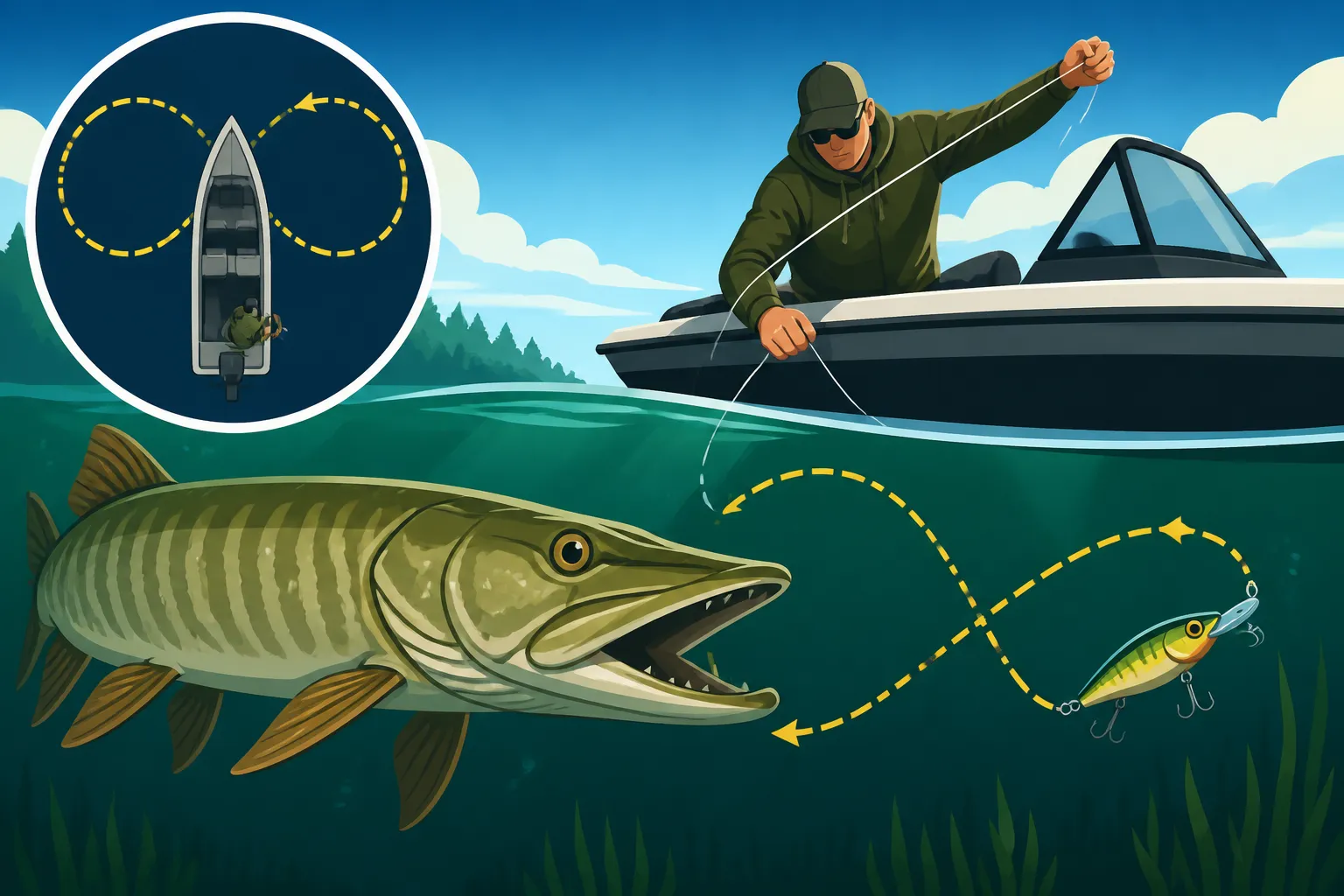
So, what exactly is a figure-eight? Simply put, it's a technique where you continue to move your lure in a large, continuous figure-eight pattern in the water beside the boat, effectively extending your retrieve and mimicking an escaping baitfish. Instead of lifting your lure out of the water, you keep it submerged and moving.
The magic of the figure-eight lies in exploiting the muskie's predatory instincts. When a muskie follows a lure right to the boat, it's often in a state of indecision. It's close, it's interested, but it hasn't committed. By keeping the lure in the water and creating a large, erratic, escaping movement, you transform the situation from a static inspection to a dynamic chase. The sudden change in direction, the increased speed of the lure's path, and the illusion of a baitfish trying to get away often trigger a "reaction strike." The muskie, no longer able to simply inspect, decides it's now or never and explodes on the lure. It's a primal response, and when it happens, it's one of the most exciting moments in all of freshwater fishing.
The Art of the Figure-Eight: A Step-by-Step Guide to Success
Performing a proper figure-eight isn't just random waving; it's a deliberate, fluid motion that takes practice and focus. But once you get it down, it will unlock a whole new dimension of muskie fishing for you.
Setting the Stage: From Retrieve to Initial Turn
The figure-eight actually begins long before you reach the boat. It starts with your retrieve. Maintain a consistent, confident retrieve all the way to the boat. Don't slow down or pull the lure out too early if you don't see a follow. Assume every cast has a muskie behind it. As your lure gets within a few feet of the boat, just before it would normally be pulled from the water, keep your rod tip low, ideally with the last foot or two of your rod tip still in the water. Your eyes should be glued to where your line enters the water, or, if you're lucky enough to see it, directly on the muskie behind your lure.
This continuity is crucial. Any hesitation or abrupt movement can spook a following muskie. You want a seamless transition from your retrieve to the beginning of your figure-eight. Think of it as merely extending the path of your lure, not starting a new motion. The momentum from your retrieve will carry into the first turn, making it feel natural and smooth for both you and the fish. Keep your body positioned so you can easily swing your rod tip in a wide arc without hitting anything in the boat.
Drawing the "8": Crafting the Perfect Loop
Now for the main event. As your lure nears the boat, smoothly sweep your rod tip in a wide, semi-circular arc, keeping the lure submerged. This is your first turn. Make it as wide as you can, often extending the lure 3-5 feet away from the boat, and keep it just below the surface, or slightly deeper if the fish is deeper. Many anglers make the mistake of making small, tight turns, which don't create enough "escape" illusion. Imagine you're drawing a giant 'D' shape on its side, away from the boat.
Once you complete that first half-circle, bring the lure back towards the boat, crossing the center of your imaginary "8" pattern. Then, immediately transition into the second half-circle, sweeping your rod tip in the opposite direction. The key is to maintain speed and fluidity. The lure should never stop or hesitate. Vary your depth slightly – sometimes dipping the lure deeper, then bringing it up – to add to the erratic, struggling baitfish illusion. Pay close attention to the fish if you can see it. If it speeds up or shows more interest, you might speed up your figure-eight or make even wider, more aggressive turns.
A good way to visualize this is to pretend there's an invisible pane of glass just below the water's surface, and you're tracing a huge '8' on it with your lure. The larger and smoother your sweeps, the more natural and enticing it will appear to that muskie. Remember, this isn't a race; it's a dance, and the muskie is your partner. You can learn more about specific techniques in our guide to Muskie Casting Techniques or even How to Cast for Muskie.
The Explosive Strike and the Crucial Hookset
The strike during a figure-eight is often the most violent and exhilarating hit in fishing. The water explodes, your rod might get nearly ripped from your hands, and chaos ensues. Your adrenaline will surge, but this is when you need to stay calm and execute the proper hookset.
Unlike bass fishing where you often rear back with a sharp, vertical hookset, a muskie strike during a figure-eight usually requires a powerful "sweep-set." As soon as you feel the bite or see the fish engulf the lure, continue the motion of your figure-eight, but this time, sweep your rod sideways with immense force. Lean into it, using your body weight. The muskie's mouth is incredibly bony, and a strong, continuous sweep helps bury those large hooks. Do not lift the rod straight up; keep it low and parallel to the water as you sweep. Maintain constant, heavy pressure once the hook is set. These fish fight hard, often making powerful runs and violent head shakes. Be ready for a tough fight, which might mean the fish making another run around the boat.
Equipping for Battle: Essential Gear and Safety Protocols
Muskie fishing, especially when you're engaging in the figure-eight technique, requires specialized gear. These fish are big, powerful, and have a mouth full of razor-sharp teeth. Having the right tools isn't just about catching the fish; it's about protecting yourself and ensuring the fish can be safely released.
The Right Tools for Muskie: Rods, Reels, and Lines
Your muskie setup needs to be robust, plain and simple. For rods, you'll want something heavy-action, typically between 8 to 9.5 feet long. This length gives you the leverage needed to cast large lures and, crucially, to make those wide figure-eight sweeps around the boat. A shorter rod would make your "8" too small. Popular brands offer excellent muskie-specific rods, and you can find a wide selection of these heavy-duty options on platforms like Amazon.
For reels, a high-quality baitcasting reel with a strong drag system is non-negotiable. Look for models with a fast retrieve ratio (e.g., 6.4:1 or higher) to quickly pick up slack line and keep pace with a fast-following muskie during the figure-eight. Make sure it has enough line capacity for heavy braid.
Speaking of line, heavy braided line is the standard for muskie fishing. Think 80 to 100-pound test. This provides the strength needed for powerful hooksets and fighting big fish, with minimal stretch. However, braid alone isn't enough. You'll need a stout leader – either heavy fluorocarbon (100-150 lb test) or a wire leader – attached to your main line. This is absolutely critical to prevent the muskie's sharp teeth from cutting your line. You can learn more about specific gear in our guide on Muskie and Pike Gear for Indiana's Glacial Lakes.
Lures Designed for the Dance
While many muskie lures can be figure-eights, some excel at it. Bucktails are a perennial favorite, designed to spin and pulse through the water, creating a strong visual and vibratory appeal. They hold up well to the high-speed turns of a figure-eight. Large jerkbaits and glide baits are also excellent choices, as their inherent erratic action can be amplified by your figure-eight motion.
The key is to use lures that maintain their action and stay submerged during the tight turns and changes in direction. Experiment with different sizes and colors to see what the fish are responding to on a given day, especially during prime times like the Best Time of Year for Muskie Fishing in Indiana or when exploring Indiana's Best Lakes for Muskie Fishing. Remember, the faster you move the lure in the figure-eight, the more reactionary the strike is likely to be.
Prioritizing Safety: Protecting Yourself and the Trophy
Muskies are magnificent creatures, but they are also incredibly dangerous. Their large, toothy jaws can cause serious injury to unprepared anglers. Therefore, a comprehensive safety kit is not optional; it's essential.
Here’s what you absolutely need:
| Item | Purpose | Why It's Crucial |
|---|---|---|
| Large Landing Net | Safely net and contain the fish. | Essential for subduing a powerful fish and protecting yourself from hooks. Look for rubberized, knotless nets to protect the fish's slime coat. |
| Long-Nose Pliers | Removing hooks safely from the fish's mouth. | Keeps your fingers far from sharp teeth and hooks. |
| Hook Cutters (Bolt Cutters) | Cutting hooks for quick release or if hooks are deeply embedded. | In case hooks are too difficult to remove, cutting them allows for safer, faster release. |
| Heavy-Duty Fishing Gloves | Protecting hands from teeth, gill plates, and sharp fins. | A single slip can lead to severe lacerations. |
| Jaw Spreader | Holding the muskie's mouth open for hook removal (use sparingly). | Can be helpful for deeply hooked fish, but can also cause jaw injury if used improperly. Exercise caution. |
Having these tools easily accessible is vital. Keep them in a designated spot in your boat, ready to go the moment a muskie is in the net. You can put together an excellent safety kit by browsing a wide range of specialized muskie tools and kits on Amazon. Speed and efficiency in handling the fish are paramount, not only for your safety but also for the well-being of the muskie, ensuring a healthy release. Remember, releasing these magnificent fish correctly helps maintain their populations in our precious Indiana waters. This also ties into knowing how to use Best Nets for Landing Muskie in Indiana.
Common Mistakes and How to Turn Failures into Future Successes
Even experienced anglers can sometimes stumble with the figure-eight. It's a technique that requires focus, consistency, and a strong understanding of what not to do. Learning from common pitfalls is a surefire way to improve your success rate.
Breaking the Illusion: The Common Errors Anglers Make
One of the most frequent mistakes is lifting the lure out of the water too soon, or even pausing it momentarily, just before you start the figure-eight. This completely breaks the illusion of an escaping baitfish. The muskie, which was just about to commit, suddenly sees the "food" disappear or stop, and its interest wanes instantly. The trick is to transition seamlessly from your retrieve directly into the first sweep of the figure-eight, keeping that lure moving and submerged. Remember that guide on Best Muskie Lures for Fall Fishing? Those lures need to stay wet!
Another common error is making the "8" pattern too small or too tight to the boat. A muskie needs room to turn and accelerate for a strike. If your turns are too small, the fish might feel cramped or simply not get that crucial reaction-triggering movement. Give it a wide berth, extending your rod as far as safely possible. Likewise, changing depth too abruptly or not varying depth at all can be a mistake. A truly escaping baitfish isn't always at the same depth; it darts and dives. Mimic that erratic behavior to make your figure-eight more convincing.
The Mental Game: Patience and Persistence
Muskie fishing is a mental game as much as it is a physical one. You'll make hundreds, maybe thousands, of casts for one muskie strike. You'll have follows that don't convert, even with a perfect figure-eight. It can be incredibly frustrating, especially when you think about the time and effort invested on productive waters like Where to Catch Muskellunge on Lake Wawasee or other prime locations known for the James Lake and Indiana's State Muskie Record.
Don't let these moments discourage you. Each follow, each non-strike, is a learning opportunity. Did the fish react to a slower turn? A faster one? Was it deeper or shallower? Pay attention to these subtle cues. Muskie anglers need immense patience and persistence. The fish of 10,000 casts isn't just a saying; it's a reality for many. But the reward, when it comes, is truly unforgettable. Keep practicing your figure-eight on every single retrieve, even if you don't see a follow. Building that muscle memory will ensure you're ready when that monster finally appears.
Practicing Your Figure-Eight at Home and On the Water
You don't need a muskie on your line to practice the figure-eight. You can practice the motion in your backyard or even in a pool. Hold your rod, make casting motions, and then smoothly transition into wide, sweeping figure-eight patterns. Pay attention to how your body moves, how your rod tip feels, and how much area you can cover. This helps develop the muscle memory and fluidity needed when the pressure is on.
Once on the water, commit to performing a figure-eight at the end of every single retrieve, regardless of whether you see a follow. This makes the technique an ingrained part of your fishing routine, ensuring you never miss an opportunity because you were caught off guard. Eventually, it will become second nature, and you'll execute it without conscious thought. This consistent practice is what transforms an occasional lucky strike into a consistent pattern of success, allowing you to confidently pursue these magnificent fish across Indiana's waters.
Disclaimer
This article is for general informational purposes only and does not constitute professional advice. Laws, prices and regulations vary by location and change over time. Consult a qualified professional for guidance on your specific situation.