Trolling Techniques for Salmon and Steelhead
There’s nothing quite like the thrill of a screaming reel, signaling a powerful salmon or steelhead on the other end, but if you've ever spent hours trolling Lake Michigan without a single strike, you know the frustration is real. It can feel like these incredible fish are playing hide-and-seek, constantly moving, and figuring out their patterns requires more than just luck. This guide is all about equipping you with the knowledge and tactics you need to unlock successful trolling for salmon and steelhead on Indiana’s stunning Lake Michigan waters, helping you turn those silent trips into memorable battles.
Understanding Salmon and Steelhead Behavior in Lake Michigan
Before you even think about dropping a line, it's crucial to get inside the heads of salmon and steelhead. These aren't just fish; they're intelligent, migratory creatures with distinct patterns that change with the seasons and even the time of day. Ignoring these nuances is often the biggest reason anglers come back empty-handed.
Seasonal Movements and Feeding Habits
Salmon and steelhead in Lake Michigan are constantly on the move, driven by water temperature, available food sources, and their natural spawning instincts. It's not just about dropping a line; these fish are constantly on the move, and what works one week might be completely useless the next. Understanding their seasonal whereabouts is your first step to success.
In the spring, as the ice recedes and nearshore waters begin to warm up, you'll often find these fish closer to the Indiana shoreline. Coho salmon and steelhead, especially, will congregate in these shallower, warmer zones, often near river mouths where they might be staging for a run or simply enjoying the first flush of warmer water and early season baitfish. This is a fantastic time for targeting them with smaller presentations higher in the water column. As summer progresses, and the big lake heats up, salmon and steelhead retreat to deeper, cooler waters, typically congregating around the thermocline – that invisible boundary where warm surface water meets cold deep water. This is where their primary forage, alewives, will also be found in abundance, making the thermocline a prime trolling target. They become much more pelagic, roaming open water in search of these baitfish schools.
By late summer and into fall, the dynamics shift again. Chinook (King) salmon, in particular, begin their pre-spawn migrations, moving closer to tributary mouths along the Indiana shoreline. They're still feeding aggressively, trying to bulk up for the spawn, but their focus starts to narrow towards staging areas. Steelhead, too, will become more active nearshore as cooler temperatures prevail and they prepare for their own spawning runs later in the year. This period offers some of the most exciting fishing, but it demands precise knowledge of their migratory routes and staging points.
Identifying Key Forage Species
Trying to pick the right lure without knowing what these fish are actually eating is like trying to guess the winning lottery numbers – pure guesswork. Salmon and steelhead are opportunistic predators, but they have preferred meals, and mimicking those meals is paramount to getting a strike. On Lake Michigan, the dominant forage fish is the alewife. These small, silvery fish form massive schools, and their abundance directly influences where salmon and steelhead will be found and what they’ll be willing to bite. A healthy alewife population generally means a healthy salmon and steelhead fishery.
Beyond alewives, other baitfish like smelt and even smaller perch can be part of their diet, especially in certain seasons or locations. For instance, early in the spring, smelt runs into tributary rivers can draw steelhead and brown trout close to shore. Pay attention to local reports and what's being coughed up by fish in your cooler; this can give you invaluable clues about their current diet. If you see tiny, silvery fish in their stomachs, you know to reach for your alewife-imitating spoons or flies. If it's something chunkier, you might adjust to a wider-bodied plug.
Understanding their diet isn't just about lure selection; it also informs your presentation. Are the alewives schooling tightly near the bottom or scattered throughout the water column? Your electronics can tell you this, and then you can adjust your trolling depth and lure spread accordingly. Often, a tight school of baitfish with a few larger arches hovering nearby is a sign you’re in the right place.
Essential Trolling Gear for Indiana Salmon and Steelhead
Successfully trolling for salmon and steelhead on Lake Michigan isn't just about having a rod and reel; it's about having the right rod and reel, along with the specialized equipment that allows you to present your lures effectively at precise depths. If you've ever hooked into a screaming king salmon on inadequate gear, you know the heartbreak of a snapped line or a blown reel.
Rods, Reels, and Line Selection
The sheer power of a large Lake Michigan Chinook or a hard-fighting steelhead demands robust and specialized tackle. For trolling, you'll want dedicated downrigger rods. These are typically medium-heavy to heavy power, ranging from 8 to 10.5 feet in length, designed with a moderate action that allows them to absorb the shock of a strike without pulling the release clip prematurely, while still having enough backbone to fight a big fish. They're built to handle the constant stress of being bent while connected to a downrigger ball. For planer board fishing, slightly lighter, longer rods (9-12 feet) with a softer tip can be advantageous, allowing the board to run smoothly and telegraphing strikes without overwhelming the board. Many reputable brands offer excellent trolling rods, and you can find a wide selection of these specifically designed for Great Lakes trolling on retailers like Amazon.
When it comes to reels, line counter reels are non-negotiable for trolling. These reels, often levelwind baitcasters, allow you to precisely measure how much line you've deployed, which is absolutely critical for replicating successful depths and patterns. Brands like Daiwa and Okuma offer excellent line counter reels that are built to withstand the rigors of big game trolling. Pair these with a quality line. Many anglers opt for 20-30 lb monofilament as their mainline due to its stretch, which acts as a shock absorber. However, some prefer braided lines (like 30-50 lb test) for their no-stretch sensitivity, especially when using dipsy divers, but then often add a long monofilament or fluorocarbon leader to absorb shock and provide invisibility. Fluorocarbon leaders (15-25 lb test) are also essential for presentation, as they are nearly invisible underwater, crucial for fooling wary fish.
Downriggers, Planer Boards, and Dipsy Divers
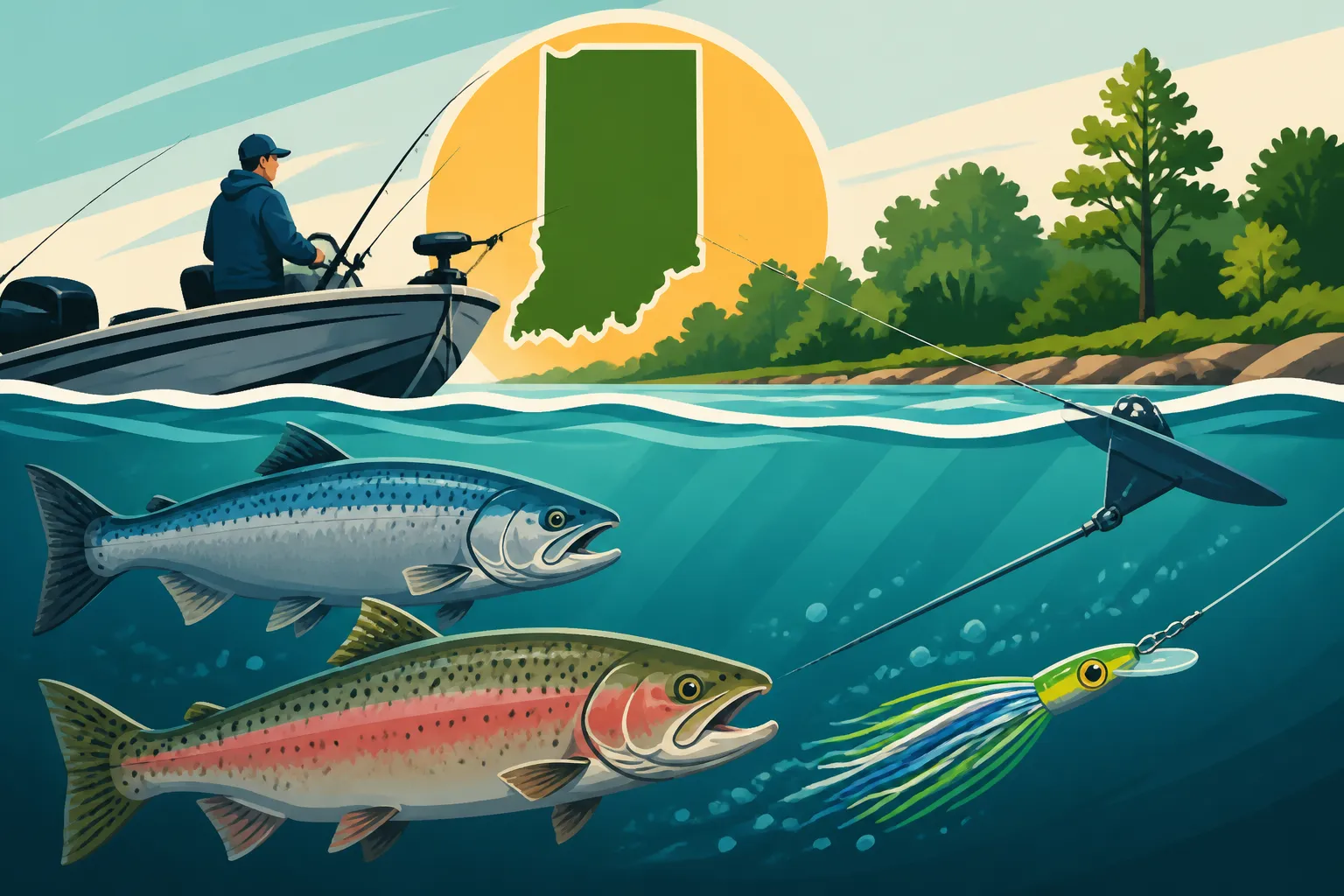
It can feel like you need an aerospace engineering degree just to set up all this complex gear, but once you understand the function of each piece, it becomes much simpler. These three tools are the cornerstones of effective trolling, allowing you to cover multiple depths and widths simultaneously. Downriggers are perhaps the most precise depth control tools available. They consist of a heavy cannonball-like weight (often 8-12 lbs) on a steel cable, with a release clip that attaches to your fishing line. The downrigger lowers your lure to a specific, measured depth, and when a fish strikes, the line pops free from the clip, allowing you to fight the fish directly without the weight. Electric downriggers from brands like Cannon or Scotty are popular for their ease of use, especially on larger boats. For more information on selecting these crucial tools, you might find our guide on the Best Downriggers for Indiana Lake Michigan Salmon to be quite helpful.
Planer boards, on the other hand, are designed to spread your lines horizontally away from the boat, covering a much wider swath of water than you could with just rods off the stern. This is invaluable for presenting lures in clear water where fish might be spooky, or for covering vast areas efficiently. There are various types, from smaller in-line boards that attach directly to your fishing line to larger mast-and-bridle systems that can run multiple lines. Walleye anglers use them on the smaller scale, but Lake Michigan salmon and steelhead demand heavy-duty boards to handle bigger lures and potentially rougher water. Our article on the Best Planer Boards for Indiana Steelhead Trolling dives deeper into selecting the right ones for your setup.
Finally, dipsy divers (or diver disks) are self-diving devices that attach to your mainline and use water resistance to dive to a set depth. They have an adjustable trip mechanism that releases when a fish strikes, allowing you to fight the fish. Dipsy divers are versatile, can be set to run at various angles to spread lines, and require no additional weights or cables, making them a popular choice for many Lake Michigan anglers. They excel at reaching depths that are sometimes too shallow for downriggers or too deep for simple long-lining.
| Trolling Device | Primary Function | Typical Depth Range | Best Use Cases |
|---|---|---|---|
| Downrigger | Precise depth control | 10 – 150+ feet | Deep-water salmon, thermocline targeting |
| Planer Board | Horizontal line spread | Surface to 40 feet | Shallow-running lures, covering wide areas, spooky fish |
| Dipsy Diver | Self-diving, line spread | 10 – 80 feet | Versatile, reaching medium depths, varying line angles |
Mastering Lure Selection and Presentation
Once you have your gear sorted, the next challenge is choosing the right lure and knowing how to present it. The sheer number of options on the market can be overwhelming, making it tough to even know where to start. However, understanding the basic categories and when to use them will dramatically improve your success.
Spoons, Plugs, and J-Plugs
Spoons are arguably the most iconic and versatile lures for salmon and steelhead. They come in an incredible array of sizes, shapes, and colors, each designed to mimic a wounded baitfish with an enticing wobble or flash. Brands like Michigan Stinger, Dreamweaver, and Silver Streak are household names among Great Lakes anglers. The key is to match the hatch – choosing a spoon size and color that imitates the local baitfish, primarily alewives. In clear water, natural baitfish patterns often work best, while in stained or cloudy water, brighter, more contrasting colors like chartreuse, orange, or "glow" patterns can be highly effective. The speed at which you troll also affects a spoon's action; faster speeds give more flash, while slower speeds emphasize wobble. Experimentation is crucial, and having a diverse selection in your tackle box, readily available from online retailers like Amazon, is a smart move.
Plugs, particularly diving crankbaits and stickbaits, offer a different kind of presentation. These lures typically have a lip that causes them to dive and swim with an erratic, often frantic action, mimicking a struggling baitfish. Brands like Storm ThunderStick, Rapala, and Reef Runner are popular choices. Plugs are fantastic for targeting salmon and steelhead that are feeding aggressively or when you want a more pronounced vibration and displacement in the water. They often work well when fish are higher in the water column or when you're targeting specific depths without a downrigger. The size and diving depth of the plug are critical; choose smaller, shallower-running plugs for spring coho and steelhead, and larger, deeper-diving models for summer kings.
J-Plugs, on the other hand, are a unique category of lipless plugs that produce a distinctive "S-curve" or "darting" action when trolled at higher speeds. They're incredibly effective for Chinook salmon, especially when they're actively feeding. Luhr-Jensen J-Plugs are a classic example, known for their ability to entice powerful strikes. The key to J-Plugs is speed; they need a certain trolling speed to achieve their characteristic action, often faster than what you might run for spoons or other plugs. They create a lot of commotion and are excellent for drawing strikes from aggressive fish.
Flashers, Dodges, and Flies/Hoochies
Beyond standalone lures, attractors play a vital role in salmon and steelhead trolling. It's a common rookie mistake to just throw out a lure without understanding how these attractors actually enhance its presentation, making your offering irresistible. Flashers and dodgers don't have hooks themselves; their job is to create commotion, flash, and vibration in the water to draw fish in, making them notice the trailing lure.
Flashers, like the Spin Doctor or Pro-Troll E-Chip, are designed to rotate or spin erratically, creating a bright, pulsating flash that mimics a school of baitfish or a struggling prey item. They're typically paired with a short leader (18-36 inches) and a trailing lure, most often a fly or a hoochie. The flasher's action imparts an erratic, darting movement to the trailing lure, making it appear more lifelike. Different flashers have different rotation patterns and speeds, so having a variety can help you dial in what the fish prefer on any given day. They are particularly effective for Chinook salmon and lake trout, which are often drawn to the aggressive action and flash.
Dodgers, while also attractors, have a different action. They wobble side-to-side with a slower, wider sweep, creating a rhythmic pulse in the water. This action is often preferred by Coho salmon and steelhead, as it can mimic the slower, more deliberate movements of injured baitfish. Dodgers are also typically paired with a trailing fly or hoochie, and the leader length is critical to ensure the lure is working correctly behind the dodger's action. Brands like the Cowbell or Luhr-Jensen Dodger are widely used. The slower, more subtle action of a dodger can sometimes be the ticket when fish are less aggressive or in clearer water. For brown trout specifically, different lure choices come into play, and our guide on the Best Lures for Trolling Brown Trout provides more tailored advice.
Flies and hoochies are the actual "lures" that trail behind flashers and dodgers. Flies are typically tied with synthetic fibers or natural hair, designed to imitate small baitfish or invertebrates. Hoochies are soft, squid-like skirts made of plastic. They have minimal action on their own but come alive when pulled by a flasher or dodger, mimicking the undulating movement of a squid or a distressed baitfish. They are often tipped with a small piece of bait, like a chunk of alewife or a commercial scent, to add a natural attractant. The color of your fly or hoochie should match the conditions and what the fish are feeding on; blues, greens, and whites are common alewife imitations, while brighter colors might be used in stained water.
Advanced Trolling Strategies for Success
Moving beyond just having the right gear, truly successful trolling involves a constant process of observation, adjustment, and strategic thinking. It’s not enough to just pick a depth and drive in a straight line; successful trolling is a constant dance of adjustments, responding to what the fish are telling you (or not telling you!).
Speed, Direction, and Depth Adjustments
Your trolling speed is one of the most critical factors influencing whether your lures entice a strike. Different species, water temperatures, and even the type of lure you're using will dictate your optimal speed. Coho salmon and steelhead often prefer faster trolling speeds (2.5-3.5 mph), which makes spoons and dodger/fly combos really dance. Chinook salmon, while sometimes aggressive, can also be caught at slower speeds (2.0-2.8 mph), especially with J-Plugs that require a certain speed to achieve their S-curve action. Lake trout, often found deeper, might prefer even slower presentations. The key is to constantly experiment; sometimes a small change of 0.1-0.2 mph can make all the difference. Using a GPS-enabled fishfinder or a dedicated speed-and-temp probe can provide accurate real-time trolling speed through the water, which is more important than your boat's speed over ground.
Direction is equally important. Simply driving in a straight line is rarely the most effective strategy. Incorporate S-turns into your trolling pattern. As your boat turns, the lures on the inside of the turn slow down and drop, while those on the outside speed up and rise. This change in speed and depth can often trigger strikes from following fish. Pay attention to current breaks, temperature changes, and structural features marked on your charts. Trolling along contours, especially offshore humps, drop-offs, or underwater points, can put your lures in prime ambush zones where baitfish gather. Our guide on the Best Time of Day to Catch Salmon on Lake Michigan delves into how these factors play into daily patterns.
Depth is perhaps the most critical variable. Salmon and steelhead are highly sensitive to water temperature and will seek out their preferred thermal comfort zone, which often coincides with the thermocline in summer. Your fishfinder will show you the thermocline as a distinct band on the screen. However, fish might be just above, just below, or right within it. Experiment with running lures at various depths – above, in, and below the thermocline – until you find the sweet spot. Also, consider the depth of baitfish schools; if you see dense bait balls at 60 feet, run some of your lures right through them. Downriggers are indispensable for precisely controlling your depth, allowing you to hit the target repeatedly.
Reading Your Electronics and Water Conditions
Many anglers have expensive electronics, but they're not really using them to their full potential. Your fish finder and GPS are not just fancy gadgets; they are your eyes and ears underwater. A good fish finder can display a wealth of information: baitfish schools, individual fish arches (the bigger the arch, generally the bigger the fish), the thermocline, and even bottom structure. Learn to interpret these signals. Dense bait balls are magnets for salmon and steelhead, so when you mark them, work that area thoroughly. Large, distinct arches either within or just outside the bait ball are often your target species. Pay attention to the depth at which you're marking fish and adjust your lures accordingly. For recommendations on optimizing your setup, check out our piece on the Best Fish Finders for Deep Water on Lake Michigan.
Your GPS is crucial for marking waypoints where you get strikes, identify bait, or notice favorable conditions. Don't just motor aimlessly. When you get a bite, mark the spot immediately. This allows you to either turn and troll back through that precise location or to note a pattern developing over multiple strikes. Tracking your trolling path on your GPS also helps you visualize your coverage and ensure you're working contours or specific areas effectively. It can also show you your actual speed over ground, which you can then compare to your speed through water (from a separate probe) to account for currents.
Water conditions – especially temperature and clarity – are paramount. As mentioned, water temperature dictates where fish will be. Use a surface temperature gauge to find optimal temperatures (e.g., 50-55°F for Chinook, 55-60°F for Coho, 50-65°F for Steelhead near the surface). Changes in surface temperature can indicate current breaks or upwellings that concentrate bait and fish. Water clarity also affects lure choice; clear water often calls for more subtle, natural colors, while stained water benefits from brighter, more fluorescent patterns. Even wave action can influence fish behavior; rougher water can scatter bait but also offer more cover for predators, sometimes making them more aggressive. Pay attention to all these factors, and your catch rates will undoubtedly climb.
Safety and Etiquette on Lake Michigan
Fishing Lake Michigan, while incredibly rewarding, demands respect. This is a big lake, and it can turn from a millpond to a monster in minutes. Beyond personal safety, understanding and adhering to good boating and fishing etiquette is vital for ensuring everyone has a pleasant and safe experience. Nothing sours a day faster than a near-miss or tangled lines with another boat because someone wasn't paying attention or understanding the rules.
Boater Safety Essentials
Before you even think about launching your boat onto Lake Michigan, a comprehensive safety checklist is non-negotiable. First and foremost, everyone on board must have a properly fitted, USCG-approved life jacket. While adults aren't always required to wear them, they must be readily accessible. Children under 13 are legally required to wear a life jacket whenever the boat is underway. Beyond individual vests, you need a throwable flotation device, like a cushion or ring buoy, if your boat is 16 feet or longer. For a full breakdown, check out our Indiana Boater Safety Gear Checklist and specifically our guide on the Best Life Jackets for Indiana Boaters.
Navigational lights are crucial, especially if you plan to be out during dawn, dusk, or after dark, which are often prime fishing times. Carry visual distress signals (flares or a distress flag) for daytime and nighttime use. A sound-producing device (horn or whistle) is also a legal requirement. Don't forget a fully charged marine VHF radio for communication, especially since cell phone service can be unreliable far offshore. A first aid kit, fire extinguisher, and extra fuel are also absolute must-haves. Always monitor the weather forecast diligently before and during your trip. Lake Michigan can brew up dangerous conditions quickly, and even small craft advisories should be taken seriously. Having a float plan, telling someone where you're going and when you expect to return, is also a smart practice.
Trolling Etiquette and Regulations
Lake Michigan can get crowded, especially during peak salmon runs or on beautiful summer weekends. Practicing good trolling etiquette is essential for harmonious coexistence on the water. The most basic rule is to give other boats ample space. This means staying a respectful distance from other trollers to avoid tangling lines or cutting off someone's spread. If you're approaching another boat, especially one with a wide trolling spread, slow down, assess their direction, and pass on the side that minimizes disruption. Never troll directly in front of another boat's spread or cut closely behind them, especially if they are actively fighting a fish.
When you're fighting a fish, it's generally accepted that you have the right-of-way, but you should still try to communicate your intentions to nearby boats if possible. If you need to turn or slow down significantly, a quick "Fish on!" shout can alert others. Be mindful of boats that are anchored or drifting; give them a wide berth. Remember, everyone is out there to enjoy the water and catch fish, so a little courtesy goes a long way.
Finally, always be aware of and abide by all Indiana fishing regulations and bag limits. These rules are in place to manage the fishery sustainably. Consult the Indiana Department of Natural Resources (IDNR) regulations handbook before each season, as rules can change. Specific rules apply to Lake Michigan that differ from inland lakes, so it's critical to understand the Lake Michigan Fishing Rules for Indiana Anglers. For example, the daily bag and possession limits for salmon and trout species are distinct, as are specific regulations regarding snagging or gear types in certain areas. It's not enough to just know the general state rules; you need to understand that Lake Michigan Fishing Regulations Are Different From the Rest of the State. Being a responsible angler means being informed and compliant.
Seasonal Breakdown for Optimal Trolling
To truly maximize your success, it's not enough to know how to troll; you need to know when and where to apply specific techniques. Salmon and steelhead behaviors shift dramatically with the seasons, demanding different approaches.
Spring into Early Summer Tactics
Spring fishing on Lake Michigan, particularly along the Indiana shoreline, is often defined by shallower water and a focus on Coho salmon and steelhead, with the occasional brown trout. As ice breaks up and nearshore waters warm, these fish move in closer to feed on newly active baitfish and to stage near river mouths. This can be a fantastic time for anglers with smaller boats, as extensive offshore runs aren't always necessary. Spring can be fickle, with fish spread out, making it hard to dial in a pattern, but when you find them, the action can be fast and furious.
Tactics revolve around presenting smaller lures higher in the water column. Small spoons (like ¼ to ⅜ oz) in bright colors (orange, chartreuse, clown patterns) or natural baitfish imitations (silver/blue, silver/green) are highly effective. Shallow-running crankbaits and stickbaits that dive only a few feet can also be deadly, especially when pulled behind planer boards to cover a wide area. Troll speeds tend to be on the faster side, typically 2.5 to 3.5 mph, to give these lures an aggressive action. You'll want to focus your efforts in the top 30 feet of the water column, often even shallower, especially early in the season when the warmest water is near the surface. Look for areas where warmer river water mixes with the cooler lake water, as these thermal breaks often concentrate bait and predatory fish. Our article on the Peak Steelhead Fishing Season in Indiana can give you even more specific timing details for these hard-fighting fish.
Mid-Summer to Fall Strategies
As summer truly sets in, the game changes dramatically. The nearshore waters warm up considerably, pushing salmon and steelhead into the cooler, deeper water offshore, typically congregating around the thermocline. If you're not equipped to reach them, you're just sightseeing, so this is where downriggers become absolutely essential. Chinook salmon become the primary target, often alongside lake trout and deeper-holding Coho and steelhead.
Your strategies will now focus on reaching depths from 40 to 100+ feet, often right at or just below the thermocline. Larger spoons, J-Plugs, and flashers with trailing flies or hoochies become the mainstays of your tackle spread. Natural baitfish colors and glow patterns are very effective, especially at deeper depths where light penetration is limited. Trolling speeds typically range from 2.0 to 3.0 mph, adjusted to optimize the action of your chosen lures and attractors. Experiment with different leader lengths behind your flashers and dodgers; even a few inches can make a difference. Early in the morning and late in the evening often see fish moving slightly higher in the water column, so adjust your depths accordingly.
As late summer transitions into fall, the focus shifts to the magnificent fall salmon run. Chinook and Coho salmon begin their annual migration towards tributary rivers to spawn. This means they will move back into shallower, nearshore waters along the Indiana coastline, concentrating around river mouths and harbor entrances. This is a prime time for targeting them with J-Plugs, larger spoons, and dodger/fly combos. Understanding the timing of this migration is crucial, and our guides on the Fall Salmon Run Timing on Lake Michigan in Indiana and Lake Michigan's Salmon Run: Indiana's Fall Fishing Season offer in-depth information to help you plan your trips. This period offers some of the most exciting and productive trolling of the year, as the fish are aggressive and often plentiful.
Disclaimer
Fishing regulations and conditions on Lake Michigan can change frequently. Always consult the latest regulations from the Indiana Department of Natural Resources (IDNR) before heading out. This guide is for informational purposes only and does not constitute professional advice. Always prioritize safety on the water.