Brown Trout Identification: Spots and Coloring
You've just landed a beautiful fish from one of Indiana's pristine streams or perhaps even the mighty Lake Michigan, and now you're wondering: "Is this a brown trout? Or did I snag a rainbow, or even a salmon?" It's a common dilemma for many anglers, as these species can sometimes look quite similar at first glance, leading to confusion and even potential issues with bag limits. This comprehensive guide is here to unravel the mystery, helping you confidently identify a brown trout by its distinctive spots and coloration so you can fish with knowledge and peace of mind.
The Classic Brown Trout Profile
Brown trout, while not native to Indiana, have been successfully introduced and thrive in many of our cooler streams and Lake Michigan. They're a favorite among anglers for their wary nature and strong fight. But before we dive into the nitty-gritty of their spots, let's establish a general understanding of their overall appearance.
Overall Body Shape and Coloration
When you first pull a brown trout from the water, you'll likely notice its sleek, torpedo-like body, built for power and speed. They tend to be a bit more robust and stocky than a rainbow trout of similar length, with a slightly larger head in proportion to their body. The general body coloration of a brown trout is incredibly variable, which can sometimes throw new anglers off. It often ranges from a golden-brown or olive-green on its back, gradually fading into yellowish or bronze flanks. The belly is typically a cream or white, providing a stark contrast to the darker upper body.
What's fascinating about this base color is how much it can adapt to the specific environment the fish inhabits. A brown trout living in a dark, tannin-stained stream might appear much darker, almost blackish on the back, while one caught from the clear, gravelly bottom of a vibrant creek could show more of that iridescent gold. Those caught in Lake Michigan often have a more silvery sheen, similar to salmon, which is part of why identification can be tricky there. This chameleon-like ability makes observing the specific markings even more critical than relying solely on the general hue.
Fin Features
Taking a close look at the fins can offer additional clues, though they might not be as definitive as the spots. Brown trout possess the characteristic adipose fin—a small, fleshy fin located between the dorsal fin and the tail—which is a hallmark of all salmonid species (trout and salmon). Their pectoral, pelvic, and anal fins usually match the yellowish-brown tones of their flanks, often without prominent coloration or distinct markings, although some may have a faint, dusky appearance.
The dorsal fin, located on the top of the fish's back, will typically share the same spotting pattern as the upper body, which we'll discuss in detail next. The caudal fin, or tail, is usually square or only very slightly forked, which is a subtle but important difference from some other trout and salmon species that might have more deeply forked tails. Crucially, brown trout tails generally lack the heavy, uniform spotting that you might see on a rainbow trout's caudal fin. Pay attention to these details, and you're already building a strong identification profile.
Unmistakable Spots and Halos
This is where brown trout truly distinguish themselves. While many fish have spots, the type of spots found on a brown trout is unique and the most reliable indicator of its identity.
Dark Spots with Light Halos
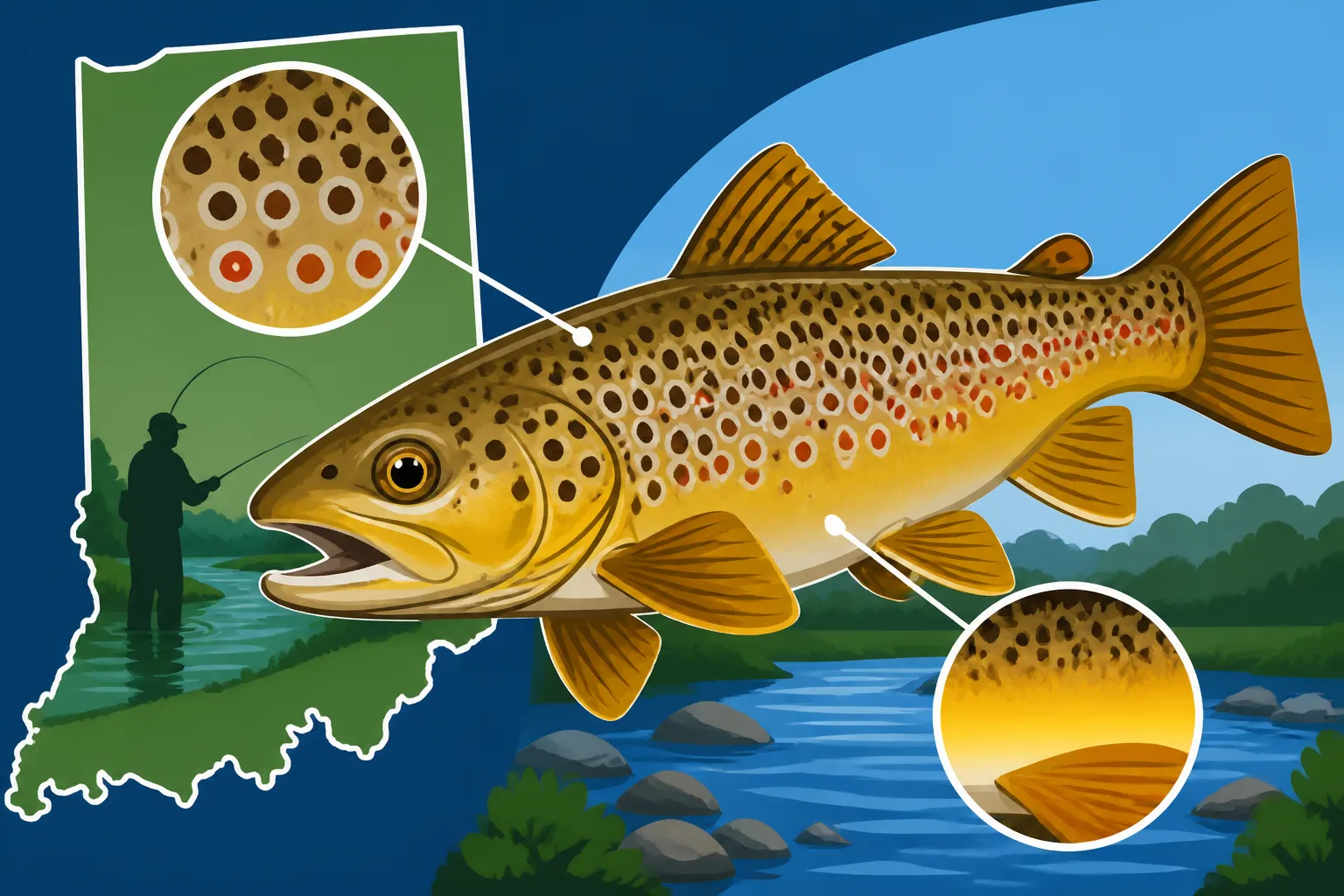
The hallmark of a brown trout is undoubtedly its dark spots, typically black or very dark brown, which are almost always surrounded by a pale, often glowing, halo. Imagine a dark dot painted on a lighter background, and then a faint ring of even lighter paint around that dot – that's the "halo effect." These haloed spots are usually most prominent on the fish's back, along its flanks, and often extend onto the gill covers. You'll notice them spread out, not necessarily in a uniform pattern, but distinct and separate.
When you're holding a brown trout, take a moment to really look at these spots. They often seem to almost pop out from the fish's skin, especially when the light hits them just right. This halo isn't just a trick of the light; it's a genuine coloration pattern that you won't typically see on other trout species found in Indiana. It’s like a signature, telling you exactly what you’ve caught. If you're struggling to see them clearly, consider bringing a good quality waterproof camera or even a small magnifying glass, easily found on Amazon, to get a clearer look at those subtle spot patterns.
Red Spots on the Flanks
Adding to their distinctive beauty, many brown trout also exhibit vibrant red or orange spots, particularly along their flanks, below the lateral line. Just like their darker counterparts, these red spots are frequently, though not always, encircled by a similar light halo. These aren't just random flecks of color; they're often bold and can really stand out against the golden-brown background of the fish's side.
The presence of these red-orange, often haloed, spots is another crucial identifier for brown trout. While other trout might have some reddish hues during spawning, these distinct, circular spots are characteristic of the brown trout throughout much of the year. The combination of dark, haloed spots and red, often haloed, spots forms an almost undeniable signature for this species.
Spot Distribution and Variation
It's important to remember that nature doesn't always follow a perfectly rigid pattern. The number, size, and exact distribution of spots can vary from one brown trout to another, even within the same population. Some might be heavily spotted, while others have fewer, more widely spaced markings. The intensity of the halo can also differ, sometimes being very pronounced and other times more subtle.
However, the type of spot—dark with a pale halo, and the presence of red spots, often also with halos—remains consistent. Don't get too hung up on counting spots or expecting perfect symmetry. Instead, focus on the fundamental characteristics of these markings. These natural variations simply add to the unique beauty of each individual fish you encounter. This understanding becomes especially helpful when you're out fishing in different parts of the state, perhaps in a river where you're used to seeing one type of pattern, then moving to Lake Michigan Fishing Rules for Indiana Anglers where the fish might present slightly differently.
Distinguishing Brown Trout from Other Indiana Trout and Salmon
Identifying your catch accurately is important, not just for bragging rights, but also for adhering to regulations and understanding the local fishery. Several other salmonid species call Indiana waters home, and they can sometimes be confused with brown trout.
Brown Trout vs. Rainbow Trout/Steelhead
The most common confusion often arises between brown trout and rainbow trout (the migratory form of which is known as steelhead). At first glance, especially if the fish is shimmering in the sun, they can look similar. However, there are key differences:
- Rainbow Trout/Steelhead Spots: Unlike brown trout's dark, haloed spots, rainbow trout typically have numerous, smaller, more uniform black spots. These spots usually lack the distinct light halos and are often found abundantly on their dorsal fin and, crucially, extend all the way onto their tail fin. The tail of a rainbow trout is usually heavily spotted, whereas a brown trout's tail has few to no spots. If you're looking for even more detail, you can check out specific comparisons like Steelhead vs Rainbow Trout: What Sets Them Apart or What's the Difference Between Steelhead and Rainbow Trout?.
- Lateral Stripe: Rainbow trout are famous for their iridescent pink or red stripe running horizontally along their lateral line, especially prominent during spawning season. Brown trout, while they can have some reddish spots, do not have this continuous, prominent stripe.
- Mouth and Body Shape: Rainbow trout generally have a smaller mouth that doesn't extend much past the eye, and their body can appear a bit more slender and silvery compared to the often more robust and golden-brown brown trout.
Consider this quick comparison:
| Feature | Brown Trout | Rainbow Trout/Steelhead |
|---|---|---|
| Primary Color | Golden-brown, olive, yellowish flanks | Silvery, iridescent, greenish back |
| Spotting | Dark spots with light halos; red/orange spots on flanks | Small, uniform black spots, often on caudal fin and body |
| Lateral Line | No prominent stripe, sometimes indistinct | Distinct pink/red stripe (especially when spawning) |
| Tail Fin | Square or slightly forked, few spots | Moderately forked, covered in small black spots |
Brown Trout vs. Lake Trout
Lake trout are another species you might encounter, particularly in the deeper, colder waters of Lake Michigan. They are part of the char family, distinct from true trout, but still share some general characteristics.
- Body and Coloration: Lake trout typically have a longer, more slender body with a much deeper forked tail than a brown trout. Their coloration is usually dark gray or greenish, with lighter, often worm-like markings (vermiculations) on their back and dorsal fin, rather than distinct spots.
- Fin Edges: A tell-tale sign of a lake trout is the white leading edges on their pectoral, pelvic, and anal fins. Brown trout do not have this feature.
- Spots: While lake trout do have light-colored spots on a darker background, these spots generally lack the dark center and prominent light halo of a brown trout. They appear more as irregular pale blotches.
Remember, identifying a fish quickly at the boat or on the bank is a skill that improves with practice and careful observation. For those who want to dig deeper, many excellent field guides are available on Amazon that provide detailed illustrations and descriptions of all the trout and salmon species found in the Great Lakes region.
Brown Trout vs. Salmon (Chinook, Coho)
While salmon are generally larger and have different life cycles, young salmon or smaller specimens caught in Lake Michigan can occasionally be confused with brown trout due to their silvery sheen. However, some key distinctions exist:
- Mouth and Gums: This is the most reliable difference. Chinook salmon, for example, have a black mouth and black gums along the base of their teeth. Coho salmon will have a black mouth but white gums. Brown trout, like rainbow trout, have a pale mouth and white gums. This is a very quick and definitive check. For more on how to identify these, look for guides like Chinook Salmon Fishing on Indiana's Lake Michigan Shore or Coho Salmon Identification: Spotting the Fall Run.
- Spotting: While salmon have spots, they are generally less distinct, often more uniform, and do not typically feature the prominent light halos seen on brown trout. Chinook salmon tend to have irregular spots on their back and both lobes of their tail, while Coho salmon often have spots only on the upper lobe of their tail.
- Tail Fin: Chinook salmon have a moderately forked tail that is heavily spotted, contrasting with the nearly unspotted, square tail of a brown trout.
- Body Shape: Adult salmon typically have a more streamlined, elongated body, especially during their migratory phases, compared to the often chunkier build of a brown trout.
Why Correct Identification is Crucial for Indiana Anglers
Beyond the satisfaction of knowing exactly what you've landed, accurately identifying brown trout in Indiana waters carries significant practical importance. It's not just a trivial detail; it impacts how you fish, what you keep, and how you contribute to conservation efforts.
Understanding Bag and Length Limits
One of the primary reasons for accurate identification is adherence to fishing regulations. Indiana, like many states, has specific Indiana Fishing Regulations and Bag Limits Guide that vary by species, and sometimes even by specific body of water. For instance, the daily bag limit and minimum length requirements for brown trout might be different from those for rainbow trout or salmon. Misidentifying your catch could inadvertently lead to exceeding the legal limit or keeping an undersized fish, which can result in penalties.
Imagine you're fishing a tributary to Lake Michigan, and you catch a beautiful fish you think is a rainbow trout, but it's actually a brown. If the regulations for brown trout in that specific area are different, you could unknowingly be in violation. This becomes particularly relevant in areas with mixed fisheries, such as Lake Michigan, where various trout and salmon species coexist. Knowing Lake Michigan Fishing Rules for Indiana Anglers intimately, including species identification, is key to a responsible and stress-free fishing trip.
Conservation and Responsible Angling
Beyond regulations, proper identification plays a vital role in conservation. Some fish populations are more sensitive than others, or certain species might be undergoing specific management efforts. By correctly identifying brown trout, you contribute to better data collection if you're participating in surveys or simply reporting your catch. This information helps fisheries biologists monitor populations and make informed decisions about stocking, habitat restoration, and future regulations.
Responsible angling also means knowing when a fish might be a protected species or a rare catch. While brown trout are introduced, understanding their presence and health within the ecosystem is crucial. If you're practicing catch-and-release, knowing the species allows you to handle it appropriately for the best chance of survival. Invest in a headlamp, often available through retailers like Amazon, to ensure you can see those crucial markings even in dim light or during those early morning bites, ensuring a quick and accurate ID for release.
Enhancing Your Fishing Experience
Finally, and perhaps most enjoyably, accurate identification deepens your connection to the sport and the natural world. Knowing the specific species you've caught allows you to research its habits, preferred baits, and typical habitats. This knowledge makes you a more skilled and informed angler.
It also helps you appreciate the biodiversity of Indiana's waterways. Did you know there are How Many Fish Species Live in Indiana Waters? You might even come across a species unique to our region, as detailed in Indiana's Lake Michigan Fishery: Species You Can't Catch Anywhere Else. Every fish tells a story, and being able to identify it correctly is the first step in understanding that narrative. It truly adds another layer of enjoyment to every single cast and every single catch. If you want a quick reference, a guide like Indiana Fish Identification: A Quick Reference Guide can be incredibly helpful. Perhaps a waterproof fish identification card from Amazon that you can clip to your tackle box would be a handy tool for quick reference on the water.
In conclusion, the next time you reel in a beautiful trout in Indiana, take a moment to look for those distinctive dark, haloed spots and vibrant red spots on its flanks. With a little practice and keen observation, you'll soon be able to confidently declare, "That's a brown trout!" and enjoy your time on the water even more.
Disclaimer
This article is for general informational purposes only and does not constitute professional advice. Laws, prices and regulations vary by location and change over time. Consult a qualified professional for guidance on your specific situation.