Wire Leaders for Muskie Fishing in Indiana’s Glacial Lakes
There’s nothing quite like the thrill of chasing muskie in Indiana’s glacial lakes, is there? You spend hours casting those big baits, working every weed line and submerged structure, all for that one explosive strike. But imagine finally hooking into that monster, feeling the incredible power, only for your line to go slack a few seconds later, leaving you with nothing but a frayed leader and a sinking feeling in your gut. This is a common, heartbreaking frustration for many anglers, but it’s entirely preventable. This comprehensive guide will explain why wire leaders are not just recommended, but absolutely essential for muskie fishing in our Hoosier waters, and how to choose, use, and even make the best ones to ensure your next trophy doesn't become another "one that got away."
The Unavoidable Truth: Why Muskie Demand Wire Leaders in Indiana's Glacial Lakes
Muskellunge are often called the "fish of 10,000 casts," and when you finally get that one cast to pay off, you don't want to lose it because of inadequate terminal tackle. These powerful predators are built like torpedoes, with a mouth full of razor-sharp teeth that can easily slice through standard monofilament or fluorocarbon lines. Trying to chase muskie without a robust wire leader is like going into a knife fight armed with a string – it's just not going to end well for you or your expensive lure.
The Muskie's Mouth: A Dental Nightmare for Regular Line
Let's talk about those teeth. A muskie's mouth is a formidable array of needle-sharp canines and smaller, razor-like teeth, perfectly designed for grabbing and holding onto prey. When a muskie hits your lure, it's not just a gentle bite; it's an aggressive attack, often involving violent head shakes and rolls. During this chaotic moment, your line can easily come into contact with those teeth. Even a momentary brush can be enough to sever your line, especially if it's under tension from a hard-fighting fish. I've seen anglers lament losing a trophy muskie because they thought a heavy fluorocarbon leader would be enough. While fluorocarbon is more abrasion-resistant than mono, it's still no match for a muskie's dental work. A dedicated wire leader is the only reliable defense against these toothy critters.
It's not just the initial strike either. Once hooked, a muskie will fight hard, often turning its head and thrashing, giving those teeth ample opportunity to find your main line or leader material. Without that tough wire barrier, your chances of landing the fish plummet dramatically. We're talking about species that can grow to impressive sizes in lakes like James Lake and Lake Wawasee, and landing them requires proper preparation. Muskellunge Fishing in Indiana: What Anglers Need to Know covers more on these magnificent fish.
The "What If" Scenario: Lost Fish and Lost Lures
The most heartbreaking scenario for any muskie angler is the lost fish, but a close second is the lost lure. Muskie baits aren't cheap. We're talking about crankbaits, bucktails, and gliders that can easily cost upwards of $20, $30, or even more for a single lure. Losing one of these prized baits to a snapped line is not only frustrating but also a significant financial hit. Many muskie anglers have a collection of baits that rivals a small treasure chest, and each one represents an investment of time, money, and hope.
Imagine spending hours searching the weed beds and deep structure for that perfect muskie, finally getting a strike on your favorite, perfectly tuned crankbait, only for the line to snap and send your lure sinking into the depths with the fish. It's a double whammy of disappointment. A high-quality wire leader acts as an insurance policy, protecting both your hard-earned catch and your valuable tackle. It’s a small investment that prevents much larger losses down the line, both literally and figuratively. When you're spending good money on specialized muskie tackle, like those you might find at Bass Pro Shops, it just makes sense to protect it with the right leader.
Protecting Your Investment: High-End Muskie Baits
Muskie fishing isn't just a casual hobby; for many, it's a dedicated pursuit that involves specialized, often expensive, equipment. From heavy-duty rods and reels to a diverse arsenal of oversized lures, anglers invest heavily in gear designed specifically for these apex predators. These high-end muskie baits are crafted with precision, often hand-tuned, and chosen for their unique action and appeal to trophy fish. Losing one of these to a line break can feel like losing a piece of art.
Wire leaders, while a small component of your overall setup, are the critical link that ensures the survival of your lure. They prevent the muskie's teeth from reaching your main line, allowing you to fight the fish confidently and bring both it and your lure back to the boat or shore. This protection is invaluable, especially when you're casting custom bucktails or limited-edition glide baits that are hard to replace. Properly preparing your gear, including your leaders, is part of being a responsible angler and respecting the investment you’ve made in your passion. For a deeper dive into all the essential gear, check out Muskie and Pike Gear for Indiana's Glacial Lakes.
Understanding Wire Leader Materials: Stainless Steel vs. Titanium
When it comes to wire leaders, you'll generally find two main material types dominating the market: stainless steel and titanium. Both serve the same fundamental purpose—to provide a bite-proof barrier against a muskie's teeth—but they achieve this with different properties, each having its own set of pros and cons. Understanding these differences is key to choosing the leader that best suits your fishing style and the conditions you face in Indiana's glacial lakes.
Stainless Steel: The Traditional Workhorse
Stainless steel leaders have been around for a long time, and for good reason. They are incredibly strong, highly abrasion-resistant, and relatively affordable. These leaders are typically constructed from multiple strands of fine stainless steel wire braided or twisted together, often with a nylon coating. The multi-strand construction gives them some flexibility, while the stainless steel provides the necessary strength to withstand sharp teeth. They come in various pound tests and configurations, making them versatile for different types of muskie baits.
The main drawback of stainless steel is its tendency to kink or develop "memory" over time. After catching a few fish or after a particularly violent strike, a stainless steel leader can get bent or twisted, especially near the lure or snap. Once kinked, its integrity can be compromised, and it should be replaced. This means you might go through several leaders in a single intense fishing trip. However, for many anglers, their reliability and lower cost make them a perennial favorite, readily available from retailers like Bass Pro Shops or even a quick search on Amazon.
Titanium: Modern Strength and Flexibility
Titanium leaders represent a more modern advancement in leader technology. They are significantly more elastic and memory-free than stainless steel. This means they can be bent, twisted, and stretched without kinking, returning to their original shape after being stressed. This "superelasticity" is a huge advantage, as it means titanium leaders last much longer than stainless steel ones, often enduring dozens of fish without needing replacement due to kinking. They are also remarkably strong for their diameter and exceptionally corrosion-resistant.
The trade-off for titanium's superior performance is its higher price point. You'll typically pay more for a titanium leader than a comparable stainless steel one. However, given their longevity, many anglers find the investment worthwhile in the long run. If you're serious about chasing trophy muskie in Indiana's waters and want a leader that can stand up to repeated abuse without failure, titanium is an excellent choice. It allows you to keep your focus on the fish, not on constantly checking your leader for damage.
Coated Wires: A Hybrid Approach
Beyond pure stainless steel and titanium, you'll also encounter leaders that feature various coatings. Often, these are multi-strand stainless steel wires encased in a nylon or plastic coating. This coating serves a few purposes: it can increase the leader's abrasion resistance, make it smoother for casting (reducing friction through rod guides), and minimize glint or flash underwater, which can sometimes spook wary muskie. The coating also helps prevent tangles and adds a bit of stiffness, which can be beneficial with certain lure presentations.
While coated wires offer some advantages, they aren't a magic bullet. The coating itself can sometimes get nicked or peeled, especially after contact with teeth or heavy cover, which can then expose the underlying wire and potentially compromise its integrity. It's a hybrid approach that tries to combine the best features of different materials, but careful inspection after each fish is still crucial. Always check your leaders, regardless of material or coating, to ensure they're in top condition before making that next cast.
Here’s a quick comparison of the two main types of wire leaders:
| Feature | Stainless Steel Wire Leaders | Titanium Wire Leaders |
|---|---|---|
| Flexibility | Good, but prone to kinking | Excellent, superelastic (kink-resistant) |
| Durability | Strong, but degrades with kinks | Extremely durable, long-lasting |
| Memory | Prone to taking kinks and bends | Minimal to no memory, returns to original shape |
| Corrosion | Very good resistance | Excellent resistance |
| Cost | More affordable per leader | Higher initial cost, but lasts longer |
| Abrasion Res. | High | High |
| Visibility | Can be shiny; often coated | Low reflectivity, less visible |
| Best Use | Budget-friendly, reliable workhorse | High-performance, for serious muskie hunters |
Choosing the Right Wire Leader Length and Strength for Indiana Muskie
Selecting the correct wire leader isn't just about material; it's also about finding the right length and strength. These factors play a huge role in everything from casting performance to how the lure presents in the water, and most importantly, in preventing break-offs. There's a delicate balance to strike, and what works for a smaller pike might not cut it for a trophy muskie.
Length Matters: Balancing Control and Stealth
The ideal length for a muskie wire leader typically ranges from 10 to 18 inches, though some anglers go shorter or longer depending on specific situations. A shorter leader (10-12 inches) can offer a more direct connection to your lure, which some believe translates to better feel and action. It also makes casting large, heavy muskie baits a bit easier as there's less leader material to tangle or whip around. However, a shorter leader increases the risk of the muskie's body or tail contacting your main line during a fight, especially if the fish rolls.
A longer leader (14-18 inches) provides a greater margin of safety, reducing the chance of your main line touching those sharp teeth. It's especially useful when using larger lures or when fishing in clear water where a longer, less visible leader might offer a stealth advantage. The downside is that longer leaders can sometimes interfere with casting, particularly if they are very stiff, or can wrap around the lure, especially during aggressive figure-eighting at the boat. The key is to find a length that gives you confidence in tooth protection without hindering your casting or lure presentation.
Breaking Strength: Matching Your Target and Tackle
Muskie leaders are not measured in typical fishing line pound test as much as they are in tensile strength, often indicated in pounds, for example, 80 lb or 100 lb test. When choosing the breaking strength, you need to consider a few things: the size of the muskie you expect to encounter, the lures you'll be throwing, and the overall strength of your rod and reel setup. For most muskie fishing in Indiana's glacial lakes, a leader in the 80 to 130 lb range is standard.
Why so strong? It's not just about the weight of the fish, but the sheer force of the strike, the violent head shakes, and the constant abrasion from those teeth. A lower strength leader might hold a fish in open water, but it could fail if the fish tangles in weeds or snags, or if the leader gets a deep kink. Err on the side of caution and go with a leader strength that feels robust for the job. Remember, you're not just fighting the fish, you're also putting pressure on your leader every time you cast those heavy baits, so a sturdy connection is vital. Best Heavy Tackle for Pike Fishing in Indiana goes into detail about the overall setup.
Swivels and Snaps: Essential Components
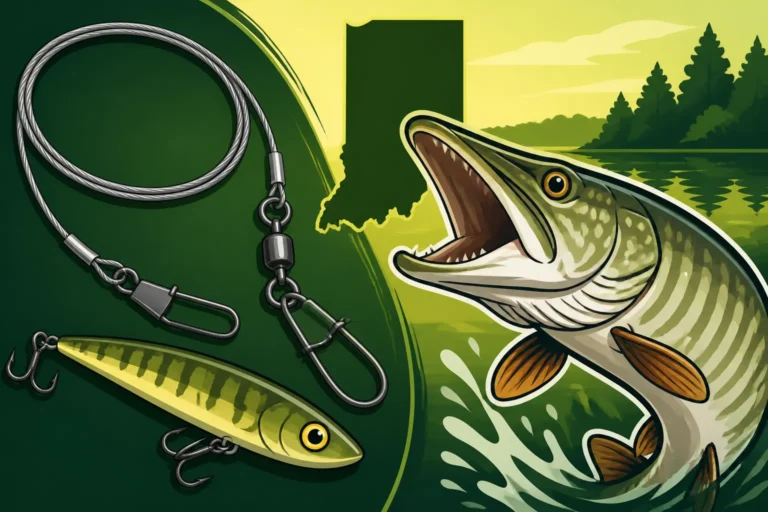
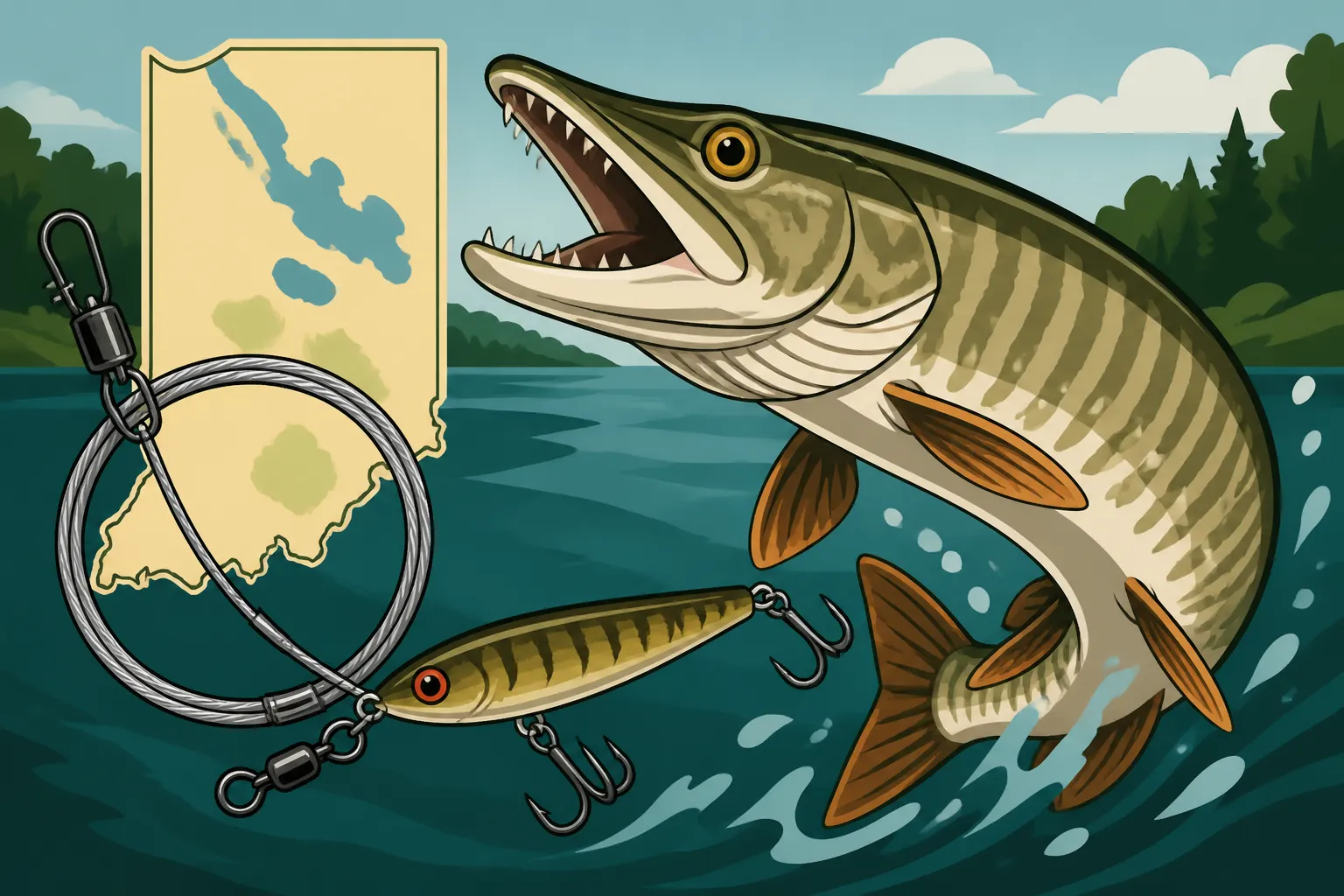
The attachment points on your wire leader are just as critical as the wire itself. Most muskie leaders feature a heavy-duty barrel swivel on one end, where you tie your main line, and a strong snap on the other end for quickly attaching and detaching lures.
The swivel's job is to prevent line twist, especially important when throwing bucktails or other lures that spin during retrieval. A high-quality ball-bearing swivel is worth the extra cost, as they offer superior anti-twist performance and durability. You don’t want a cheap swivel binding up during a fight.
The snap is where your lure connects, and it needs to be incredibly strong and reliable. Look for heavy-duty, interlock snaps or split rings designed for muskie. Avoid small, flimsy snaps that can bend open or break under pressure from a large muskie. The convenience of quickly changing lures is great, but not at the expense of losing a trophy fish. Make sure both the swivel and snap are rated for the same or higher breaking strength as your wire leader. You can find excellent options for these components at sporting goods stores or online retailers like Amazon.
DIY vs. Pre-Made Wire Leaders: What's Best for You?
When it comes to wire leaders for muskie fishing, you essentially have two paths: buy them pre-made or craft your own. Both options have distinct advantages and disadvantages, and the "best" choice often comes down to personal preference, budget, and how much control you want over your terminal tackle. Many dedicated muskie anglers find themselves exploring both avenues at different times.
The Convenience of Pre-Made Leaders
For many anglers, especially those just starting out or short on time, pre-made wire leaders are an absolute godsend. They are readily available in various lengths and strengths at virtually any tackle shop that caters to muskie fishing, and certainly online from places like Bass Pro Shops. These leaders are professionally crimped or tied, ensuring consistent quality and strength. You simply take them out of the package, tie your main line to one end, clip your lure to the other, and you're ready to fish.
The biggest advantage here is convenience and reliability. You don't need to invest in specialized tools, learn crimping techniques, or worry about the strength of your knots to the wire. Just pick up a few packs, and you're good to go. This can be especially helpful if you're traveling for a fishing trip and don't want to bring a full leader-making kit. The main downside, of course, is the cost. Pre-made leaders can add up, especially if you're frequently replacing them due to kinks or wear, and they might not always offer the exact specifications you're looking for.
Crafting Your Own: Customization and Cost Savings
For the truly dedicated muskie angler, making your own wire leaders can be a highly rewarding experience. The primary benefits are customization and cost savings. You can choose the exact material (stainless, titanium, or a specific brand of wire), the precise length, the breaking strength, and the specific type of swivel and snap you prefer. This allows you to fine-tune your leaders to match your lures, fishing techniques, and personal preferences perfectly. Want an extra-long leader for a specific presentation? No problem. Prefer a certain type of snap? You can add it.
While there's an initial investment in tools and bulk materials, the cost per leader significantly drops once you have everything you need. Buying spools of wire, bags of swivels, and packs of snaps in bulk is much cheaper than buying individual pre-made leaders. However, there's a learning curve involved. You'll need to learn how to properly crimp or tie knots with wire, which requires practice to ensure strength and reliability. A poorly made leader is a recipe for disaster when a muskie hits! If you're looking for guidance, How to Rig a Wire Leader for Muskie Fishing offers some great step-by-step advice.
Essential Tools for Building Muskie Leaders
If you decide to dive into the world of DIY muskie leaders, you'll need a few specialized tools. These aren't just nice-to-haves; they are essential for creating leaders that are both strong and safe.
- Crimping Pliers: These are non-negotiable if you plan to use crimps (sleeves) to secure your wire. Good crimping pliers have multiple crimping stations designed for different sleeve sizes, ensuring a secure, consistent crimp that won't slip or cut the wire.
- Crimps/Sleeves: These small metal tubes are used with crimping pliers to create loops for attaching swivels and snaps. They come in various sizes to match your wire diameter. Always match the crimp size to your wire for maximum strength.
- Wire Cutters: Heavy-duty wire cutters are needed to cleanly cut through stout wire leader material. Regular fishing line cutters just won't do the trick.
- Vice or Helping Hand: A small bench vise or a "helping hand" tool can be incredibly useful for holding components steady while you're working, freeing up both of your hands.
- Heat Shrink Tubing (Optional but Recommended): While not strictly essential for strength, heat shrink tubing applied over crimps can provide a cleaner finish, protect the crimp from abrasion, and reduce any sharp edges that might catch on your line or fingers.
Investing in quality tools and materials is paramount. Cheap crimpers or incorrect crimp sizes can lead to leader failure, which is the last thing you want when that trophy muskie finally bites.
Fishing with Wire Leaders: Techniques and Considerations
Integrating wire leaders into your muskie fishing setup isn't just about tying them on; it also involves understanding how they impact your casting, retrieve, and the critical boat-side fight. Because wire leaders are inherently stiffer and often heavier than regular line, they require a few adjustments to your technique to maximize their effectiveness and ensure you land that prized fish.
Casting and Retrieving: Handling the Heavier Setup
When you're casting big, heavy muskie lures with a wire leader, the overall weight of your terminal tackle increases. This demands a powerful rod designed for muskie fishing, typically with a heavy or extra-heavy action and a fast taper. You'll need to use a smooth, deliberate casting motion, allowing the rod to load properly. Jerking or snapping your cast can lead to tangles, especially if the leader wraps around the lure or your rod tip. Focus on a controlled, sweeping cast that generates momentum.
During retrieval, the leader's stiffness can sometimes slightly alter a lure's action, especially smaller or more subtle baits. With most muskie lures, however, this effect is minimal and often negligible given their aggressive design. Pay attention to how your lure is running and adjust your retrieve speed or pauses accordingly. If you notice any unusual action, check for kinks in your leader or issues with the snap. This heavier setup also means more resistance when retrieving, so having a high-quality reel with a strong drag system and ample cranking power is crucial.
Figure-Eighting: The Crucial Boat-Side Maneuver
Perhaps the most iconic and essential technique in muskie fishing, especially when using wire leaders, is the figure-eight. This maneuver is performed at the end of your retrieve, right as the lure reaches the boat or shore. Instead of simply pulling the lure out of the water, you keep it submerged and sweep your rod in a wide, horizontal figure-eight pattern alongside the boat. This keeps the lure in the water and moving, often triggering a follow that was shy about committing.
The wire leader is critical here because a muskie that follows your lure right to the boat is often very agitated and aggressive. If it strikes during the figure-eight, those sharp teeth will be right on your leader, which is exactly what it's designed for. Without a wire leader, a boat-side strike would almost certainly result in a cut-off. The stiffness of the wire can sometimes make the turns in the figure-eight a little wider, but this is a small price to pay for the protection it offers. Mastering the figure-eight is a game-changer for landing muskie, and How to Figure-Eight a Muskie at the Boat provides a fantastic breakdown of this technique.
Maintenance and Inspection: Keeping Your Leaders Tip-Top
Wire leaders, even the durable titanium ones, are not indestructible. Regular maintenance and vigilant inspection are paramount to preventing lost fish and lures. After every single muskie, and even after a few aggressive casts, you should always thoroughly inspect your leader.
Look for any signs of damage:
- Kinks: Especially on stainless steel leaders, even a small kink can weaken the wire considerably. If you see one, replace the leader immediately.
- Fraying: Though less common with wire, check for any visible strands coming loose or a fuzzy appearance, which indicates wear.
- Nicks or Cuts: Examine the coating (if applicable) for any nicks that might expose the inner wire.
- Bent Snaps or Swivels: Check that your snap hasn't been bent open or weakened, and that your swivel still rotates freely.
If you find any signs of damage, it's time to replace the leader. Don't try to "get one more fish" out of a compromised leader; it's a gamble you will almost certainly lose. Carry a good supply of spare leaders, both pre-made and components for DIY repairs, especially on extended trips to Indiana's muskie hotspots. Proper care ensures your leaders remain reliable, giving you the best chance to land that trophy muskie that Indiana's glacial lakes are famous for.
Disclaimer
This article is for general informational purposes only and does not constitute professional advice. Laws, prices and regulations vary by location and change over time. Consult a qualified professional for guidance on your specific situation.