How to Rig a Wire Leader for Muskie Fishing
Oh, the muskie! The fish of a thousand casts, the apex predator of our Indiana waters. There's nothing quite like the thrill of chasing these elusive giants, but let's be honest, it can be utterly soul-crushing when you finally get a strike, only for your line to go limp mid-fight. You feel that sudden lack of resistance, the heartbreaking realization that your prize catch, and probably a rather expensive lure, just swam away with a souvenir. That's usually the tell-tale sign of a bite-off, and it's a frustration every serious muskie angler in Indiana has faced. This guide is here to walk you through exactly why a wire leader is an absolute non-negotiable for muskie fishing and how to rig one up effectively, saving your lures, your sanity, and ensuring those toothy critters make it back to the water safely.
Why a Wire Leader is Non-Negotiable for Muskie Fishing
When you're targeting muskie in places like Lake Webster, James Lake, or even some of the deeper channels of the Tippecanoe River, you're not just going after any fish. You're hunting a formidable predator with a mouth full of razor-sharp teeth. Trying to tackle a muskie without a proper leader is like bringing a butter knife to a sword fight – it's simply not going to end well for you or your gear.
The Muskie's Mouth: A Lure Destroyer
Let's talk about those teeth. Muskies possess rows of needle-sharp teeth, often described as canine-like, that are perfectly designed for grasping and tearing prey. When a muskie strikes, it's not a gentle peck; it's an explosive, violent ambush. Their jaws clamp down with incredible force, and those teeth can slice through standard monofilament or even heavier fluorocarbon lines in an instant. Imagine finally hooking into that Indiana trophy muskie you've been dreaming about, feeling the power, seeing the flash of green and gold, only for the line to snap right at the lure. It's a gut punch, pure and simple. I've been there, and I know many fellow anglers who have too. It's not just about losing the fish; it's about losing that beautiful, often expensive, custom-painted bucktail or jerkbait you shelled out good money for. Without a robust, bite-proof barrier, your main line doesn't stand a chance against that dental arsenal.
Protecting Your Investment and the Fish
Beyond the sheer frustration of losing a fish and a lure, using a wire leader is a critical aspect of responsible angling. When a muskie bites through your line, the lure often remains lodged in its mouth or gills. While muskies are incredibly resilient, this can impair their ability to feed, injure them further, or even lead to infection. As anglers who appreciate these magnificent creatures, our goal should always be to ensure their well-being, especially when practicing catch-and-release, which is common for muskie. A properly rigged wire leader ensures that when you land that fish, you can safely remove the lure, snap a quick photo, and send it back to grow even bigger.
Think of it this way: you invest in a quality muskie rod, a sturdy reel, and those specialized lures. Why would you skimp on the one piece of terminal tackle that directly interfaces with the fish's teeth? It's like putting racing tires on a car with a faulty steering wheel. The leader is the crucial link that protects both your gear investment and the future of the muskie fishery in Indiana. It’s an essential part of your Muskie and Pike Gear for Indiana's Glacial Lakes setup.
Balancing Strength with Stealth
A common concern among anglers, especially those new to muskie fishing, is that a visible wire leader will deter a fish. While muskies are predatory and often react aggressively to a moving lure, there's always a balance to strike between brute strength and natural presentation. Modern wire leaders have come a long way. They're often thinner, more flexible, and can be camouflaged with various coatings or made from materials that are less reflective in the water.
The truth is, a muskie that's committed to striking a lure is rarely going to be spooked by a well-chosen wire leader. Their predatory instinct takes over. The key is to select a leader that is strong enough to withstand those teeth but doesn't overtly impede the action of your lure. A leader that's too stiff or too short can make a crankbait wobble unnaturally or prevent a jerkbait from gliding properly. We'll dive into different types of wire leaders next, helping you choose the right balance for your Indiana muskie hunt.
Understanding Wire Leader Types for Muskie
When it comes to wire leaders for muskie, you've got a few main options, each with its own set of characteristics. Knowing the differences can really help you fine-tune your approach for different lures and fishing conditions across Indiana's muskie hotspots.
Single-Strand Wire Leaders: The Classic Choice
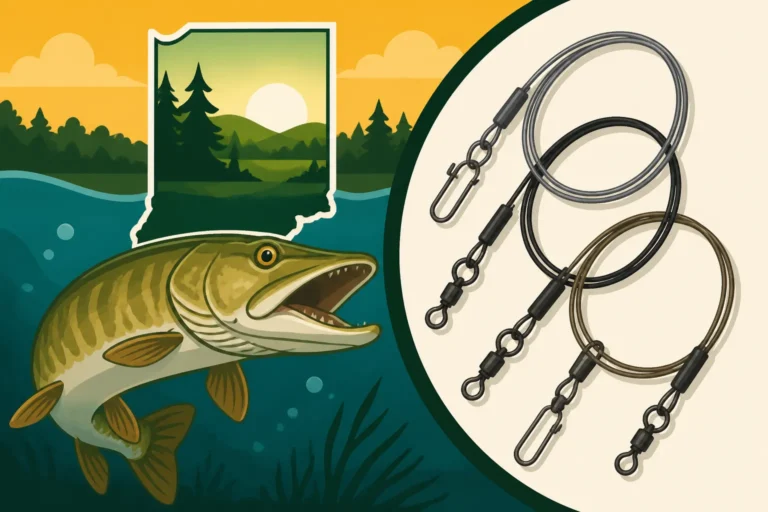
Single-strand wire leaders, typically made from stainless steel or a nickel-titanium alloy, are what many anglers first think of when they hear "wire leader." These are exactly what they sound like: a single, solid strand of metal wire. They offer exceptional abrasion resistance and virtually no stretch, which can be great for transmitting every subtle bump and vibration from your lure.
- Pros: They are incredibly tough against teeth and abrasive structures. They offer a very direct connection to your lure, enhancing sensitivity. For baits that don't need a lot of nuanced action, like certain spinnerbaits or inline bucktails, they work well.
- Cons: The biggest drawback is their tendency to kink. Once a single-strand leader gets a sharp bend or kink in it, its structural integrity is compromised, and it should be replaced immediately. This can happen from a fish fight, a snag, or even rough handling. They can also be more visible in clear water, though modern coatings help.
- Best Use Cases: These are often favored for fast-moving baits like bucktails, especially larger ones, where the lure's action is primarily generated by its design rather than leader flexibility. Some anglers prefer them for certain trolling setups because of their strength and minimal stretch.
Multi-Strand (Braided) Wire Leaders: Flexibility and Forgiveness
Multi-strand leaders are made up of several fine wires braided or twisted together, often then coated with nylon or another polymer. This construction gives them a flexibility that single-strand wire simply can't match.
- Pros: Their flexibility allows for a much more natural action from your lures, particularly crucial for jerkbaits, glide baits, and soft plastics that rely on subtle movements to entice a strike. They are far less prone to kinking than single-strand wire, offering more forgiveness during a fight or if the lure gets a bit tangled. The coating can also make them less visible in the water and protect the individual wire strands from fraying.
- Cons: While flexible, direct tooth contact with the coating can eventually wear through it, potentially leading to fraying of the underlying wire strands. You need to inspect them regularly. They might not be quite as abrasion-resistant as a fresh single-strand wire against a sharp tooth if the coating is compromised, but they generally hold up very well.
- Best Use Cases: These are incredibly versatile and are a go-to for most muskie anglers, especially when fishing with jerkbaits, glide baits, and topwater lures where lure action is paramount. They're excellent when you need a little more finesse with your Best Muskie Lures for Fall Fishing or throughout the season.
Titanium Leaders: The Modern Edge
Titanium leaders represent a more modern advancement in muskie fishing tackle. These leaders are often single-strand or multi-strand, but they utilize titanium or a titanium alloy known for its incredible strength-to-weight ratio and unique properties.
- Pros: The standout feature of titanium is its super-elasticity. It resists kinking almost entirely, meaning it can bend and twist extensively during a fight and still return to its original straight form. This makes them incredibly durable and long-lasting, often outperforming other wire types in terms of lifespan. They are also very lightweight and offer excellent lure action.
- Cons: The primary downside of titanium leaders is their cost. They are typically more expensive than stainless steel options, which can be a consideration for anglers on a budget. However, their durability often means you replace them less frequently, potentially balancing out the initial higher price tag.
- Best Use Cases: If you're running high-end lures and want the ultimate in leader performance, durability, and a natural lure presentation, titanium is an excellent choice. They are especially popular with anglers who frequently change lures or want a leader that can stand up to multiple trophy fish. Many anglers looking for quality gear at places like Bass Pro Shops will gravitate towards these.
Essential Components of a Muskie Wire Leader Rig
It's not just about the wire itself; a robust muskie leader system involves several key components working in harmony. Each piece plays a vital role in ensuring your connection to the fish is strong and reliable, from the moment of the strike until it's safely in the net.
The Wire Itself: Pound Test and Material
Choosing the right wire material, as we've discussed, is crucial. But equally important is the pound test, or breaking strength, of that wire. For muskie fishing in Indiana, you'll generally want to aim for leaders in the 80- to 150-pound test range. This might sound like overkill, especially when your main line might only be 65 or 80-pound braided line, but remember, the leader's job isn't just to hold the weight of the fish; it's to resist cutting from those sharp teeth. A lower pound test might be fine for the pulling force, but it could still be more easily nicked or cut.
- Material: Reiterate that stainless steel (single or multi-strand) and titanium (single or multi-strand) are your primary choices. Each has its place, depending on your budget and preferred fishing style.
- Pre-made vs. DIY: Many tackle shops and online retailers (like Amazon) offer excellent pre-made leaders. These are convenient and usually well-constructed. However, many experienced muskie anglers prefer to make their own. This allows for customization of length, component choice, and can be more cost-effective in the long run. Plus, there's a certain satisfaction in catching a fish on a rig you tied yourself!
Swivels, Snaps, and Split Rings
These seemingly small metal pieces are absolutely critical to your muskie rig. Skimping on quality here can lead to heartbreak just as easily as a weak wire.
- Heavy-Duty Ball Bearing Swivels: These are a non-negotiable. Lures like bucktails spin in the water, and without a high-quality ball bearing swivel, your main line will quickly twist into a bird's nest. Line twist weakens your line, causes tangles, and is a major headache. Ensure your swivels are rated for the heavy pound test of your leader and are smooth-turning. They prevent line twist and provide a strong connection between your main line and the leader.
- High-Quality Snaps: You'll be changing lures frequently when muskie fishing – trying different colors, sizes, and actions to crack the code. A strong, reliable snap allows for quick lure changes without re-tying your entire leader. Look for heavy-duty, stainless steel snaps designed for muskie or pike. Common types include "stay-lock" or "coastlock" snaps, which offer excellent security against accidental opening during a violent strike. Avoid cheap, flimsy snaps at all costs; they are a major point of failure.
- Split Rings: These are used to attach the snap to the leader and sometimes to connect components within the leader itself. Just like snaps, they need to be heavy-duty. Flimsy split rings can bend open under the stress of a fighting muskie, allowing your lure to come free. Always use strong, stainless steel split rings appropriate for the size of your lure and target fish.
Sleeves and Crimpers (for DIY Anglers)
If you're delving into the world of making your own muskie leaders, you'll need two additional pieces of equipment: crimp sleeves and a crimping tool.
- Crimp Sleeves: These are small metal tubes that you thread your wire through to create a secure loop. They come in various sizes to match the diameter of your wire. You'll typically find single-barrel (one hole) and double-barrel (two holes) sleeves. Double-barrel sleeves are often preferred for their added security and neatness when creating loops. Ensure you match the sleeve size to your wire diameter for a snug, secure crimp.
- Crimping Tool: This specialized plier-like tool is essential for properly compressing the crimp sleeves onto your wire. A good crimping tool has different sized jaws to match various sleeve sizes and will create a strong, consistent crimp without damaging the wire. Do not try to use regular pliers; they will create a weak, insecure connection that can easily fail under pressure. A proper crimping tool is an investment, but it's vital for creating reliable DIY leaders.
Step-by-Step: Rigging Your Own Wire Leader
Making your own wire leaders can be a really satisfying part of the muskie fishing experience. It allows you to customize the length, strength, and components to perfectly match your fishing style and the lures you're throwing on Indiana's diverse waters. Plus, knowing you built it yourself adds an extra layer of confidence when that big fish hits!
Gathering Your Tools and Materials
Before you start, lay out everything you'll need. This helps ensure a smooth process and that you don't miss any critical steps.
Here’s a checklist:
- Wire: Your chosen muskie leader wire (e.g., multi-strand stainless steel or titanium, 80-150 lb test). You can often find spools of this at specialty tackle stores or online, including through retailers like Amazon.
- Crimp Sleeves: Matched to your wire diameter. Double-barrel sleeves are often easier to work with.
- Heavy-Duty Swivels: Ball bearing swivels are preferred to prevent line twist.
- High-Quality Snaps: Stay-lock or coastlock types are recommended for secure lure changes.
- Crimping Tool: A dedicated tool with appropriately sized jaws for your sleeves.
- Wire Cutters: Heavy-duty cutters that can cleanly cut through thick wire without fraying.
- Measuring Tape: To ensure consistent leader length.
- Optional: Lighter/File: For cleaning up any sharp edges on the wire after cutting (though a good cut with proper cutters minimizes this).
Creating the Loop and Securing the Components
This is where the magic happens. Take your time, and ensure each crimp is solid.
- Cut Your Wire: Decide on your desired leader length. A common length for muskie leaders is 9-12 inches, but some anglers prefer shorter or longer depending on the lure and technique. Use your wire cutters to make a clean cut.
- Thread the First Sleeve: Take one crimp sleeve and thread your leader wire through one barrel.
- Add Your Swivel: Now, thread the tag end of your wire through the eye of your chosen heavy-duty ball bearing swivel.
- Form the Loop: Bring the tag end back and thread it again through the second barrel of the crimp sleeve, creating a small loop with the swivel now securely captured within it. Make sure the loop is just large enough for the swivel to move freely, but not so large that it creates excess slack. Ensure the wire isn't crossed inside the sleeve.
- Crimp the Sleeve (First End): Position the crimp sleeve in the appropriate jaw of your crimping tool. Apply firm, steady pressure to compress the sleeve. You'll usually crimp it twice for double-barrel sleeves – once near the swivel eye, and once further down the sleeve. The goal is a uniform, secure compression that doesn't pinch or damage the wire itself, only the sleeve. Give it a good tug test to ensure it’s secure.
- Repeat for the Snap End: On the other end of your cut wire, repeat steps 2-5, but this time, thread on your chosen heavy-duty snap instead of the swivel. Again, ensure a neat loop and a solid crimp.
Once both ends are crimped, you should have a finished wire leader with a swivel on one end (for your main line) and a snap on the other (for your lure). Give the entire leader a final inspection and a few strong tugs to verify the integrity of your work.
Here's a simple visual table for the components:
| Component | Purpose | Important Features |
|---|---|---|
| Wire | Prevents bite-offs from muskie teeth | 80-150 lb test, multi-strand or titanium preferred |
| Crimp Sleeves | Secures loops for swivels and snaps (DIY) | Match wire diameter, double-barrel for security |
| Crimping Tool | Properly compresses sleeves for strong connections | Sized jaws, specific for wire crimping |
| Swivel | Connects main line to leader, prevents line twist | Heavy-duty ball bearing, smooth rotation |
| Snap | Allows quick lure changes | Heavy-duty, stainless steel, stay-lock/coastlock |
Attaching to Your Main Line
Now that your wire leader is assembled, you need to connect it to your main line. Since your main line will typically be braided, you'll want to use a strong, reliable knot designed for braid-to-leader connections.
- Albright Knot: This is a very popular and strong knot for connecting lines of different diameters or materials. It creates a relatively compact knot that passes through guides easily.
- Double Uni Knot: Another excellent choice, the double uni knot is reliable and strong. It's often preferred by anglers who find the Albright a bit tricky to tie.
- Palomar Knot (with careful attention): While excellent for tying lures directly to braid, it can be a bit bulky for a leader-to-main line connection. If using it, ensure it's very neat and cinched down well.
Whichever knot you choose, practice it until you can tie it consistently and correctly. A poorly tied knot is a weak point, regardless of the strength of your wire leader. Lubricate your knot with saliva before cinching it down tightly, and always trim tag ends close for a clean, snag-free connection. With your leader attached, you're now ready to tie on your favorite muskie lure and hit the water! Remember to check Muskie Casting Techniques or How to Troll for Muskie in Deep Water depending on your chosen method.
Maintenance and When to Replace Your Leaders
Even the strongest, most well-rigged wire leader isn't indestructible. Muskie fishing is tough on tackle, and regularly inspecting and maintaining your leaders is crucial for continued success and to prevent that heartbreaking feeling of a lost fish. A leader's job is to take a beating, so don't expect it to last forever.
Inspecting for Wear and Tear
After every fishing trip, and even throughout a long day on the water, take a few moments to thoroughly inspect your leaders. This quick check can save you from future frustrations.
- Kinks: If you're using single-strand wire, any sharp bends or kinks are a red flag. These are stress points where the wire has been compromised and could snap under pressure. Titanium leaders are very kink-resistant, but it's still good to check.
- Fraying: For multi-strand (braided) wire leaders, look for any signs of the individual wire strands fraying or the outer coating wearing thin. This often happens near the snap where the lure moves, or further up if the muskie's teeth slid up the leader.
- Nicks or Abrasions: Even with wire, running against sharp objects (rocks, submerged timber) or repeated contact with a muskie's gill plates during a fight can cause nicks or abrasions. Feel the leader with your fingers; any rough spots could be a weak point.
- Damaged Snaps or Swivels: Check the snap for any signs of bending, distortion, or if it feels loose when opening and closing. Inspect the swivel for rust, stickiness, or any resistance when spinning it. A seized swivel will lead to line twist, and a bent snap is an accident waiting to happen.
Remember, a muskie can find the weakest link in your setup, and it often does so when you least expect it. Consistent inspection is your best defense.
Proper Storage and Care
How you store your leaders when not in use can also impact their longevity.
- Prevent Kinks: Don't just wad them up and throw them in a tackle box. If they're pre-made, try to keep them flat or coiled neatly. If you make your own, consider using leader wallets or winding them gently onto a small spool to maintain their straightness.
- Cleanliness: After fishing, especially if you've been in murky water or if the leader has gotten slimy from fish, a quick rinse with fresh water can help. This removes grime and extends the life of metal components by preventing corrosion. Dry them thoroughly before storing.
- Separate from Lures: Try to store leaders separately from lures, especially those with sharp hooks. This prevents hooks from snagging the leader and potentially kinking or abrading the wire.
Knowing When to Say Goodbye
This is perhaps the most important rule of muskie leader maintenance: when in doubt, replace it. A muskie leader is a consumable item. It's designed to take a beating so your main line and lure don't. While titanium leaders are incredibly durable, even they won't last forever.
Consider the cost of a new leader (often just a few dollars, or even less if you make your own) versus the cost of a lost trophy muskie, a $30+ lure, and the emotional toll of that lost opportunity. It’s a no-brainer. If you see any of the signs of wear and tear mentioned above, or if you've landed a particularly violent fish, swap out that leader for a fresh one. It's a small precaution that can make all the difference in connecting with that next big fish on Indiana's Best Lakes for Muskie Fishing.
Disclaimer
This article is for general informational purposes only and does not constitute professional advice. Laws, prices and regulations vary by location and change over time. Consult a qualified professional for guidance on your specific situation.