How to Identify a Largemouth Bass in Indiana Waters
There's nothing quite like the thrill of feeling that solid thud on your line, setting the hook, and battling a powerful fish to the boat or shore. But for many anglers, especially newer ones or those visiting new waters, correctly identifying your catch can be a real head-scratcher. Indiana's waters are home to a few different species of bass, and knowing "How to Identify a Largemouth Bass in Indiana Waters" is crucial for adhering to regulations and simply knowing what magnificent creature you've just landed. This guide will walk you through the tell-tale signs, so you can confidently distinguish a largemouth from its cousins every time.
The Hallmarks of a Hoosier Largemouth: First Impressions
When you first pull a bass from an Indiana lake, pond, or river, there are a few immediate visual cues that scream "largemouth!" These aren't always definitive on their own, but they create a strong first impression that helps narrow down your identification. Think of them as the broad strokes before we dive into the fine details.
Overall Body Shape and Coloration
A largemouth bass, true to its name, typically has a more elongated, somewhat cylindrical body compared to some of its chunkier relatives. It often appears deep green to olive green on its back, fading to lighter green or even white on its belly. This coloration isn't just for show; it's a fantastic camouflage, helping them blend into the submerged vegetation and shady banks where they often lurk. You'll notice that the green hues can vary wildly depending on the water clarity and type of habitat. A largemouth caught from a clear, weedy lake might be vibrant green, while one from a murky, tannin-stained pond could appear much darker, almost blackish-green.
What's really striking is often a distinct, broken, or sometimes solid horizontal dark stripe running along the side of its body, from the gill plate all the way to the tail. This lateral stripe is like a fingerprint, though it can fade or become more pronounced with the fish's age, environment, or even its stress levels after being caught. Sometimes, especially in younger fish, this stripe is very prominent, making identification easy. As the fish gets older and larger, it might break up into blotches or become quite faint, especially if the fish has been spending a lot of time in open, brighter water.
The Distinctive Lateral Line
Beyond the broad horizontal stripe, let's talk about the actual lateral line. All fish have a lateral line system, a sensory organ that helps them detect movement and vibration in the water. For a largemouth bass, this line is typically very clear and runs straight from behind the gill cover to the base of the tail. It's usually a slightly darker color than the surrounding scales and can sometimes have a row of individual dots, almost like a dotted line. While this is a common feature across many fish, its prominence and the way it integrates with the overall body stripe can be a helpful, albeit subtle, cue for the largemouth.
It's important to remember that the lateral line itself is not the same as the dark horizontal stripe we mentioned earlier, although they often run parallel. The lateral line is a series of pores along the side of the fish that are part of its sensory system. The dark stripe is a pigment pattern. Observing both together gives you a fuller picture. If you're really interested in the best ways to catch these beautifully camouflaged fish, be sure to check out Largemouth Bass Fishing in Indiana: The Complete Guide for detailed tips on finding them in their preferred hideouts.
Size Expectations for Indiana Bass
Indiana largemouth bass can reach impressive sizes, though it takes time and the right conditions. While most anglers will encounter fish in the 1-to-3-pound range, fish over 5 pounds are not uncommon, especially in prime lakes with abundant forage. Trophy largemouth in Indiana can push towards the double-digit mark. The state record stands as a testament to the potential of these waters, though catching one like that is often a once-in-a-lifetime experience for even the most dedicated angler. Generally, a largemouth will appear robust and thick-bodied for its length, especially mature females.
Don't let size alone be your only identifier, though. A small largemouth might be confused with other juvenile bass species. But knowing that a particularly large bass in Indiana is most likely a largemouth due to their growth potential can be a good supporting piece of evidence. If you're curious about how big these fish truly get, we have a whole article dedicated to How Big Do Largemouth Bass Get in Indiana?.
The Crucial Jaw Test: Largemouth's Signature Feature
Alright, buckle up, because this is the most reliable way to tell if you've got a largemouth bass in your hands. Everything else we've discussed so far gives you hints, but the jaw structure is often the definitive factor. It's a simple, quick check that you can do every time.
Upper Jaw Beyond the Eye
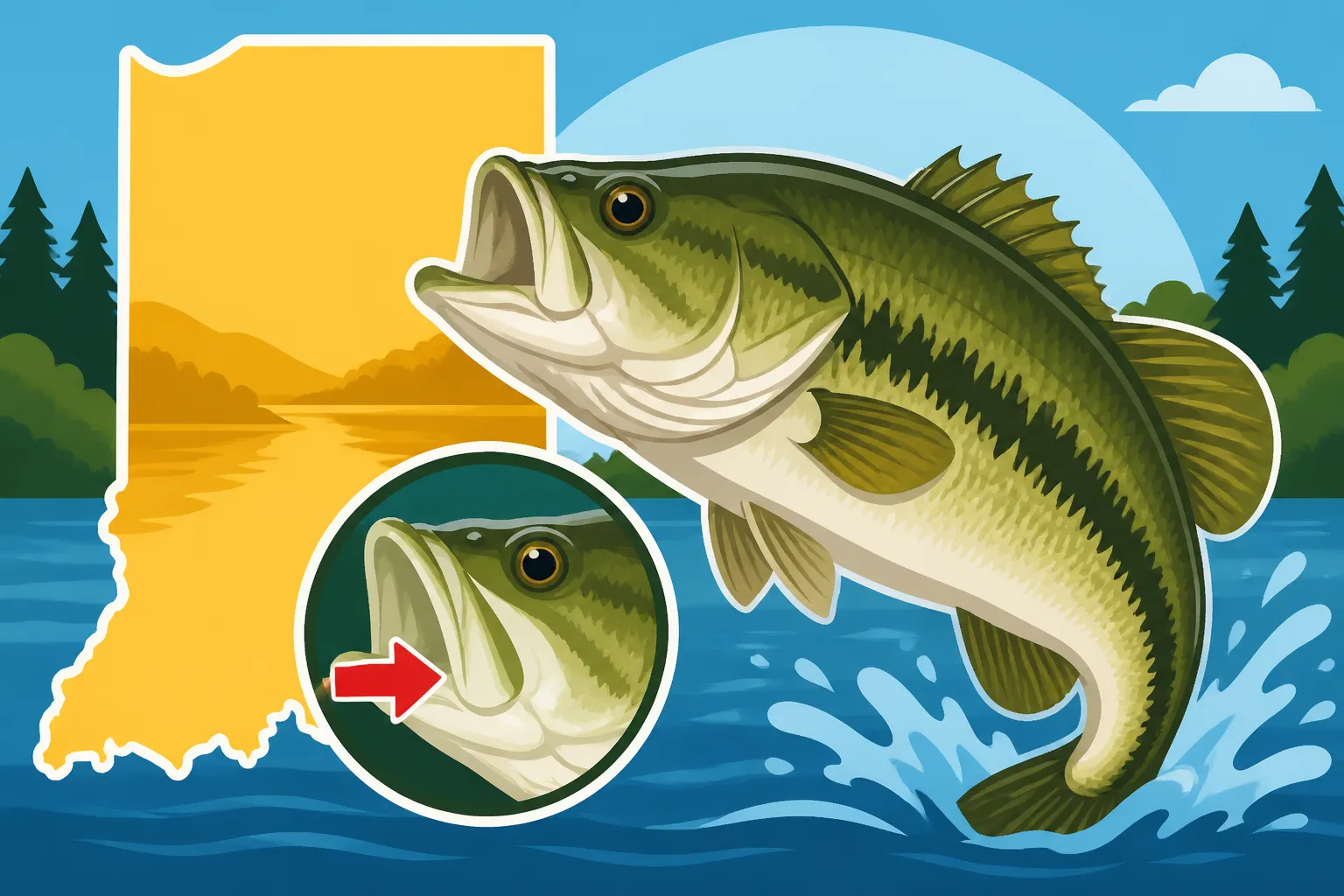
The absolute key to identifying a largemouth bass lies in its upper jaw, specifically how far back it extends. Gently close the fish's mouth and observe the end of the upper jaw (maxilla). If it extends noticeably past the rear margin of the eye, congratulations, you've almost certainly got a largemouth bass. This is the feature that gives the largemouth its name and makes it relatively easy to distinguish from its smaller-mouthed relatives. It's a critical difference that even a novice angler can spot with confidence.
Imagine holding a credit card or a ruler parallel to the fish's head. If the corner of the jaw goes beyond the imaginary line dropping straight down from the back of the eye, that's your sign. This is particularly useful when comparing it to a smallmouth bass, whose jaw typically stops short of, or only just reaches, the back of the eye. Getting this visual down will serve you well on the water and help you correctly identify your catch.
The Mouth and Tongue Patches
While the jaw extension is the primary giveaway, a quick peek inside the mouth can offer further confirmation. Run your finger (carefully!) over the tongue of the bass. A largemouth bass typically lacks a patch of teeth on its tongue. Its tongue is generally smooth. This is a subtle difference, but one that more experienced anglers often use as an additional check, especially if they're still learning the nuances of bass identification or dealing with a fish that's a bit harder to differentiate.
When you open that jaw wide – and you'll see just how wide it can go – you'll notice why they're such ambush predators. That massive maw allows them to gulp down surprisingly large prey, from big shiners to frogs and even small ducks! When considering gear for these hungry fish, a robust tackle box with plenty of space for larger lures, which you can find on Amazon, is always a good idea. This impressive feeding strategy is why they're such a blast to catch.
Fin Details: What to Look For
The fins of a largemouth bass, like all fish, play a vital role in their movement and stability in the water. But they also hold subtle clues that can aid in identification, particularly when observing the dorsal fin. These aren't as striking as the jaw test, but they are consistently present.
Dorsal Fin Separation
The dorsal fin is the prominent fin on the fish's back. For a largemouth bass, you'll notice that the dorsal fin is distinctly separated into two parts: a spiny front section and a soft-rayed rear section. While these two sections are connected, there's a deep notch, almost a complete separation, between them. If you gently run your finger along the top of the fin, you'll clearly feel where the spiny rays end and the soft rays begin. This deep "notch" is a characteristic feature of largemouth bass.
In contrast, other bass species, like the smallmouth, often have a more continuous dorsal fin with a much shallower notch, or sometimes no discernible notch at all. This might sound like a small detail, but it's consistent across the species and serves as another reliable identifier. Observing this feature takes a bit more attention than the jaw but becomes second nature with practice.
Caudal Tail and Pectoral Fins
The caudal fin, or tail fin, of a largemouth bass is typically broad and slightly forked, with rounded tips. The coloration often matches the body, with darker greens fading to lighter edges. It's a powerful fin that propels the bass through water, allowing for those explosive strikes and sudden changes in direction. The pectoral fins, located just behind the gill plates, are generally somewhat rounded and clear or slightly colored.
While these fins are less unique than the dorsal fin separation or the jaw extension, they contribute to the overall profile of the largemouth. You won't typically use the pectoral or caudal fins for primary identification, but they complete the picture. Understanding these anatomical details enhances your overall knowledge of the species. For tips on maximizing your catch rates, exploring different Best Bass Fishing Techniques for Pre-Spawn might reveal new insights into how these fish use their powerful fins to ambush prey.
Distinguishing Largemouth from Its Cousins
Indiana waters are not exclusively home to largemouth bass. Their close relatives, the smallmouth bass and spotted bass, also reside in various parts of the state. It's easy to confuse them, especially if you're new to fishing or are used to only one type of habitat. Learning the differences is key to proper identification and following bag limits, as some species might have different regulations.
Largemouth Bass vs Smallmouth Bass
This is the most common point of confusion for many anglers. Both are fantastic sport fish, but they look quite different once you know what to look for.
| Feature | Largemouth Bass | Smallmouth Bass | Spotted Bass |
|---|---|---|---|
| Upper Jaw | Extends past the rear margin of the eye | Rarely extends past the rear margin of the eye | Extends to or slightly past the rear margin of the eye |
| Lateral Line | Dark, often broken, horizontal stripe | Vertical bars or tiger stripes | Dark spots in rows below the lateral line |
| Body Shape | More elongated, somewhat cylindrical | More compact, football-shaped | Similar to largemouth but usually stockier |
| Dorsal Fin | Deep notch, almost separated into two sections | Shallow notch, appearing more continuous | Deep notch, similar to largemouth |
| Eye Color | Typically yellowish or golden | Often reddish or brownish | Typically yellowish or golden |
| Tongue Patch | Usually absent (smooth tongue) | Usually absent (smooth tongue) | Usually present (rough patch of teeth) |
| Cheek Scales | Scales on cheek roughly same size as body scales | Scales on cheek roughly same size as body scales | Smaller scales below the eye on the cheek |
The primary difference, as we covered, is the jaw extension. If you're on a northern Indiana lake, you might encounter both species in the same day, especially around areas with varied structure. Smallmouth bass typically prefer cooler, clearer waters with rocky bottoms, whereas largemouth gravitate toward warmer, weedier environments. Understanding Largemouth Bass vs Smallmouth Bass: Key Differences will really solidify your ID skills. When preparing for a trip targeting specific species, make sure you have the right lures. Many effective bass lures are readily available on Amazon, from crankbaits to soft plastics.
Largemouth Bass vs Spotted Bass (The Lesser-Known Rival)
While less common than smallmouth in many Indiana waters, spotted bass are indeed present, particularly in some southern reservoirs and rivers. They can be tricky because they share some characteristics with both largemouth and smallmouth. The jaw test is still paramount here. A spotted bass's jaw will typically extend to or only slightly past the rear margin of the eye, often falling into a gray area between the largemouth and smallmouth.
However, the most reliable differentiator for a spotted bass is often its namesake: the distinct rows of dark spots along its lower flanks, below the lateral line. These spots are usually very clear and appear in distinct rows, unlike the more blotchy or uniform pattern of a largemouth. Also, if you run your finger over the tongue, a spotted bass will almost always have a small, rough patch of teeth on its tongue, which is absent in a largemouth. This tongue patch is a definitive ID marker for spotted bass. Finally, check the scales on the cheek area; spotted bass tend to have smaller scales below the eye on the cheek compared to the body scales, whereas largemouth have uniform scales in that region. If you're in an area where spotted bass are known to roam, these subtle differences become crucial.
Habitat Clues: Where Largemouth Like to Hang Out
Beyond the physical characteristics, understanding the preferred habitat of a largemouth bass can offer strong clues to their identity even before you reel them in. Fish often behave and reside in specific environments that cater to their survival needs, and largemouth are no exception. Knowing where to find them is half the battle in identification and certainly in catching them!
Preferred Cover and Structure
Largemouth bass are ambush predators, and they absolutely adore cover and structure. They love to hide and wait for unsuspecting prey to swim by. This means you'll typically find them around:
- Weed Beds: Thick mats of lily pads, submerged hydrilla, coontail, and milfoil are classic largemouth haunts. They provide shade, cover from predators, and a rich feeding ground for baitfish.
- Laydowns and Brush Piles: Fallen trees, submerged logs, and artificial brush piles are magnets for largemouth. These offer both cover and a place to ambush.
- Docks and Piers: The shaded areas and pilings under docks provide excellent cover.
- Rock Piles and Boulders: While smallmouth are famous for rocks, largemouth will use them too, especially if there's adjacent vegetation or deeper water.
- Stumps and Timber: Remnants of flooded forests in reservoirs are prime targets.
If you're fishing a weedy, shallow cove with plenty of woody debris, the odds are much higher that the bass you catch will be a largemouth. This knowledge helps you mentally prepare for what you might encounter. Exploring different Best Fishing Spots in Indiana will show you just how varied the habitats for largemouth can be across the state.
Water Types and Clarity
Largemouth bass thrive in a wide range of water conditions, but they generally prefer warmer, less turbulent water than their smallmouth cousins. You'll find them abundantly in:
- Lakes and Ponds: These are the quintessential largemouth bass habitats in Indiana, from small farm ponds to massive reservoirs like Monroe Lake and Patoka Lake. They often prefer the shallower, warmer coves and bays with plenty of vegetation.
- Slow-Moving Rivers and Backwaters: While not as common in swift currents, largemouth will inhabit the calmer sections of rivers, oxbows, and backwater areas where the flow is minimal, and vegetation can establish itself.
- Murkier Water: Largemouth bass are quite tolerant of less-than-crystal-clear water. Their lateral line system and keen sense of vibration allow them to hunt effectively even in stained or slightly murky conditions.
If you're casting into a clear, fast-flowing river with a rocky bottom, you might be more likely to encounter a smallmouth. Conversely, a quiet, somewhat murky pond choked with weeds is practically a largemouth guaranteed zone. Many anglers prefer fishing for largemouth in their characteristic habitats because the strikes are often so explosive. Remember, having a reliable tackle management system, like some of the excellent storage options available on Amazon, can keep your lures organized for different species and fishing conditions. Knowing the typical haunts of these fish is just one more tool in your angler's toolbox for successful fishing and accurate identification.
Disclaimer
This article is for general informational purposes only and does not constitute professional advice. Laws, prices and regulations vary by location and change over time. Consult a qualified professional for guidance on your specific situation.