Best Crappie Jig Colors for Cloudy Water
It’s a scenario every crappie angler in Indiana has faced: you wake up excited for a day on the water, only to find that overnight rain or recent agricultural runoff has turned your favorite crappie haven into a murky, stained mess. You stand there, tackle box open, wondering which tiny jig color could possibly cut through that soupy water and entice a bite. It’s frustrating, feeling like your usual go-to colors are suddenly invisible. But don't throw in the towel! This comprehensive guide is dedicated to helping you understand the best crappie jig colors for cloudy water in Indiana, so you can adapt your approach and keep reeling in those papermouths even when conditions are tough.
Understanding Cloudy Water Conditions and Their Impact
Before we even talk about colors, it's essential to grasp what "cloudy water" actually means and why it impacts crappie fishing so profoundly. Water clarity isn't just a suggestion; it fundamentally changes how fish see, hunt, and react to your presentation. Overlooking this crucial environmental factor is a common mistake that can lead to an empty livewell.
What Makes Water Cloudy?
Cloudy water, often called murky, stained, or turbid water, isn't always the same. The specific cause of the cloudiness can influence its color and density, which in turn affects how light behaves and which jig colors might perform best.
- Rain and Runoff: One of the most common culprits, especially here in Indiana, is heavy rainfall. When rain washes over agricultural fields, construction sites, or even urban areas, it carries sediment, silt, clay, and organic debris into lakes and rivers. This can turn crystal-clear water a dull brown or tan, making visibility extremely low. Imagine trying to see a small object in a cup of muddy coffee – that's what your jig might look like to a crappie.
- Algae Blooms: In warmer months, especially in nutrient-rich Indiana lakes like Lake Monroe or Patoka Lake, algae can proliferate rapidly. These microscopic plants can tint the water green, sometimes a light pea-soup shade, other times a dense, almost neon green. While different from muddy water, algae-stained water still significantly reduces visibility and light penetration.
- Suspended Sediment from Wind and Waves: Even without rain, strong winds can stir up the bottom of shallower lakes, suspending sediment and making the water cloudy. This is particularly common in areas with soft, mucky bottoms. Similarly, heavy boat traffic can churn up shallower areas, reducing clarity.
- Tannins: Some water bodies, especially those surrounded by wetlands or dense foliage, might have a tea-stained appearance due to tannins released from decaying leaves and wood. This water often has a slightly amber or brownish tint but can still be quite clear if you look closely. It's different from muddy water because light can still penetrate, but the overall color is darker.
How Light Penetration Changes
The core issue with cloudy water is reduced light penetration. Different colors of light penetrate water to varying depths. In clear water, reds disappear first, followed by oranges, yellows, greens, and finally blues and violets, which penetrate the deepest. However, in cloudy or murky water, this absorption and scattering effect is dramatically amplified.
When the water is heavily stained, most of the light is absorbed or reflected by the suspended particles very near the surface. This means that at even shallow depths, the underwater world becomes a very dim, monochromatic place for crappie. Colors that might "pop" in clear water can become completely invisible in murky conditions. Instead of seeing vibrant hues, crappie are mostly detecting silhouettes and changes in light intensity. This is why a simple jig color change can be the difference between a frustrating day and a successful outing. You’re trying to make your offering stand out in a drastically altered visual environment.
The Science of Crappie Vision and Color Perception
Understanding how crappie see is key to picking the right jig color in cloudy water. We often project our human vision onto fish, assuming they see colors and shapes exactly as we do. But fish vision is quite different, especially for species like crappie that often inhabit a variety of water clarities and light conditions.
Crappie Eye Structure and Light Absorption
Crappie, both black and white, are visually oriented predators, meaning they primarily use their eyesight to locate food. Their eyes are well-adapted for low-light conditions, which is why they often feed actively during dawn, dusk, and even at night, or in deep, shady areas during the day. Their retinas contain both rods and cones, allowing them to detect both light intensity (rods) and color (cones).
However, in cloudy water, the light entering their eyes is significantly reduced and altered. The suspended particles in the water scatter and absorb certain wavelengths of light. This means that the full spectrum of colors simply isn't present for the crappie to perceive. For example, if red light doesn't penetrate beyond the first few feet of muddy water, a red jig will appear as a dark blob, if it's seen at all. Crappie might still be able to distinguish between some colors at very close range or in very specific light conditions, but their primary focus shifts to detecting movement, vibration, and contrast against the minimal available light. It's a fundamental difference from what we experience above the surface.
Why Contrast Matters Most
In cloudy water, the concept of contrast becomes far more critical than the exact hue of your jig. Think of it this way: if you're trying to read a newspaper in a dimly lit room, you're not focusing on the intricate colors of the pictures; you're trying to distinguish the dark letters from the lighter paper. Crappie do something similar.
Instead of seeing "chartreuse" or "pink," they are likely seeing a shape that is either significantly lighter or significantly darker than the surrounding water. This creates a silhouette effect. A jig that stands out in contrast, either by being much brighter than the dark water or much darker than a slightly lighter, stained water, is more likely to be detected.
This is why many effective "cloudy water" jig colors are either incredibly bright or incredibly dark. They create a strong visual footprint. Furthermore, the size and profile of the jig play into this. A larger, bulkier jig will create a more noticeable silhouette than a tiny, slender one. It’s all about creating an obvious visual target in an environment where everything else is muted and hard to discern.
Top Crappie Jig Colors for Overcast Days and Murky Water
When the water turns cloudy, your approach to jig color needs to shift from trying to mimic baitfish to creating a visual disturbance the crappie can't ignore. It's about maximizing visibility and triggering a reaction strike, rather than a subtle, curious bite. You'll find a wide selection of these effective jigs on popular online marketplaces like Amazon, often bundled in multi-color packs perfect for experimenting.
Bright and Bold Choices
When light penetration is poor, you want colors that scream "look at me!" These are often fluorescent or highly pigmented colors that absorb UV light and re-emit it, making them appear brighter to fish, even in dim conditions.
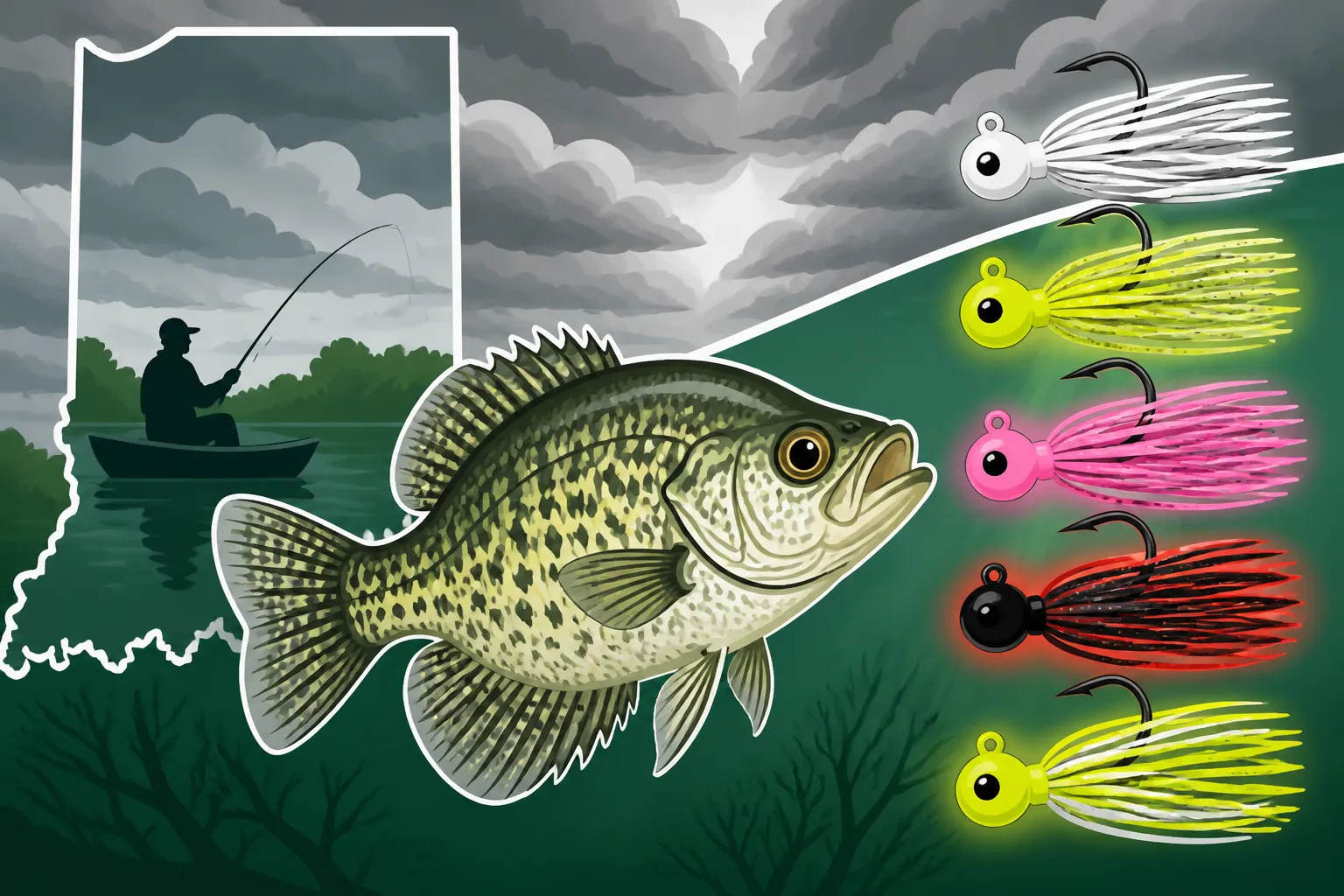
- Chartreuse: This is arguably the most famous and consistently productive color for cloudy water crappie fishing. Its vibrant yellow-green hue is highly visible in stained water, often appearing to glow even when light levels are low. Many anglers consider a chartreuse jig, especially those with a black back or tail, an absolute must-have for Indiana's murky waters. I've personally had countless days fishing local ponds or the White River after a rain, where a plain chartreuse jig was the only thing that got a bite.
- Orange: A fiery, high-contrast color that can be surprisingly effective. Orange offers a strong visual presence and provides a stark contrast against a muddy or greenish background. It's often overlooked but can be a game-changer when other bright colors aren't producing. Consider a jig with an orange head and a contrasting body.
- Pink: From neon pink to hot pink, this color family offers excellent visibility in many stained water situations. It’s a bold, attention-grabbing color that fish seem to notice quickly. Pink is particularly effective when crappie are feeling aggressive or when you're trying to entice a reaction strike from suspended fish.
- Neon Green: Similar to chartreuse but with a stronger green tint, neon green also leverages fluorescence to stand out. It can be a great alternative if crappie are shying away from chartreuse, offering a slightly different wavelength while still maintaining high visibility. Combining neon green with chartreuse or orange in a two-tone jig can sometimes be particularly deadly. You can often find great multi-color packs of jigs featuring these bright hues on Amazon, which makes stocking up easy.
Dark and Opaque Silhouettes
While bright colors aim to be seen through the murk, dark colors work by creating a strong, unmistakable silhouette against the minimal light that does penetrate the water. This is about making your jig look like a substantial, edible morsel without relying on its true color.
- Black: In truly muddy or heavily stained conditions, a black jig can be incredibly effective. Instead of trying to be bright, black absorbs all light, creating a strong, solid outline that crappie can easily detect. When a crappie looks up from below, a black jig appears as a clear, dark shape moving against the lighter surface, making it an easy target. It's a fantastic choice when the water is so dark that other colors simply vanish. I've cleaned up on crappie in farm ponds near Lafayette with a simple black jig on days when the water looked like chocolate milk.
- Dark Blue: Similar to black, dark blue jigs provide excellent contrast in cloudy water. They create a solid silhouette but can sometimes offer a subtle "glow" or presence that differentiates them from pure black. This can be especially effective in slightly less murky conditions where a hint of color might still be perceived.
- Purple: Deep purple jigs offer a fantastic compromise between the high visibility of bright colors and the strong silhouette of dark ones. Purple often maintains good visibility in stained water, offering a distinct profile that crappie can key in on. It's a versatile color that can work in a range of cloudy conditions, from slightly turbid to quite dark.
Glow-in-the-Dark and UV Reactive Jigs
These specialized jigs take advantage of properties beyond simple color to grab a crappie's attention when visibility is at its absolute worst.
- Glow-in-the-Dark Jigs: As the name suggests, these jigs literally emit light after being "charged" by a light source (like a flashlight or camera flash). While the glow might not last forever, that initial burst of luminescence can be absolutely irresistible to crappie in very dark or deeply stained water. They are particularly effective for night fishing or in extremely deep, dark holes, offering a clear target that can be seen from a distance.
- UV Reactive Jigs: Many of the "bright" colors we discussed (chartreuse, pink, neon green) are also UV reactive, meaning they reflect ultraviolet light. UV light penetrates water better than visible light, especially in stained conditions. A jig that glows or reflects UV light essentially becomes more visible to fish that can perceive UV wavelengths, even if it looks dull to the human eye. Look for jigs specifically advertised as "UV enhanced" or "UV bright." These can be easily found and ordered in bulk on platforms like Amazon from brands like Crappie Magnet or Bobby Garland, which often specialize in these effective designs.
Here's a quick reference table to help you choose:
| Water Clarity | Recommended Jig Colors | Why They Work |
|---|---|---|
| Lightly Stained | Chartreuse, Neon Green, Orange, Pink, White | Good light penetration still allows bright colors to pop; good contrast. |
| Murky/Turbid | Chartreuse, Orange, Hot Pink, Dark Blue, Purple, Black | High visibility colors for contrast, or dark colors for strong silhouette. |
| Muddy/Chocolate | Black, Dark Blue, Glow-in-the-Dark | Maximize silhouette; direct light emission in extreme low visibility. |
| Algae-Stained | Chartreuse, White, Pink, Black/Chartreuse Combinations | Cut through green tint; offer strong contrast against greenish backdrop. |
Tips for Success Beyond Jig Color
While choosing the right crappie jig color for cloudy water is crucial, it's only one piece of the puzzle. Crappie fishing, especially when conditions are challenging, requires a holistic approach. You can have the perfect color, but if your presentation or location is off, you'll still struggle. Mastering a few additional techniques can dramatically increase your catch rate.
Jig Size and Profile
In cloudy water, visibility is low, meaning crappie have less time to react to your lure. This is where a slightly larger or bulkier jig profile can make a huge difference. A bigger jig creates a more substantial silhouette, making it easier for crappie to spot from a distance.
Instead of your usual 1/32 or 1/48 ounce micro-jigs, consider bumping up to a 1/16 or even 1/8 ounce jig head, paired with a slightly larger soft plastic body. Think about soft plastic profiles that displace more water, such as those with larger paddle tails, curly tails, or ribbed bodies. These designs not only create a bigger visual target but also generate more vibration, appealing to the crappie's lateral line system. Sometimes, a "chunkier" presentation is simply more noticeable, giving the crappie a better chance to find and strike it before it passes by. Don't be afraid to experiment with different sizes and shapes from your tackle box, or check out the variety of jig bodies available for purchase on Amazon.
Adding Scent and Vibration
When crappie can't see your jig well, their other senses become paramount. This is where scent and vibration come into play, turning your jig into a multi-sensory attraction.
- Scent: Crappie have a keen sense of smell, and adding a scent enhancer can be a game-changer in murky water. Many anglers swear by commercially available crappie scents that mimic baitfish, garlic, or other appealing smells. Apply a dab of scent to your jig before each cast or every few casts. You can also use soft plastics that are pre-impregnated with scent. The idea is to create an olfactory trail that leads the crappie to your jig, even if they can't quite see it. This is especially helpful if you're fishing slowly or in dense cover where visual detection is nearly impossible.
- Vibration: Crappie also detect vibrations in the water through their lateral line, a sensory organ that runs along their sides. Lures that create subtle thumps or pulses can attract crappie from a greater distance. Soft plastic bodies with curly tails, paddle tails, or even those designed with specific ribs or appendages are excellent for this. Pair these with a jig head that has some "thump" or choose jig heads that incorporate small rattles. When you're fishing a structure where crappie are holding tight, even a slight quiver from your jig can be enough to draw them out.
Slow and Steady Retrieve
In clear water, a fast, erratic retrieve might trigger aggressive strikes. But in cloudy water, crappie are often less aggressive and need more time to locate and commit to your bait. A slow, steady retrieve is usually far more effective.
The goal is to keep your jig in the strike zone for as long as possible, giving the crappie ample opportunity to find it. This means less jerking and more smooth, deliberate movements. A slow, gentle lift-and-drop, or a subtle retrieve with occasional pauses, can work wonders. If you're using a curly tail jig, retrieving it just fast enough to get the tail to undulate will create both visual appeal (silhouette) and vibration. Sometimes, simply letting the jig sit motionless for a few seconds before a very slow pull can be what it takes. Remember, crappie might be hesitant to chase in low visibility, so bringing the meal right to them is often the best strategy.
When fishing for crappie, especially during key periods like the spring spawn, understanding their behavior can make a huge difference. You might find useful information on topics like Crappie Spawn Timing on Indiana Lakes to pair with your murky water tactics.
Finding Structure in Low Visibility
Even with the perfect jig color and retrieve, you won't catch crappie if you're not fishing where they are. Cloudy water often means crappie will hold even tighter to structure than usual, seeking cover and ambush points.
- Vertical Structure: Look for standing timber, brush piles, submerged logs, bridge pilings, or dock posts. Crappie will often position themselves right up against these structures, using them as ambush points or safe zones. Fan cast around these areas, dropping your jig right next to the cover.
- Contour Changes: Underwater humps, ledges, creek channels, and drop-offs are always crappie magnets. In cloudy water, these depth changes can concentrate fish even more. Use your fish finder to locate these contours and present your jig precisely along them.
- Vegetation Edges: If there are weed lines or lily pad fields, crappie will often be found along the deep edges or in pockets within the vegetation. The vegetation itself provides cover and can attract baitfish, making it a prime feeding zone.
- Shade: Even on overcast days, shaded areas—like those under bridges, overhanging trees, or deep docks—can be crappie magnets. The low light conditions of these areas can make crappie feel more secure.
Remember, even the best crappie fishing spots in Indiana will be impacted by water clarity, so adapting your strategy is key. Techniques like How to Jig for Crappie in Spring or How to Tightline for Crappie can be adapted for cloudy water conditions, emphasizing slower presentations and focusing on these high-percentage structural elements. Don't forget to keep an eye on your Panfish Daily Limit in Indiana: 25 per Species, regardless of the water conditions! For more on the basic knowledge of your target, consider reviewing Crappie Fishing in Indiana: Black Crappie Basics. Sometimes, you might need specific gear for these conditions, so a guide like Best Tackle for Crappie Fishing in Indiana could also be helpful.
By combining the right jig colors with these strategic adjustments, you can turn those challenging cloudy water days into memorable crappie catches.
Disclaimer
Fishing regulations and conditions can change rapidly. Always consult the latest Indiana Department of Natural Resources (DNR) regulations before heading out. This guide is for informational purposes only and does not constitute legal advice. Adhere to all local, state, and federal fishing and boating laws.