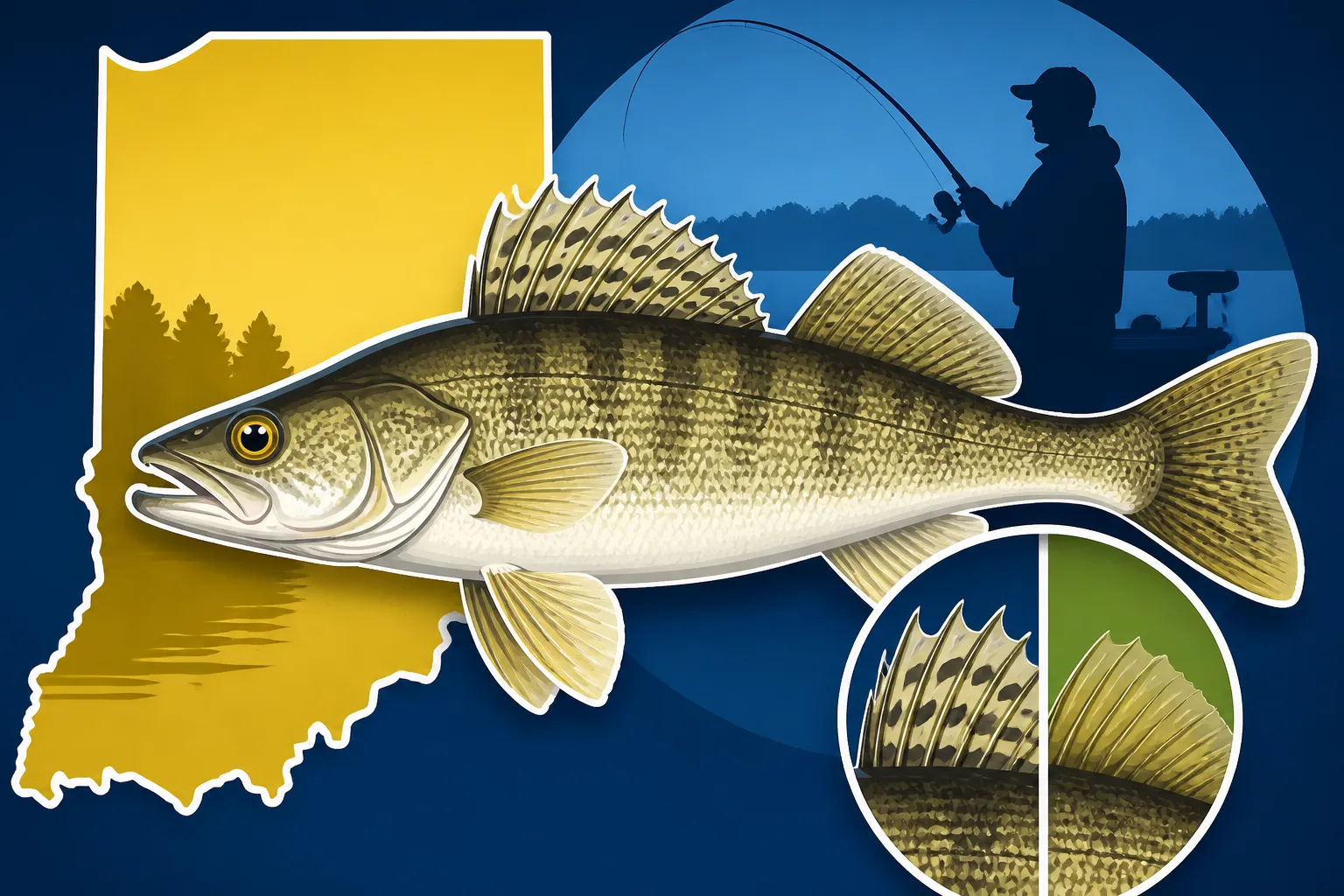
Saugeye Identification: Spotting a Walleye-Sauger Hybrid
It can be incredibly frustrating to be out on the water, pull in a beautiful fish, and then stare at it, wondering if it's a walleye, a sauger, or one of those elusive saugeye hybrids Indiana is known for. The truth is, these three species can look remarkably similar, leading to confusion that can impact not only your understanding of your catch but also whether you're complying with specific regulations. This guide is here to untangle that mystery, giving you clear, actionable ways to confidently identify a saugeye when you reel one in.
The Basics of Saugeye: What Exactly Are We Looking At?
Before we dive into the nitty-gritty of visual identification, let's get a handle on what a saugeye actually is. Think of it as nature's clever compromise, a fish specifically engineered, in a sense, to combine the best traits of its parent species. For anglers in Indiana, understanding this lineage is key to appreciating why these fish are stocked and why they can be so tricky to differentiate.
A Tale of Two Parents: Walleye and Sauger Traits
The saugeye is a hybrid, a cross between a female walleye (scientific name: Sander vitreus) and a male sauger (Sander canadensis). This intentional breeding creates a fish that often grows faster than a pure sauger and is more tolerant of turbid (cloudy) waters than a pure walleye. It's like getting a super-fish designed for Indiana's diverse waterways!
From its walleye parent, the saugeye often inherits a somewhat larger potential size and a more streamlined, torpedo-like body. Walleyes are known for their impressive growth rates, especially in good conditions, and their preference for clearer, deeper waters. On the flip side, the sauger parent contributes traits that help the saugeye thrive in less pristine environments. Sauger are typically smaller than walleye, with a more mottled, camouflaged appearance, and they are notoriously comfortable in silty, faster-moving river systems or reservoirs with fluctuating water levels. The saugeye pulls from both, resulting in a fish that's often chunky, hardy, and a fantastic fighter. You'll find a deeper dive into the pure species in our guide on Walleye Identification: Olive-Gold Color and White-Tipped Tail.
Why the Hybrid Exists: Stocking Efforts in Indiana
So, why would fisheries biologists intentionally create a hybrid fish? It all comes down to optimizing the fishing experience and ecological fit. Indiana has numerous reservoirs and rivers that might not be ideal for pure walleye due to higher turbidity or warmer average temperatures, yet they're too clear or deep for sauger to truly dominate. Enter the saugeye.
These hybrids thrive in these "in-between" waters, offering anglers a fantastic sport fish that can withstand a wider range of environmental conditions. They grow quickly, reach respectable sizes, and provide excellent table fare. The Indiana Department of Natural Resources (IDNR) regularly stocks saugeye in various lakes and reservoirs across the state, ensuring that these hard-fighting fish are available for anglers. This stocking program is why it's so important to be able to tell them apart, especially if you're fishing in a lake known for both walleye and saugeye populations. Knowing Where Does Indiana Stock Saugeye? can give you a clue on what to expect in your local waters.
Key Visual Cues for Saugeye Identification
Alright, let's get to the fun part: actually looking at the fish. When you pull one of these beauties out of the water, there are a few tell-tale signs that can help you definitively say, "Aha! That's a saugeye!" It's all about paying close attention to the details, especially on the fins and body.
Dorsal Fin Differences: The Most Reliable Indicator
This is, hands down, the easiest and most reliable way to distinguish a saugeye from its parent species. All three fish—walleye, sauger, and saugeye—have two dorsal fins. It's the spiny dorsal fin (the front one) that holds the crucial clues.
- Walleye: A pure walleye will have a distinct, often dark, blotch at the base of the spiny dorsal fin. Think of it as a thumbprint at the very back of that fin. The rest of the fin is typically clear or somewhat opaque, but that dark spot is the giveaway.
- Sauger: Sauger, on the other hand, boast several clear, distinct spots or bars running across the entire spiny dorsal fin. These spots are usually arranged in neat rows, giving the fin a speckled or banded appearance. There's no single dark blotch at the base; it's a pattern all over.
- Saugeye: This is where the hybrid nature shines through. A saugeye will typically have both the distinct dark blotch at the base of the spiny dorsal fin (like a walleye) and some of the clear spots or bars spread across the fin (like a sauger). It's a combination platter! You might see a prominent dark blotch and some faint, scattered spots higher up on the fin. This "best of both worlds" fin pattern is the strongest visual cue you have. Sometimes, the spots might be less defined than a pure sauger, but the presence of both the basal blotch and some form of spotting is key.
If you can get a good look at that front dorsal fin, your identification challenge is usually over. This critical detail is often the first thing experienced anglers check, and for good reason—it rarely lies.
Body Shape and Coloration: A Blending of Genes
While the dorsal fin is the primary indicator, the overall body shape and coloration can offer supporting evidence, though these can be a bit more variable depending on the fish's specific environment and diet.
- Body Shape: Saugeye tend to have a body shape that's intermediate between a walleye and a sauger. Walleye are generally more elongated and streamlined, often with a more golden-olive hue. Sauger are typically a bit stockier, with a more pronounced arch to their backs and a more irregular, mottled pattern. A saugeye often strikes a balance, being robust and muscular but perhaps not as sleek as a true walleye, and often larger than a sauger.
- Coloration and Markings: Saugeye often exhibit a blended coloration. They usually have the darker, mottled, and sometimes banded appearance of a sauger, which provides excellent camouflage in murkier waters. However, they might also carry some of the golden or olive tones characteristic of a walleye, especially on their flanks. You might notice distinct, tiger-like bars or blotches along their sides, which are more prominent than on a typical walleye but perhaps not as starkly contrasted as on some sauger. Think of it as a soft, earthy camouflage pattern rather than a uniform color. This combination makes them look incredibly striking and unique. When you're comparing your catch, remember that a walleye's pattern is usually more subtle and uniform, as described in What Does a Saugeye Look Like Compared to a Walleye?.
Cheek Scales: Another Subtle Clue
For the really keen-eyed angler, or if the dorsal fin isn't perfectly clear (maybe the fish is thrashing, or the light is bad), you can examine the scales on the cheek plate, behind the eye. This is a much more subtle difference, but it can help confirm your initial hunch.
- Walleye: Generally, walleyes have smooth cheeks, meaning they are mostly scaleless or have very fine, sparsely distributed scales.
- Sauger: Sauger, on the other hand, typically have fully scaled cheeks, with rougher, more noticeable scales.
- Saugeye: As you might expect, saugeye often fall somewhere in the middle. Their cheeks might be partially scaled, meaning you'll see some patches of scales, or they might have scales that are finer and less dense than a pure sauger but more present than on a walleye. It's not always a definitive marker, but it's another piece of the puzzle. This detail requires a very close look, so it's probably not your first choice for identification on a squirming fish!
Practical Tips for Identifying Saugeye on the Water
Even with all the knowledge in the world, identifying a fish quickly and accurately in a real-world fishing scenario can be tough. The fish is flopping, you're excited, and maybe the light isn't perfect. Here are some practical tips to help you make that call right at the water's edge.
Learning to Look: Training Your Eye for Detail
The best way to get good at identifying saugeye is practice. The more you see them, and see walleye and sauger too, the more intuitive the differences become.
- Visual Aids: Consider carrying a waterproof fish identification card or a printed guide with clear illustrations or photos. You can often find excellent, compact guides on Amazon that fit right into your tackle box or pocket. Having a quick reference can be invaluable when you're uncertain.
- Photo Reference: When you're out fishing, don't just rely on your memory. Take a quick, clear photo of any questionable catch, especially focusing on that spiny dorsal fin and the overall body pattern. This allows you to review the details later, compare it to reliable sources, or even share it with experienced anglers for a second opinion. A good quality camera on your phone is usually more than sufficient for this.
- Handle with Care: Remember that if you're not sure about the identification, you might be planning to release the fish. Handle it gently, minimize its time out of water, and get those identification shots quickly. A proper fish gripper can help keep the fish still for a moment while you examine it.
When in Doubt: The "It's Probably a Saugeye" Rule
In many of Indiana's saugeye-stocked waters, if you catch a fish that looks like a walleye but has some sauger-like characteristics, there's a good chance it's a saugeye. This isn't a hard-and-fast rule, but rather a statistical likelihood in reservoirs where saugeye are actively stocked. Pure walleye can sometimes be present, as can naturalized sauger in river systems that feed into reservoirs, but the hybrid is often the dominant species in those stocked environments.
However, don't let this be your only guide. Always try to confirm with the dorsal fin markings. The "when in doubt" rule is more for managing expectations and mental preparedness. If you're fishing a body of water specifically mentioned in guides like Reservoirs Known for Trophy Saugeye, you should certainly expect to encounter the hybrid.
Documenting Your Catch for Further Confirmation
Beyond just identifying for your own knowledge or for immediate release/keep decisions, documenting your catch can be helpful for various reasons:
- Community Learning: Share your photos with local fishing groups or online forums. Fellow Indiana anglers are often passionate and happy to help with identification, and it's a great way to learn from collective experience. Just be prepared for a lively debate sometimes!
- Conservation Data: While you don't typically need to report individual catches, understanding what's being caught in specific waters can be valuable for fisheries management. The more anglers can accurately identify species, the better collective data there is about fish populations.
- Personal Records: Keeping a fishing log, either physical or digital, of your catches (species, size, location, bait) can help you learn patterns over time. This data is incredibly useful for improving your future fishing success. You can even find specialized fishing logbooks on Amazon to keep track of your adventures.
Saugeye vs. Walleye vs. Sauger: A Comparison Table
To really nail down the differences, let's put it all side-by-side. This table summarizes the key identification markers we've discussed, making it easy to see the distinctions at a glance.
| Feature | Walleye | Sauger | Saugeye (Hybrid) |
|---|---|---|---|
| Spiny Dorsal Fin | Single distinct dark blotch at the base. | Several distinct rows of spots/bars, no basal blotch. | Combines both: dark basal blotch + some spots/bars. |
| Body Color/Pattern | More uniform golden-olive, less mottled. | More mottled, irregular dark blotches/bars. | Intermediate: often mottled with some walleye tones, pronounced bars. |
| Cheek Scales | Generally smooth, mostly scaleless or very fine scales. | Fully scaled, rougher texture. | Partially scaled, intermediate density. |
| Caudal Fin (Tail) | Often a white tip on the lower lobe. | No white tip on tail. | Typically a white tip on the lower lobe, like a walleye. |
| Size Potential | Larger, can reach significant sizes (up to 25+ inches). | Smaller, typically 12-18 inches. | Intermediate, often larger than sauger, can exceed 20 inches. |
| Habitat Preference | Clearer, deeper lakes and large rivers. | Turbid rivers, deeper pools, slower currents. | Tolerant of wide range, often stocked in turbid reservoirs. |
Remember, while this table is a fantastic reference, the dorsal fin is usually your fastest and most reliable key. Don't stress if you can't see every single detail on a lively fish; focus on the most prominent markers. For a complete understanding of walleye characteristics, refer to our comprehensive guide, Indiana Walleye Fishing: A Complete Guide.
The Importance of Correct Identification for Anglers
You might be thinking, "Who cares if I call it a walleye or a saugeye? It's just fishing!" But in Indiana, knowing the difference isn't just about bragging rights or scientific accuracy; it has real-world implications that can affect your fishing trip, your legal standing, and even the health of the fisheries.
Understanding Bag Limits and Regulations
This is probably the most crucial reason for accurate identification. Indiana's fishing regulations are designed to protect fish populations and ensure sustainable angling for everyone. Often, different species have different minimum length limits and daily bag limits.
For example, a specific lake might have a 16-inch minimum length limit for walleye, but a different limit for saugeye, or perhaps no length limit at all for sauger. If you misidentify a saugeye as a walleye and keep it, you might be in violation of regulations, leading to potential fines or other penalties. The reverse is also true – you might release a legal saugeye thinking it's an undersized walleye. This is why resources like Walleye Minimum Length North of State Road 26 are so important to review before you head out. Always check the current Indiana Fishing Guide for the specific body of water you're fishing, as rules can vary not just by species, but also by lake, river, or even sections of a river.
Beyond simply avoiding a citation, respecting these regulations is part of being a responsible angler. They exist for a reason: to maintain healthy fish populations for future generations of Hoosier anglers. Getting good at identifying your catch means you're playing your part.
Contributing to Conservation Efforts
When you, as an angler, can accurately identify the fish you catch, you're indirectly contributing to broader conservation efforts. Fisheries biologists rely on data, both from surveys and sometimes from angler reports, to understand how fish populations are doing. If everyone is misidentifying saugeye as walleye, it can skew the data and make it harder for the IDNR to make informed decisions about stocking, harvest limits, and habitat management.
For example, if saugeye are thriving in a particular reservoir but are constantly being counted as walleye, it might lead to incorrect assumptions about the walleye population's health in that specific water body. By being precise in your identification, you're providing more accurate "ground truth" observations, which can collectively paint a clearer picture of Indiana's diverse aquatic ecosystems. It's a small but significant way for every angler to give back to the sport they love.
Ultimately, whether you're chasing the thrill of a big fight or looking forward to some delicious fish for dinner (Is Saugeye Good Table Fare?), knowing exactly what you've caught adds a layer of satisfaction and responsibility to your fishing experience. With a little practice and attention to those key details, you'll be confidently spotting those walleye-sauger hybrids in no time!
Disclaimer
This article is for general informational purposes only and does not constitute professional advice. Laws, prices and regulations vary by location and change over time. Consult a qualified professional for guidance on your specific situation.