Indiana Fishing License Reciprocity With Ohio
Navigating the myriad of state fishing regulations can often feel like trying to untangle a fishing line after a particularly enthusiastic cast, especially when you plan to wet a line near a state border. For anglers eyeing the waters that flow between Indiana and Ohio, understanding fishing license reciprocity isn't just helpful; it's essential to avoid a costly misunderstanding. This comprehensive guide will cast a clear light on how Indiana and Ohio treat each other's fishing licenses, focusing on shared waters and what you need to know before your next outing.
Understanding Fishing License Reciprocity Between States
Fishing license reciprocity is a concept that often causes confusion, and for good reason. It's not always a simple "yes" or "no" answer, especially when rivers or lakes form state boundaries. Each state has its own set of rules, and these agreements can vary significantly depending on the specific body of water.
What Exactly is Reciprocity?
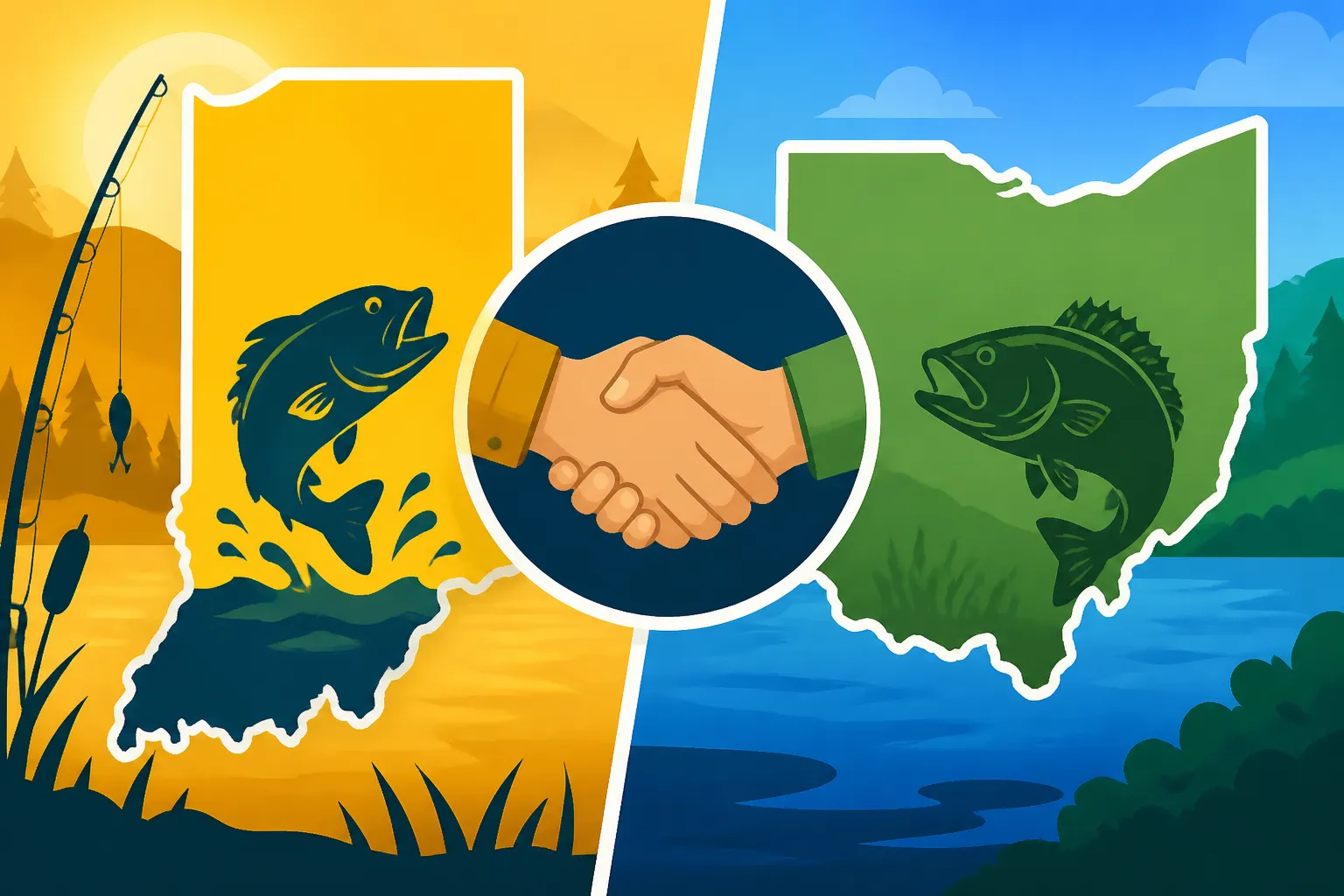
At its core, fishing license reciprocity means that under certain conditions, a fishing license issued by one state might be recognized as valid in another state. Think of it as a handshake agreement between two states, allowing anglers to fish shared waters without needing to purchase two separate licenses. However, these agreements are rarely universal. They are typically established for specific boundary waters, like major rivers or lakes that physically divide states, and they often come with their own set of caveats, such as where you can launch your boat or which bank you're fishing from. It’s never safe to assume that because you have an Indiana fishing license, you can automatically fish in any Ohio water, and vice-versa.
Why States Implement Reciprocity Agreements
States implement reciprocity agreements primarily to simplify fishing for residents and visitors on shared waterways and to promote recreational angling. Imagine living on one side of a river that forms a state border. Without reciprocity, you’d have to buy two licenses just to fish both banks or the middle of the river. This would be a significant deterrent for many, potentially hurting local tourism and discouraging anglers. These agreements acknowledge the shared natural resource and try to make it as accessible as possible, while still maintaining each state's regulatory authority over their part of the resource. It’s a delicate balance designed to foster good neighbor relations and, frankly, make life a little easier for those of us who just want to fish.
The Dangers of Assuming Reciprocity
The biggest danger, by far, is assuming that a license from your home state is valid everywhere. This is a common pitfall that can lead to frustrating and expensive encounters with conservation officers. Without a clear understanding of the rules, you could unknowingly be fishing illegally, even if you’ve been fishing for years. The penalties for fishing without a license can range from hefty fines to the confiscation of your gear, and in some cases, even a permanent mark on your fishing record. This is why it’s always crucial to do your homework. A quick search online, or even checking an updated fishing guide you might find on Amazon, can save you a lot of grief. Don't risk a ruined day or a significant fine; understanding the specifics is paramount. You can read more about the serious implications in our guide on the Penalties and Fines for Fishing Without a License.
Indiana's Stance on Ohio Licenses
When it comes to Ohio fishing licenses, Indiana generally operates under a very specific set of rules, largely centered around the mighty Ohio River. Outside of this particular waterway, anglers will find that their Ohio fishing license holds no weight in Indiana waters.
General Rule: No Full Reciprocity
For the vast majority of Indiana's lakes, rivers, and streams, an Ohio fishing license is simply not valid. If you're an Ohio resident planning to fish inland waters like Monroe Lake or the Tippecanoe River, you will absolutely need to purchase an Indiana Nonresident Fishing License Guide. This is a common practice among states that don't share extensive border waterways. Indiana maintains its own distinct fisheries management programs, stocking efforts, and revenue generation through license sales, which fund these crucial conservation efforts. Expect to buy a nonresident license if you're venturing beyond the Ohio River. The same applies to Indiana residents traveling to Ohio for inland fishing; you'll need an Ohio nonresident license.
Exceptions: The Ohio River Main Stem
The primary exception to Indiana's general rule of no reciprocity with Ohio lies along the main stem of the Ohio River. This massive river forms a significant portion of the border between the two states, and for anglers, it offers a unique reciprocal agreement. If you possess a valid resident fishing license from either Indiana or Ohio, you are permitted to fish the entire main stem of the Ohio River. This means an Indiana resident can fish from the Indiana bank, boat in the middle of the river, or even fish from the Ohio bank (as long as they don't step off the bank onto Ohio land) with just their Indiana license. The same courtesy is extended to Ohio residents with their Ohio license.
This reciprocal agreement is a huge benefit for anglers in cities like Evansville, New Albany, or Lawrenceburg, as it opens up a vast fishery without the need for multiple licenses. However, it's critical to understand that this reciprocity only applies to the main stem of the Ohio River. It does not extend into any of the tributaries or embayments that feed into the Ohio River from either state. For instance, if you decide to fish up the White River from the Indiana side, you would need an Indiana license, regardless of your Ohio license. Similarly, if you go up an Ohio tributary, your Indiana license would not cover you. It's a nuance that can catch many anglers off guard, so always be mindful of where the main stem ends and a tributary begins.
Indiana Resident Annual Fishing License Cost and Options
For Indiana residents, the process of getting a fishing license is straightforward. The most common option is the annual resident license, which is quite affordable. As of my last check, the Indiana Resident Fishing License Cost: $23 a Year for a basic annual license. This covers most types of fishing in Indiana's public waters. There are also specific stamps, like the Indiana Trout and Salmon Stamp Requirements, if you plan on targeting those species in designated waters. For those who frequently fish but aren't planning on buying a lifetime option, the annual license is the way to go. You can easily purchase or renew your Indiana fishing license online, at authorized retailers like sporting goods stores, or at a local Department of Natural Resources (DNR) office. It's always a good idea to check the Indiana DNR website for the most current pricing and options, as these can sometimes be updated.
Ohio's Stance on Indiana Licenses
Much like Indiana, Ohio also has specific rules regarding fishing license reciprocity, particularly concerning the Ohio River. An Indiana fishing license won't get you far in Ohio's inland waters, but it does have specific recognition on their shared border.
General Rule: No Full Reciprocity
Just as an Ohio license isn't valid in most Indiana waters, an Indiana fishing license generally won't work in Ohio's inland lakes, reservoirs, or rivers outside of the shared Ohio River main stem. If you're an Indiana angler hoping to fish places like Lake Erie or the countless inland lakes Ohio boasts, you'll need to purchase an Ohio nonresident fishing license. This ensures you're contributing to Ohio's fisheries management, stocking programs, and conservation efforts, which are funded through their license sales.
It's a two-way street when it comes to state regulations: each state manages its own resources and requires anglers to support those efforts. So, while it might seem like a hassle to buy multiple licenses for cross-state trips, it's part of ensuring healthy fish populations and accessible fishing opportunities for everyone. Before planning any extensive trip into Ohio's interior, make sure to check their state DNR website for their specific nonresident license costs and requirements, including any special permits for certain species or areas.
Ohio's Specific Border Water Agreements
Ohio, similar to Indiana, has a reciprocal agreement specifically for the main stem of the Ohio River. If you hold a valid Ohio resident fishing license, you can fish the entire main stem of the Ohio River, including from the Indiana bank, or from a boat anywhere in the river. Conversely, if you are an Indiana resident with a valid Indiana fishing license, you are also permitted to fish the main stem of the Ohio River from either state's bank or from a boat within the river's main channel.
This specific agreement simplifies things immensely for anglers living near the border. It’s a testament to good inter-state cooperation in managing shared natural resources. However, it’s imperative to remember the critical limitation: this agreement applies only to the main stem. As soon as you enter a tributary river or creek that flows into the Ohio River, whether it’s on the Indiana or Ohio side, the reciprocity ends. At that point, you would need the appropriate resident or nonresident license for the state whose tributary you are fishing. Ignoring this distinction can lead to penalties, as these tributary waters are considered exclusively within the jurisdiction of their respective states.
Ohio License Requirements for Indiana Residents
For Indiana residents venturing beyond the Ohio River's main stem into Ohio's dedicated waters, you'll need to purchase an Ohio nonresident fishing license. Ohio offers several options, including annual licenses and shorter-term licenses (like a 1-day or 3-day) for those just visiting for a brief fishing trip. The cost will generally be higher than a resident license, which is standard across most states. For example, an Ohio nonresident annual license might be around $50-$60, while a shorter-term license could be in the $10-$20 range.
It's always a good idea to visit the Ohio Department of Natural Resources (ODNR) website directly for the most accurate and up-to-date pricing and information. They often have online portals where you can easily purchase your license before your trip. Having your license in hand, whether printed or digitally on your phone, is crucial. Ensure you understand any additional stamps or permits that might be required for specific species (like trout or salmon if Ohio has designated areas for them) or specific methods of fishing. Proper preparation can make all the difference between a successful, worry-free trip and one marred by regulatory issues.
Border Waters and Shared Jurisdictions
The concept of shared jurisdiction on border waters is where things can get particularly intricate. It’s not just about what license you hold, but where you are physically fishing. The Ohio River is the prime example of this complex, yet mutually beneficial, arrangement between Indiana and Ohio.
The Ohio River: A Unique Situation
The Ohio River is unique in that its entire northern bank technically belongs to Kentucky, meaning the entire river itself is legally within Kentucky's jurisdiction. However, both Indiana and Ohio have long-standing agreements with Kentucky that allow their residents to fish the main stem of the Ohio River with just their resident license. This complex legal history simplifies into a reciprocal fishing agreement for anglers. What this means for Indiana and Ohio residents is that if you have a valid resident fishing license from either state, you can legally fish the entire main stem of the Ohio River. This includes fishing from a boat launched from any of the three states (Indiana, Ohio, or Kentucky), or from the banks of Indiana or Ohio.
This generous agreement means you don’t need to worry about accidentally drifting across an invisible state line in the middle of the river while reeling in a channel catfish or a hard-fighting hybrid striped bass. It simplifies the experience significantly for hundreds of thousands of anglers. However, as always, the devil is in the details, particularly when we talk about what constitutes the "main stem."
Understanding the Ohio River Main Stem Rule
The main stem rule for the Ohio River is clear but often misunderstood. It covers the actual river channel itself, from bank to bank. If you're out on the open water, fishing structure or drifting with the current, your resident Indiana or Ohio license covers you. The confusion arises when anglers start venturing into the smaller waterways that feed into the Ohio River. These are known as tributaries or embayments.
Consider a boat launch at a small creek mouth on the Indiana side that opens into the Ohio River. As long as you are within the main flow of the Ohio River, your Indiana license is sufficient. But if you motor or paddle into that creek, even just a few feet upstream from where it meets the main river, you are now in a water body that is exclusively Indiana's jurisdiction. At this point, only an Indiana fishing license would be valid. The same applies on the Ohio side: entering an Ohio tributary requires an Ohio license. This distinction is crucial because conservation officers from each state patrol their respective tributaries vigorously. You might be perfectly legal one moment, and then illegally fishing a few minutes later without realizing it.
Tributaries and Embayments: Where Rules Change
The rule of thumb for tributaries and embayments connected to the Ohio River is simple: once you leave the main channel and enter an inlet, creek, or river that flows into the Ohio, you are subject to the licensing requirements of the state that tributary belongs to. For example, if you launch your boat from the Ohio side and decide to explore a small bay or feeder creek, your Ohio resident license is all you need. But if you’re an Indiana resident with only an Indiana license, and you venture into that same Ohio tributary, you’re now fishing illegally in Ohio waters without an Ohio license.
This applies equally to Indiana. If an Ohio resident with an Ohio license decides to fish up the mouth of the Wabash River (which meets the Ohio River at the state's southwestern corner), they would need an Indiana nonresident license. The Ohio River forms a border with Kentucky and parts of Ohio, but the tributaries are wholly contained within their respective states. Always consult a map or your GPS to understand exactly where you are and whose regulations apply. When in doubt, it’s always safer to err on the side of caution and ensure you have the appropriate license for the specific body of water you intend to fish. Our guide to Indiana Fishing Regulations and Bag Limits Guide can offer additional context for Indiana's specific rules.
Here's a quick reference table to help visualize the reciprocity on the Ohio River:
| Fishing Location | Indiana Resident License | Ohio Resident License | Kentucky Resident License |
|---|---|---|---|
| Ohio River Main Stem (from boat) | VALID | VALID | VALID |
| Ohio River Main Stem (from Indiana bank) | VALID | VALID | INVALID |
| Ohio River Main Stem (from Ohio bank) | VALID | VALID | INVALID |
| Indiana Tributaries of Ohio River | VALID | INVALID | INVALID |
| Ohio Tributaries of Ohio River | INVALID | VALID | INVALID |
| Kentucky Tributaries of Ohio River | INVALID | INVALID | VALID |
| Any Inland Lake/River in Indiana | VALID | INVALID | INVALID |
| Any Inland Lake/River in Ohio | INVALID | VALID | INVALID |
Note: "Invalid" means you would need a nonresident license for that state to legally fish there.
Specific Scenarios and Common Questions
The nuances of fishing license reciprocity often become clearer when looking at specific, real-world scenarios that anglers might encounter. Let's tackle some common questions and tricky situations.
Fishing from Shore vs. Boat on Border Waters
The distinction between fishing from shore and fishing from a boat on border waters, particularly the Ohio River, is incredibly important. If you are fishing from a boat on the main stem of the Ohio River, whether you are an Indiana or Ohio resident, your resident license is sufficient. You can move freely across the entire width of the main river channel, from bank to bank, without concern for state lines. This is because the reciprocal agreement covers the waters of the main stem.
However, if you are fishing from shore, the rules are slightly different. An Indiana resident with an Indiana license can fish from the Indiana bank of the Ohio River. Similarly, an Ohio resident with an Ohio license can fish from the Ohio bank. The reciprocity extends to allowing an Indiana resident to fish from the Ohio bank of the main stem of the Ohio River with their Indiana license, and vice versa for Ohio residents on the Indiana bank. The crucial caveat here is that this only applies if you are on the bank itself and not venturing onto the land of the other state. Stepping off the bank onto private or public land in the adjacent state typically voids the reciprocity and could be considered trespassing or fishing without a valid license for that specific land jurisdiction. It’s always best to stick to your own state’s land when fishing from shore, unless you have explicit permission or have purchased the appropriate nonresident land-use permits.
Crossing State Lines on the Ohio River
As we've discussed, the beauty of the Ohio River's reciprocal agreement is that it allows anglers to cross state lines freely while fishing from a boat on the main stem. You don't need to fear accidentally drifting into Ohio waters if you're an Indiana resident, or vice versa. This freedom makes fishing the expansive Ohio River much more enjoyable and less stressful. Imagine chasing a school of wipers or catfish that moves from one side of the river to the other; you don't have to pack up and get a new license.
However, remember this freedom strictly applies to the main stem. If you decide to take your boat up a tributary on the Ohio side, your Indiana license is no longer valid. You would then need an Ohio fishing license. The same applies if an Ohio resident enters an Indiana tributary. Always keep a mental note of where the main river channel ends and where smaller, state-specific waterways begin. GPS devices are incredibly helpful for this, as many can show waterway boundaries. If you don't have a marine GPS, even a detailed physical map (you can often find these readily on Amazon) can be a lifesaver. This understanding ensures that your pursuit of Indiana's Statewide Bass Daily Bag Limit or a trophy walleye doesn't lead to an unexpected citation.
What About the St. Joseph River?
It's important to clarify that while Indiana shares the St. Joseph River, this particular waterway forms a border with Michigan, not Ohio. Therefore, the reciprocal agreements for the St. Joseph River are entirely separate from those governing the Ohio River. Anglers fishing the St. Joseph River, which flows through northern Indiana and into Michigan, need to understand the specific rules between Indiana and Michigan.
For instance, on certain stretches of the St. Joseph River, a valid resident fishing license from either Indiana or Michigan might be recognized. However, these agreements can be complex and are often subject to very specific geographic boundaries, sometimes even changing at particular bridge crossings or dams. If you're planning a trip to the St. Joseph River, it's absolutely crucial to consult the Indiana DNR's guidelines on Indiana Fishing License Reciprocity With Michigan or Michigan's DNR information. Do not assume that any Ohio River reciprocity applies to the St. Joseph River or any other shared waterway with a different state. Each state border has its own distinct set of rules.
Tips for Cross-State Anglers
Fishing across state lines can be incredibly rewarding, offering a wider variety of waters and species. However, it requires a little extra homework. Here are some indispensable tips to ensure your cross-state angling adventures are smooth and legal.
Always Check Current Regulations
This cannot be stressed enough: regulations change! What was true last year might not be true this year. State fish and wildlife agencies, like the Indiana Department of Natural Resources (DNR) and the Ohio Department of Natural Resources (ODNR), regularly update their fishing regulations, license costs, and even reciprocity agreements. These changes can be driven by conservation needs, legislative actions, or administrative decisions. Before every cross-state fishing trip, make it a habit to visit the official websites of both states' DNRs.
Look for the most current fishing guides, pamphlets, or online summaries. These documents will clearly outline license requirements, special stamps, bag limits for different species, and any size restrictions. Pay particular attention to sections on boundary waters. A few minutes of research can prevent a costly fine or, worse, the confiscation of your hard-earned catch. Many experienced anglers even download the digital versions of the regulation guides onto their phones, ensuring they have the rules handy even when offline on the water.
Carrying Both Licenses: Is It Necessary?
For the Ohio River main stem, as long as you have a valid resident license from either Indiana or Ohio, you are good to go. You do not need to carry both. This is the beauty of the reciprocal agreement. However, if your fishing plans are more extensive and include venturing into the inland waters or tributaries of the neighboring state, then yes, carrying both licenses is absolutely necessary.
For example, if you're an Indiana resident planning to fish the main stem of the Ohio River and a day trip to an Ohio inland lake, you'll need your Indiana resident license for the river and an Ohio nonresident license for the lake. In this scenario, it would be prudent to have both licenses readily accessible. Many states now offer digital licenses that can be stored on your smartphone, making it convenient to carry multiple proofs of licensure without bulky paper copies. Just ensure your phone is charged and protected from water! If you prefer physical copies, consider a waterproof holder you might find on Amazon to keep them safe. Understanding How to Get an Indiana Fishing License or a nonresident license for Ohio is your first step.
Planning Your Trip: License Requirements by Waterbody
Effective trip planning involves more than just picking a good fishing spot and bait; it means understanding the specific license requirements for each body of water you intend to fish. If you plan a trip that might take you from the Ohio River's main stem into an Indiana tributary, and then perhaps even to a small lake wholly within Indiana, you need to be covered for each segment.
Example Scenario: An Ohio resident wants to fish the Ohio River near Cincinnati.
- Main Stem Ohio River: Ohio resident license is valid.
- Venturing into an Indiana tributary (e.g., Tanner's Creek): Ohio resident would need an Indiana nonresident license.
- Fishing an Indiana inland lake (e.g., Lake Monroe): Ohio resident would also need an Indiana nonresident license.
In this situation, the Ohio angler would carry their Ohio resident license and an Indiana nonresident license. The best practice is to outline your planned route and identify every distinct water body. Then, cross-reference each water body with the specific reciprocal agreements and state-specific regulations. This diligent approach ensures you're always fishing legally, avoiding unnecessary stress and allowing you to fully enjoy your time on the water. Don't forget to check the overall Indiana Fishing License Requirements Explained before you head out.
Disclaimer
Please be aware that fishing regulations and reciprocity agreements can change. While every effort has been made to provide accurate and up-to-date information, it is the angler's responsibility to verify all current rules and regulations with the Indiana Department of Natural Resources (DNR) and the Ohio Department of Natural Resources (ODNR) before fishing.