Best Landing Nets for Bank Fishing
There's nothing quite like the thrill of feeling a strong tug on your line, fighting a fish all the way to the bank, only to watch it slip away at the last second. It's a gut-wrenching moment that every bank angler in Indiana knows all too well. Whether it's a chunky largemouth spitting the hook just inches from your grasp or a slippery catfish sliding back into the murk, those missed opportunities sting. This guide is here to help you prevent those heartbreaks by walking you through how to choose the best landing net for your bank fishing adventures across the Hoosier State, ensuring more fish make it into your cooler or safely back into the water.
Why a Dedicated Bank Fishing Net Matters
When you're fishing from a boat, you often have the luxury of maneuvering to get the perfect angle for landing a fish. You can drop the trolling motor, lean over the side, or even motor over to a calmer spot. But on the bank, you're pretty much stuck where you are. This constraint is precisely why a specialized landing net isn't just a convenience, it's an absolute game-changer. It addresses the unique challenges of shore-based angling head-on, giving you the reach, control, and fish-friendliness you need.
The Frustration of Losing a Fish at the Bank
Think about it: you've spent hours perfecting your cast, choosing the right bait, and waiting patiently. Finally, a solid bite! You reel it in, feeling that powerful resistance, your heart pounding with anticipation. You see the fish, it's a good one, maybe a nice channel cat from the White River or a hefty bass from Monroe Lake. You try to grab it, but the bank is steep, or there's a tangled mess of weeds, or the fish gives one last powerful head shake right when it's within reach. Splash! Gone. It's demoralizing, isn't it? That moment of frustration is exactly what a well-chosen landing net is designed to eliminate. It provides that critical extension and secure scoop, transforming potential losses into triumphant catches.
Reach and Maneuverability from Shore
The biggest hurdle for bank anglers is often the distance and the terrain between you and the water's surface. Whether you're standing on a flat, sandy beach, a rocky embankment, or a muddy river bank, the fish you're trying to land is almost always lower than you. This calls for a net with serious reach. A short, boat-style net just won't cut it. You need a handle that can extend far enough to comfortably reach the fish without you having to precariously lean over, potentially losing your balance or, worse, losing your footing.
Maneuverability also plays a huge role. Once you've got that reach, you still need to be able to guide the net head around the fish quickly and efficiently. This means the net shouldn't be overly bulky or heavy, even when fully extended. It needs to feel like an extension of your arm, allowing you to react to the fish's last-ditch efforts to escape. A good bank fishing net strikes a balance between impressive reach and nimble handling.
Protecting Your Catch and the Environment
Beyond the sheer joy of landing a fish, many anglers in Indiana are keen on practicing catch-and-release, especially for species like bass or muskie, or when they're targeting smaller panfish for the frying pan but want to release the larger breeders. A quality landing net is vital for the health of the fish you intend to release. Nets made with traditional nylon string can chafe a fish's delicate slime coat, remove scales, and even damage fins or eyes, especially if the fish thrashes around.
This is where rubberized or knotless netting really shines. These materials are much gentler on fish, reducing injury and stress, which in turn increases their chances of survival after release. A deep net is also beneficial, as it cradles the fish securely once it's in, preventing it from flopping out and injuring itself on the bank or ground. Investing in a fish-friendly net isn't just good for the fish; it reflects a responsible angling ethic that benefits everyone who enjoys Indiana's waters.
Key Features to Look for in a Bank Fishing Net
Choosing the right landing net isn't as simple as grabbing the first one you see. There are specific design elements that make a huge difference, particularly for bank fishing. You want a tool that enhances your fishing experience, not one that adds to the struggle. Let's break down the most important features to consider.
Handle Length and Material
This is arguably the most critical feature for a bank fishing net. You need a handle that can extend significantly. Look for telescoping handles that can stretch from a compact carrying length to several feet long. A minimum extended length of 6 to 8 feet is often ideal for most bank scenarios, and even longer can be beneficial if you frequently fish from high banks or docks.
The material of the handle is equally important. Aluminum is a popular choice because it offers a good balance of strength and light weight, and it's resistant to corrosion from water. Carbon fiber or fiberglass options might be even lighter but can be more expensive. Ensure the locking mechanism for the telescoping sections is robust and easy to operate, even with wet hands. You don't want the handle collapsing just as you're about to net your trophy! A comfortable, non-slip grip on the handle is also a must, providing secure control when that big fish makes a run for it.
Hoop Size and Shape
The hoop is the frame that holds the netting, and its size and shape should match your target species. For general bank fishing in Indiana, a hoop with dimensions ranging from 18×20 inches to 24×28 inches is a good versatile choice. If you're primarily targeting smaller panfish like bluegill or crappie, a slightly smaller hoop might be sufficient. However, if you're chasing bigger fish like largemouth bass, walleye, or even smaller catfish, you'll appreciate a larger opening.
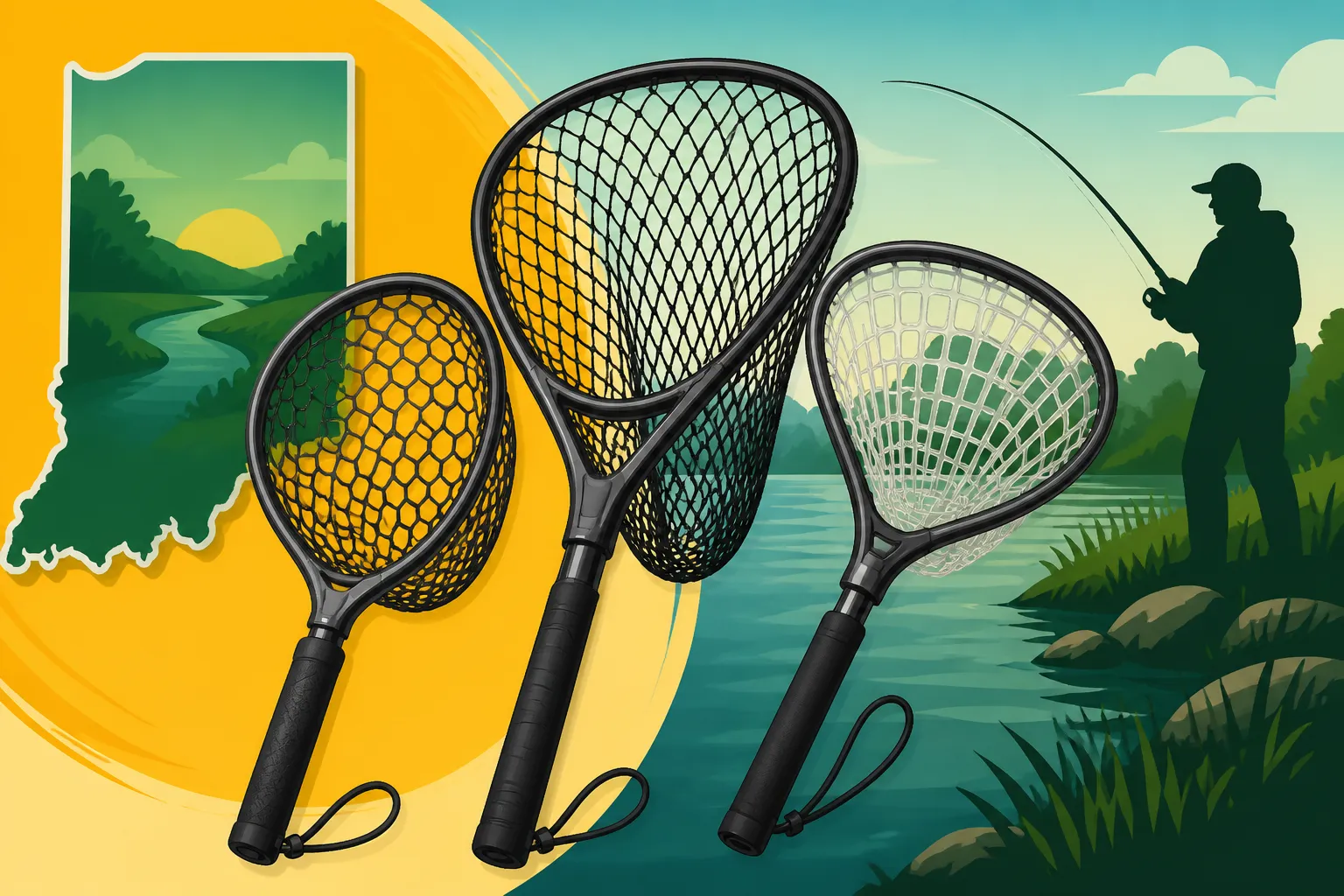
The shape of the hoop can vary too – some are round, some are tear-drop, and some are D-shaped. A D-shaped or tear-drop hoop can sometimes be easier to maneuver through the water, especially if you're trying to scoop a fish in current. Ultimately, choose a size that allows you to easily scoop your anticipated catch without being so large that it becomes cumbersome to carry or maneuver.
Netting Material and Depth
As mentioned before, the netting material is crucial for fish welfare. Your top choices are typically rubberized mesh or knotless nylon.
- Rubberized Nets: These are fantastic for catch-and-release. The smooth, soft rubber is very gentle on fish scales and slime coats, and it reduces the chance of hooks getting tangled in the mesh – a huge time-saver and stress-reducer for both you and the fish. They are also easier to clean and don't absorb odors. The main downside is that they can be a bit heavier and sometimes create more drag in the water when scooping.
- Knotless Nylon Nets: A good alternative if rubberized is out of budget or preference. "Knotless" is the key term here, as traditional knotted nylon nets are rougher on fish. These nets are generally lighter and create less drag than rubberized versions. They can be a bit more prone to hook tangles, but nowhere near as bad as knotted nets.
The depth of the netting is also important. A deep net bag helps to contain the fish once it's in, preventing it from flopping out. For most sport fish, a net depth of 12-18 inches is usually adequate.
Portability and Storage
Since you're fishing from the bank, you're likely hiking to your spot, carrying your gear, and sometimes even moving between different locations along the shore. This makes portability a prime concern. Look for nets that are:
- Foldable: Many bank nets feature a collapsible hoop or a handle that folds in half, significantly reducing their overall length for transport.
- Lightweight: Even a few extra pounds can feel like a lot after a long walk to a remote fishing spot.
- Equipped with a Carrying Strap or Clip: Some nets come with a shoulder strap or a belt clip, making it easier to carry when your hands are full with rods and tackle boxes.
When you're packing your gear, you want a net that stows away neatly. Whether it's in the trunk of your car, strapped to a backpack, or tucked into a storage compartment, a compact design is a huge advantage. You can often find a wide array of options at outdoor retailers like Bass Pro Shops or even online through platforms like Amazon that prioritize these portable features.
Types of Landing Nets Best Suited for Bank Fishing
Navigating the different styles of landing nets can feel a bit overwhelming, but for bank fishing, a few types consistently rise to the top. Each has its own set of advantages and potential drawbacks, so understanding these can help you pinpoint the perfect net for your specific angling style and the waters you frequent in Indiana.
Telescoping Landing Nets
These are the workhorses of bank fishing. Their design, which allows the handle to extend and retract, is perfectly suited for the variable reach demands of shore fishing. You might need just a short extension when fishing from a low, easy-to-access spot, but full extension when you're perched on a steeper river bank.
Pros:
- Excellent Reach: This is their strongest selling point, enabling you to land fish from elevated positions or across obstacles.
- Adjustability: You can customize the length to the exact situation, making them incredibly versatile.
- Relatively Compact for Transport: While not as small as some folding nets, a telescoping handle significantly shortens the net for carrying compared to a fixed-length net of similar extended reach.
- Strong Construction: Most quality telescoping nets are built with durable materials like aluminum, designed to withstand the rigors of frequent use.
Cons:
- Potential for Handle Play: Over time, or with lower-quality models, the telescoping sections might develop a bit of wobble when fully extended.
- Weight: Longer, sturdier telescoping handles can add a bit of weight compared to a shorter, fixed handle net.
These nets are ideal for anglers who fish a variety of bank access points, from urban ponds with paved edges to wilder riverbanks. If you often find yourself needing to reach out a good distance, a telescoping net is likely your best bet.
Folding/Collapsible Nets
For those who prioritize ultimate portability, folding or collapsible nets are fantastic. These nets often feature a mechanism that allows the hoop to fold down or the handle to fold in half, creating a very compact package for transport. They’re great for anglers who hike to remote spots or have limited storage space.
Pros:
- Superior Portability: They fold down incredibly small, making them easy to strap to a backpack or tuck into a small gear bag.
- Lightweight: Often designed with lightweight materials to enhance their portability.
- Quick Deployment (usually): Once you get the hang of it, most folding nets can be deployed rapidly when a fish is on the line.
Cons:
- Can Be Less Robust: The folding mechanisms, while convenient, can sometimes be a point of weakness if not well-designed or if heavily abused.
- Slightly Less Reach: While many folding nets also have telescoping handles, some purely folding models might not offer the same extended reach as a dedicated telescoping design.
Folding nets are a top choice for backpack anglers, kayak anglers (who might also do some bank fishing), or anyone who values a minimal gear footprint. If you’re exploring some of Indiana’s Best Remote and Uncrowded Fishing Spots and need to carry your gear over rough terrain, a folding net is a true lifesaver.
Specialty Nets for Specific Species
While a good all-around net will serve most bank anglers well, sometimes a specialized net can make a huge difference if you're consistently targeting a particular species.
- Bass Nets: For largemouth and smallmouth bass, you'll want a net with a good-sized hoop (at least 20-24 inches) and often a rubberized mesh to protect the fish's slime coat, especially if you're practicing catch-and-release. The handle length is still paramount for bank fishing. Largemouth Bass Fishing in Indiana: The Complete Guide will tell you everything you need to know about the species, and a quality net helps you land them.
- Panfish Nets: If bluegill, crappie, and other panfish are your primary targets, you might get away with a slightly smaller and lighter net. However, don't go too small, as a larger panfish can still be surprisingly wide. The main considerations remain handle length and fish-friendly mesh. For tips on catching these, check out Crappie and Panfish Fishing Techniques for Beginners.
- Catfish Nets: For big channel catfish or flatheads, you'll need a net with a robust hoop and a deep, strong net bag. Catfish can be surprisingly heavy and powerful, and a flimsy net won't hold up. Look for large, deep rubberized or heavy-duty knotless nylon mesh. You'll want good reach here too, as many prime catfish spots are on steeper riverbanks. For more on catching these whiskered beauties, see Channel Catfish Fishing in Indiana: The Complete Guide.
Ultimately, for most bank anglers, a versatile telescoping or folding net with a medium-to-large hoop and fish-friendly mesh will handle the vast majority of Indiana's diverse catches.
Choosing the Right Net for Indiana's Diverse Waters
Indiana offers a fantastic variety of fishing environments, from sprawling reservoirs and serene glacial lakes to winding rivers and countless farm ponds. The "best" landing net for you really depends on where you plan to cast your line most often. Thinking about the specific challenges of each environment will help you make an informed decision.
Rivers and Streams
Fishing Indiana's rivers and streams, like the Wabash River or the Tippecanoe, often means navigating uneven terrain, brushy banks, and sometimes swift currents. Here, reach is paramount. You might be fishing from a high bank, or the water's edge could be cluttered with submerged logs or thick vegetation.
A telescoping net with an extended length of 8-10 feet (or more) will give you the confidence to land fish even when you can't get right to the water's edge. Look for a net with a sturdy handle and a reasonably deep bag, as river fish, especially smallmouth bass or catfish, can put up a strong fight even at the net. The current can also add resistance, so a net that slices through the water efficiently (like one with a thinner, but still strong, hoop) can be an advantage. When fishing specific stretches, like the Wabash River Smallmouth Bass Fishing Spots or looking for good access, check out Best Fishing Access Points on the Wabash River in Indiana or Tippecanoe River Smallmouth Bass Fishing Spots.
Lakes and Ponds
Lakes and ponds, including the numerous smaller waters or larger impoundments like Monroe Lake, offer a different set of challenges. While you might encounter some steep banks, many areas will have more gradual slopes or even dedicated fishing piers and docks. Here, versatility and portability can be key.
A telescoping or folding net with a 6-8 foot extended reach is usually sufficient for most lake and pond scenarios. Since you might be walking around the shoreline to find good spots, a lightweight and easily carried net is a huge bonus. A rubberized mesh is highly recommended here, especially if you're releasing bass or crappie back into popular spots like Monroe Lake Shore Fishing Access Points or Patoka Lake Crappie Fishing Spots, ensuring they swim away healthy. If you're planning a family trip to find some Family-Friendly Fishing Coves on Monroe Lake, a compact, easy-to-use net is also great for helping kids land their catches. For a general overview of great places to fish, don't forget to check Best Fishing Spots in Indiana. If you're seeking good spots from shore, Best Shore Fishing Spots in Indiana can give you some excellent ideas.
Safety and Maintenance Tips
Even the best landing net won't do you any good if it's not used safely or maintained properly.
- Safe Usage: Always extend your net fully and ensure the locking mechanisms are secure before the fish is right at the bank. Trying to extend it while wrangling a fish is a recipe for disaster. When netting a fish, try to lead it headfirst into the net rather than chasing it tail-first. Once the fish is in, lift straight up rather than swinging it, especially if it's a heavy catch or the handle is fully extended, to avoid putting undue stress on the net's components.
- Cleaning: After each use, especially in dirty or muddy water, rinse your net thoroughly with fresh water. This removes mud, weeds, and fish slime, preventing odors and prolonging the life of the mesh and handle. For rubberized nets, this is usually a quick spray. For nylon, you might need a gentle scrub.
- Drying: Always allow your net to air dry completely before collapsing and storing it. Storing a wet net, especially in a dark, enclosed space, can lead to mildew and degradation of the materials.
- Storage: Store your net in a cool, dry place, ideally collapsed or folded to protect the hoop and mesh from accidental damage. Check the locking mechanisms and net integrity periodically, especially if you don't use it frequently, to ensure it's always ready for your next Indiana fishing adventure.
By considering these features and matching them to your fishing style and preferred Indiana waterways, you can confidently select a landing net that will serve you well for many seasons to come, turning those almost-had-'em moments into solid, satisfying catches.
Disclaimer
This article is for general informational purposes only and does not constitute professional advice. Laws, prices and regulations vary by location and change over time. Consult a qualified professional for guidance on your specific situation.