Muskie vs Northern Pike: How to Tell the Difference
It’s a tale as old as time for many Hoosier anglers: you’re out on your favorite lake, you get a solid strike, and you pull in a long, toothy creature that looks vaguely familiar. Is it a muskie? Is it a northern pike? The confusion is real, and it’s a common frustration when you’re trying to identify your catch, especially given their similar appearances and shared habitats in many parts of Indiana. This comprehensive guide is here to untangle that mystery, giving you the clear, actionable tips you need to confidently tell the difference between a muskellunge and a northern pike in Indiana's waters, ensuring you're compliant with regulations and truly know what kind of magnificent fish you've just landed.
The Challenge of Identification: Why Anglers Get Confused
Let's be honest, at first glance, both muskellunge (often just called "muskie") and northern pike can look remarkably similar. They both possess that distinct torpedo-shaped body, those menacing rows of teeth, and a predatory glint in their eyes. This striking resemblance is a major reason why even seasoned anglers can occasionally scratch their heads when trying to tell them apart, especially if they're not intimately familiar with the subtle, yet critical, distinguishing features.
Shared Habitats and Similar Appearances
One of the biggest contributors to this confusion is the overlap in their preferred habitats. Both muskie and northern pike thrive in cool, clear waters with ample vegetation, which describes many of Indiana's lakes, particularly in the northern glacial lake region. It’s not uncommon to pull one out of a weed bed only to have another angler nearby ask, "Is that a muskie or a pike?" because they've caught both in the same general area. They are both apex predators, lurking in similar ambush points, making their presence interchangeable in the minds of many. This environmental similarity further blurs the lines when trying to make a quick identification on the water.
Imagine you're fishing a shallow bay on Lake Wawasee, known for both species. You cast a spinnerbait near some lily pads and hook into a strong fish. As it comes to the boat, its long body and sharp teeth immediately scream "esocid!" – the family name for pikes and muskies. But then the nuances begin. Is that really a northern pike's spot pattern, or is it a muskie's bar? The water splashes, the fish thrashes, and in the excitement, those subtle differences can easily be missed. It takes a deliberate look at specific features to move beyond the initial impression.
The Importance of Correct Identification for Regulations
Beyond just satisfying your curiosity, knowing whether you've caught a muskie or a northern pike is absolutely crucial for compliance with Indiana's fishing regulations. These two species often have different size limits, possession limits, and sometimes even seasonal restrictions. For instance, muskellunge in Indiana often have very specific and quite large minimum length requirements, designed to protect these slow-growing, trophy-sized fish. Accidentally keeping a muskie that's undersized because you thought it was a legal northern pike could lead to a citation and a hefty fine.
Consider the scenario: you're fishing one of the Best Muskie Lakes in Indiana's Glacial Lakes and you catch what you think is a large pike. You measure it, and it meets the length for pike, but if it was actually an undersized muskie, you're in violation. The conservation efforts for muskie, in particular, are stringent because they are such a prized, but vulnerable, sport fish. Many anglers spend years, even decades, trying to land a trophy muskie, so protecting the younger fish is paramount. Always remember that conservation officers are looking for adherence to the rules, and "I thought it was a pike" usually isn't a valid excuse. Understanding the distinctions ensures you're fishing responsibly and helping to preserve these incredible fish populations for future generations. For more on these regulations, you can read Indiana Fishing Regulations and Bag Limits Guide.
Distinctive Jawline and Markings: The Primary Indicators
When trying to distinguish between a muskie and a northern pike, your first point of inspection should always be their heads, specifically their gill covers and cheeks, and then their body coloration. These are the most reliable visual cues, even for a quick glance, that will help you tell them apart. It's like learning to identify different dog breeds – you look at the key facial features and coat patterns first.
Gill Cover and Cheek Scale Patterns
This is often cited as the definitive way to tell a muskie from a northern pike. You need to look at the scales on the lower half of their gill cover (operculum) and their cheek (subopercle and preopercle).
- Northern Pike: Will have scales covering the entire cheek and the upper half of the gill cover. The lower half of the gill cover will be bare (scaleless). Think of it as "half-cheeked" or "half-gilled" if you're only looking at the gill cover.
- Muskellunge: Will have scales only on the upper half of both the cheek and the gill cover. The lower halves of both will be bare. This is often referred to as "half-cheeked and half-gilled."
This difference, though seemingly small, is incredibly consistent. It's the biological fingerprint that reliably separates the two. It takes a moment of careful observation, sometimes needing to gently lift the gill cover slightly or just observe the cheek area, but it's worth the effort. It’s like the secret handshake of the esocid family. If you're unsure, gently hold the fish steady and look closely at this area. You can even find illustrations online or in fishing guides, and carrying a laminated identification card with you, perhaps ordered from Amazon, can be a real game-changer when you're on the water.
Body Markings and Coloration: More Than Just Spots
While the scales on the head are definitive, the body markings are often the first thing anglers notice, and they offer a strong secondary indicator, though they can sometimes be more variable.
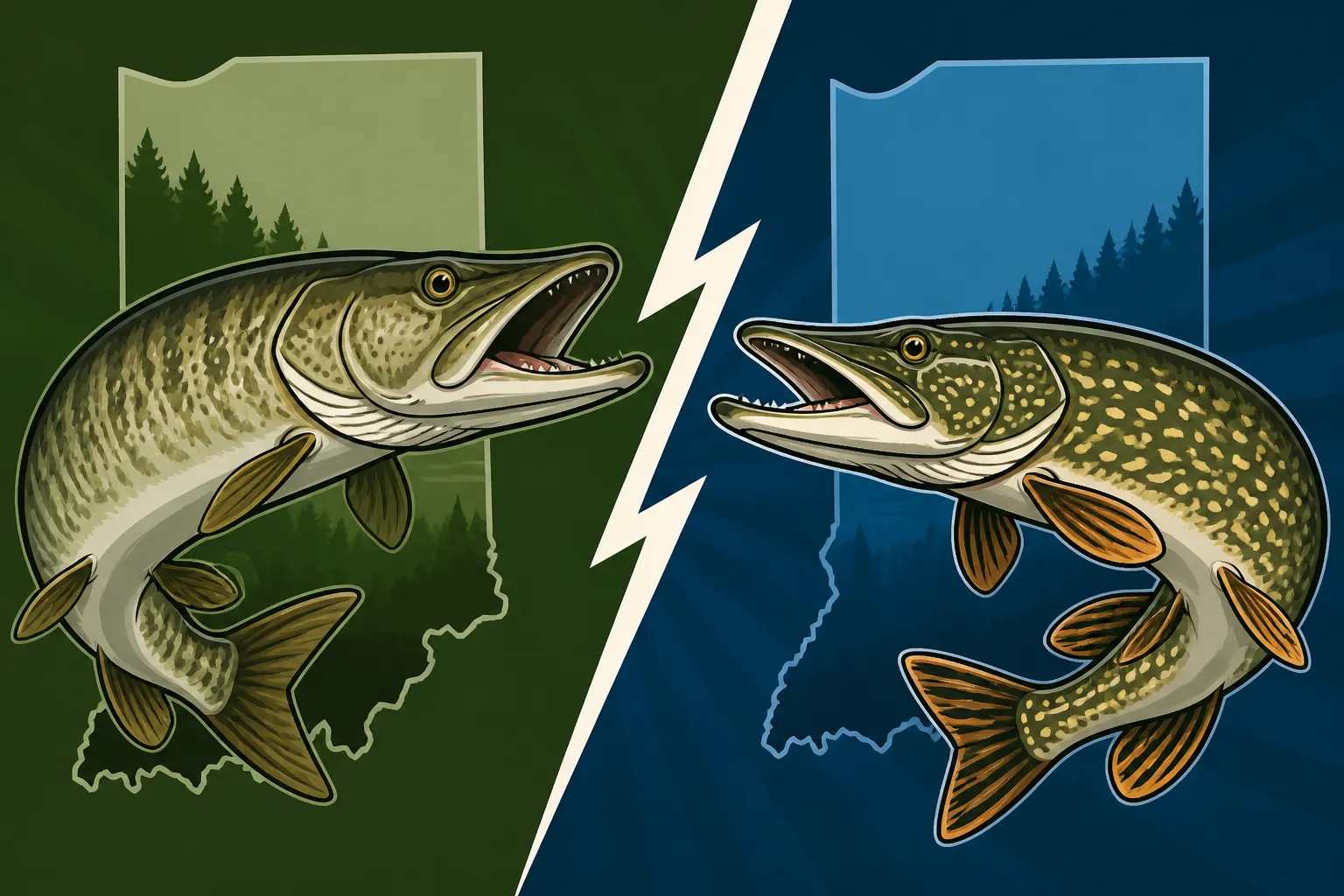
- Northern Pike: Typically have light, bean-shaped, horizontal spots or streaks on a darker green or olive background. Their overall appearance is often described as having "light on dark" markings. The spots might be yellowish or whitish. Think of a camouflage pattern where the lighter shapes are distinct from the darker base color. For a deeper dive into pike identification, check out Northern Pike Identification: Light Spots on a Dark Body.
- Muskellunge: Usually have dark spots, bars, or blotches on a lighter background, often olive, silver, or brownish. Their pattern is typically "dark on light." These markings can range from distinct spots to wavy, vertical bars that almost look tiger-striped. Some muskie can be nearly plain, especially older specimens, which adds to the confusion. This is why checking the gill plates is so vital. You can learn more about this by reading Muskellunge Identification: Spotting Indiana's Toothiest Fish.
It's important to remember that coloration can vary based on habitat, water clarity, and even the fish's mood. A pike from murky water might have less defined spots than one from clear glacial lakes. However, the type of marking – light on dark for pike, dark on light for muskie – tends to hold true. If you see distinct light spots, it's almost certainly a pike. If you see darker spots or bars against a lighter background, you're likely looking at a muskie.
Fin Facts: What the Fins Tell You
Beyond the head and body, the fins, particularly the dorsal and anal fins, can provide additional clues for identification. While not as foolproof as the gill cover scales, these features, when combined with other indicators, can solidify your identification.
Dorsal and Anal Fin Differences
Both muskie and northern pike have their dorsal and anal fins set far back on their bodies, close to the tail, which is a common characteristic of fast-striking ambush predators. However, there's a subtle difference in their typical count of fin rays.
- Northern Pike: Generally have 7-9 pores on the underside of their lower jaw (mandibular pores), and typically fewer than 10 fin rays in their dorsal fin.
- Muskellunge: Usually have 12-18 pores on the underside of their lower jaw, and more fin rays (10-14) in their dorsal fin.
Counting fin rays can be tricky and requires a very close, careful inspection, which might not be practical or safe when you're trying to quickly release a toothy fish. It's more of a scientific method than an on-the-water identification trick. However, the general impression of the fins can still offer a hint. Muskie often have slightly larger, more robust dorsal and anal fins relative to their body size compared to pike. It’s not a hard rule, but it’s part of the overall picture.
Tail Fin Shape: A Subtle but Key Clue
The shape of the tail fin (caudal fin) can also offer some insight, though it's another one of those more subtle distinctions that might not be immediately obvious.
- Northern Pike: Tend to have a more deeply forked or concave tail fin. The "V" shape at the center of the tail is usually quite pronounced.
- Muskellunge: Often have a less deeply forked, more rounded, or even slightly convex tail fin. The "V" at the center might be shallower, or the outer lobes might be more rounded.
Again, this isn't a definitive, stand-alone characteristic, as individual fish can vary, and tail fins can be damaged. But if you combine this with the gill plate scales and body markings, it adds another piece to your identification puzzle. If you're looking at a fish with clear light spots on a dark body, a half-scaled gill plate, and a deeply forked tail, you can be very confident you've got a northern pike. If you see dark markings on a lighter body, a half-scaled cheek and gill plate, and a less-forked tail, you’re likely holding a muskie. These small details, when considered together, create a robust identification strategy.
Size and Behavior: Beyond Visual Cues
While the physical characteristics are the primary method for telling muskie and northern pike apart, considering their general size and behavioral tendencies can also add context to your identification. These are often broad generalizations, but they reflect typical patterns observed in Indiana's waters.
General Size Expectations in Indiana Waters
Muskie and northern pike can both grow to impressive sizes, but there are typical differences in their maximum potential in Indiana.
- Northern Pike: While large pike do exist, they typically don't reach the extreme lengths and weights that muskie can. A "trophy" northern pike in Indiana might be in the 30-40 inch range. You can find more information about these impressive fish in Northern Pike Fishing in Indiana: A Complete Guide.
- Muskellunge: These are often referred to as "the fish of 10,000 casts" for a reason – they are notoriously challenging to catch and grow to truly massive sizes. Indiana is home to some genuine giants, with muskie regularly exceeding 40 inches, and many anglers pursuing fish over 50 inches. These are the true freshwater giants, often weighing upwards of 30 pounds. To understand just how big these fish can get, check out How Big Do Muskellunge Get in Indiana Waters?.
It's important to remember that a small muskie can look very much like a small pike, and a truly exceptional pike might approach muskie sizes. So, size alone should never be the only factor in your identification. However, if you've got a fish that's pushing five feet, it's almost certainly a muskie. If it's a very robust fish in the 30-inch range, it could easily be either, necessitating a closer look at the head and markings.
Behavioral Tendencies: Aggression and Habitat Preference
While both are formidable predators, some subtle behavioral differences can be observed, particularly in their preferred hunting styles and how they react when hooked.
- Northern Pike: Are often considered slightly more aggressive and less particular in their feeding habits. They're more likely to strike a wider variety of lures and baits. They can be found in a broader range of habitats, from weedy bays to river systems, and are sometimes more tolerant of warmer water than muskie. Their fight is often characterized by powerful runs and violent headshakes.
- Muskellunge: Are generally more elusive and notoriously finicky. They are ambush predators that often lurk in dense cover or along sharp breaks. Their strikes are explosive, and their fights are often long, powerful battles with incredible bursts of speed and acrobatic jumps. Many muskie anglers will tell you that a muskie's intelligence and wariness make them a true challenge. You can learn more about the thrilling pursuit of these fish in Muskellunge Fishing in Indiana: What Anglers Need to Know. They are also often found in deeper, cooler sections of lakes, especially when water temperatures rise.
For instance, when fishing for muskie, anglers often employ the "figure-eight" technique at the boat, a desperate last-ditch effort to trigger a strike from a following fish. This behavior is less commonly associated with pike, which are often more immediate in their commitment to a strike. Pike, being a bit more widespread and perhaps less picky, might be caught more often on incidental encounters, whereas muskie are usually the target of dedicated, specialized efforts.
Where You'll Find Them in Indiana: Preferred Haunts
Understanding where these two species are typically found in Indiana can also help with identification. While there can be overlap, both species have distinct strongholds and preferred environments that can give you a clue before you even make a cast.
Muskie Strongholds: The Glacial Lakes
If you're casting in Indiana's renowned glacial lakes, particularly in the northern part of the state, there's a good chance you're in prime muskie territory. Lakes like Webster, Tippecanoe, Lake James, and Lake Wawasee are legendary for their muskie populations. These lakes offer the deep, clear, cool water, and intricate structures that trophy muskie seek.
Anglers targeting muskie often travel specifically to these locations, spending countless hours meticulously working large baits in search of these apex predators. The dedication required reflects the challenge and reward of catching a muskie in these waters. If you're fishing one of these well-known muskie lakes, and you hook into a monster, your odds of it being a muskie are significantly higher. Indiana's Glacial Lake District: Home to Muskie, Pike, and Walleye is a great resource to learn more about these prime fishing locations. Additionally, places like Best Muskie Lakes in Indiana's Glacial Lakes provide even more specific details on where to find these elusive fish.
Northern Pike Hotspots: More Widespread, Still Specific
Northern pike, while also present in some of the glacial lakes, tend to have a broader distribution across Indiana. They can be found in a wider variety of lakes, reservoirs, and even some larger river systems, particularly those with good aquatic vegetation. You might encounter pike in lakes in the central or even southern parts of the state where muskie stocking isn't as prevalent.
Pike are perhaps a bit more adaptable, often tolerating slightly warmer, murkier water than muskie. They're very much at home in the extensive weed beds that characterize many Indiana fisheries. So, if you're fishing a smaller, weed-choked lake that isn't typically known as a muskie destination, and you hook a long, toothy fish, the odds might lean towards it being a northern pike. However, some glacial lakes, like those in Kosciusko County, also hold excellent northern pike populations. If you want to know more about prime pike locations, Where to Catch Northern Pike in the Glacial Lake District and Kosciusko County's Best Lakes for Northern Pike are excellent reads. Understanding these geographical preferences can give you a good starting point for identification even before the fish is in the net.
Angling Implications: Why Knowing the Difference Matters
Knowing the difference between a muskie and a northern pike isn't just about showing off your fish identification skills; it has direct implications for your fishing strategy, the gear you choose, and most importantly, your adherence to Indiana's conservation efforts.
Gear and Technique Adjustments
While both species are powerful predators that require robust tackle, there are nuances in gear and technique that differentiate dedicated muskie fishing from pike fishing.
- Muskie: Targeting muskie often involves specialized heavy-duty gear. Think long, heavy-action rods, large baitcasting reels spooled with strong braided line, and oversized lures like bucktails, jerkbaits, and swimbaits that can measure over a foot long. The "figure eight" maneuver at the boat, mentioned earlier, is a classic muskie technique. Anglers might also invest in special release tools like long-nosed pliers and jaw spreaders for safe handling of these giants. You can find excellent selections of this specialized gear, from rods to lures, on Amazon.
- Northern Pike: While pike can certainly hit big lures, they are often caught on slightly lighter, though still heavy-duty, tackle. Standard heavy spinning or baitcasting setups with medium-heavy rods are common. Pike readily hit spinnerbaits, spoons, and various crankbaits. While wire leaders are essential for both due to their razor-sharp teeth, pike fishing generally doesn't demand the same extreme scale of tackle as trophy muskie fishing. For more details on what you might need, check out Best Heavy Tackle for Pike Fishing in Indiana.
Knowing which species you're primarily targeting (or have just caught) will influence whether you're reaching for that 10-foot muskie rod or a more general-purpose heavy-action setup. If you're solely focused on muskie, you'll want to be prepared with the right equipment to handle these massive fish safely and effectively. Similarly, if you're catching a lot of pike, you might adjust your lure choices to smaller, faster-moving presentations.
Understanding Regulations and Conservation
As we touched on earlier, regulations are a major reason why proper identification is so important. Muskie are almost exclusively managed as trophy fish in Indiana, meaning strict length limits and often catch-and-release practices are encouraged or required. Pike, while also a respected sport fish, typically have different, often more liberal, size and bag limits.
Here’s a simplified breakdown, but always consult the current Indiana Fishing Guide for precise and up-to-date information:
| Feature | Northern Pike | Muskellunge |
|---|---|---|
| Gill Cover Scales | Scaled on upper half, bare on lower half | Scaled on upper half, bare on lower half |
| Cheek Scales | Fully scaled | Scaled on upper half, bare on lower half |
| Body Markings | Light spots/streaks on a dark background | Dark spots/bars/blotches on a light background |
| Tail Fin | More deeply forked/concave | Less deeply forked/more rounded |
| Mandibular Pores | 7-9 (underside of jaw) | 12-18 (underside of jaw) |
| Max Size in Indiana | Generally smaller (up to 40" trophy) | Generally larger (often over 40-50" trophy) |
| Key ID Tip | Fully scaled cheek, half-scaled gill cover | Half-scaled cheek and half-scaled gill cover |
Note: This table provides general characteristics. Always check current regulations.
Mistaking a small muskie for a northern pike and keeping it could be a serious violation, resulting in fines and potentially losing your fishing privileges. Conversely, unnecessarily releasing a legal-sized pike because you thought it was an undersized muskie means you missed out on potential table fare. Both species are exciting to catch, but respecting their biological differences and the regulations designed to protect them is part of being a responsible angler. For specific information on pike, consider Best Bait for Northern Pike in Indiana Lakes, and for muskie, review Walleye and Muskie Fishing in Indiana's Glacial Lakes. Always carry a reliable tape measure and familiarize yourself with the current Indiana fishing guide before hitting the water.
Disclaimer
This article is for general informational purposes only and does not constitute professional advice. Laws, prices and regulations vary by location and change over time. Consult a qualified professional for guidance on your specific situation.