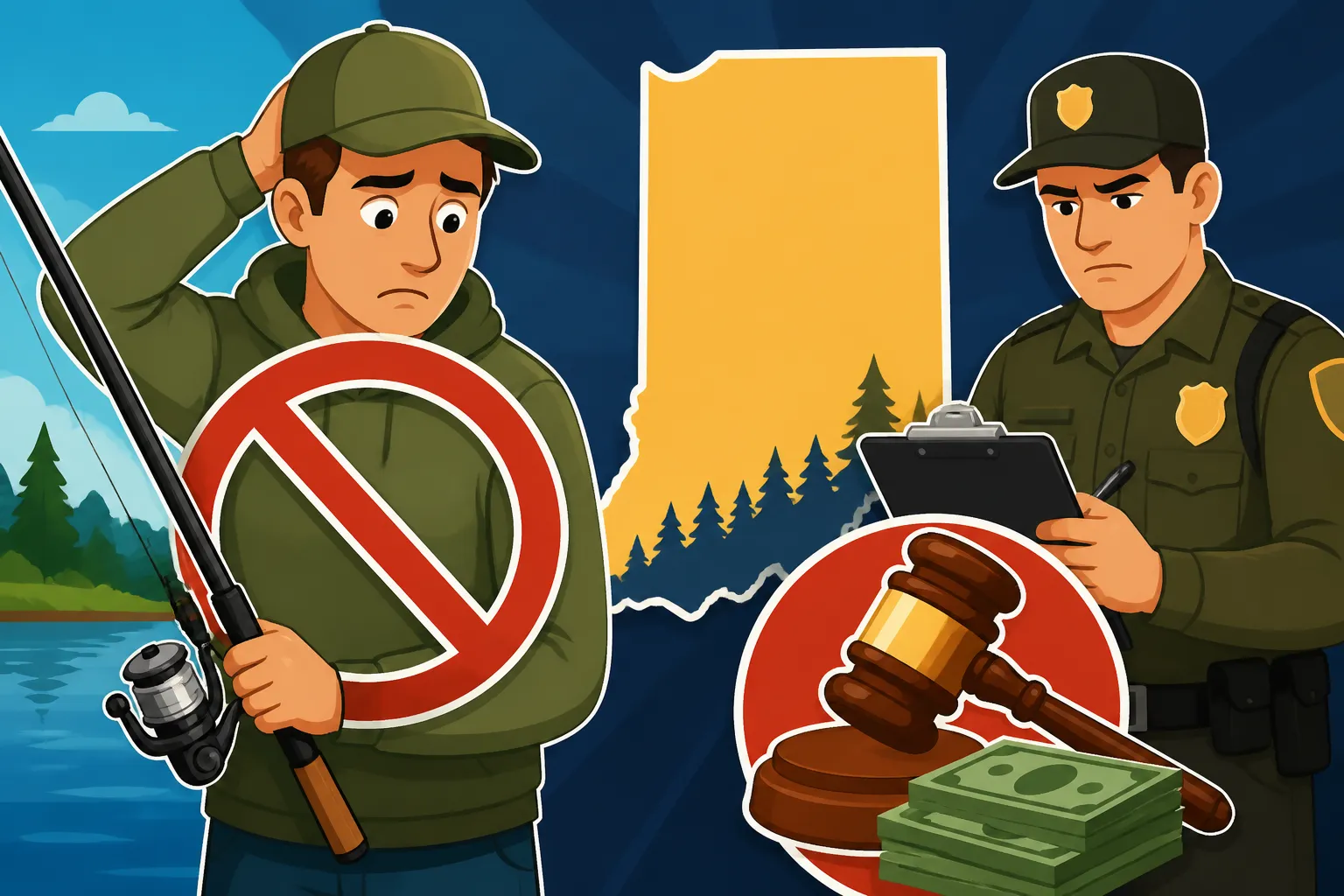
Penalties and Fines for Fishing Without a License
It’s an all too common scenario: you’re out on a beautiful Indiana lake or river, the sun is shining, the fish are biting, and then a conservation officer approaches. Your heart sinks as you realize you either forgot your fishing license, or worse, never got one in the first place. This simple oversight can quickly turn a peaceful day into a stressful and expensive ordeal. This guide is here to walk you through exactly what happens when you’re caught fishing without a valid license in the Hoosier State, detailing the penalties, fines, and other serious consequences you might face.
Understanding Indiana's Fishing License Requirements
Before we dive into the nitty-gritty of penalties, it’s crucial to grasp why fishing licenses exist and who needs them. Many anglers, especially those new to the sport or visiting from out of state, simply don't realize the critical role these licenses play or the specific rules that apply to them. It's not just about paying a fee; it's about being a responsible steward of Indiana's incredible aquatic resources.
Who Needs a License and When?
In Indiana, pretty much anyone aged 18 and older who wants to cast a line in public waters needs a valid fishing license. This applies whether you're dangling a worm off a dock, fly fishing a rushing river, or trolling for walleye on a vast lake. There are some specific exemptions, of course. For instance, children under 18 years old can fish without a license, which is a fantastic way to introduce kids to the joys of fishing without an extra barrier. You can learn more about this in our guide on Free Fishing for Indiana Residents Under 18.
Additionally, Indiana offers a few special days each year when anyone, resident or nonresident, can fish without a license. These are called Indiana Free Fishing Days Guide, and they’re a great opportunity to try fishing or introduce a friend to the sport. However, these are specific dates, and relying on them outside those windows can lead to trouble. Always double-check the current year's schedule! Nonresidents, by the way, have specific license options, and their costs differ significantly from residents, as detailed in our Indiana Nonresident Fishing License Guide.
The Importance of a Valid License
Beyond simply avoiding a fine, holding a valid Indiana fishing license is a direct contribution to the health and sustainability of our state's fisheries. The funds generated from license sales are absolutely vital. They go directly towards conservation efforts, like stocking fish populations, improving habitat, conducting scientific research to manage species, and maintaining public access sites. Without these funds, our favorite fishing spots wouldn’t be nearly as robust or accessible.
It's not just about fish, either. These funds also support the enforcement presence of Indiana Conservation Officers, who work tirelessly to ensure that everyone is playing by the rules, which in turn protects the resource from overexploitation and illegal activity. So, when you purchase your license, you're not just buying permission to fish; you're investing in the future of fishing in Indiana for everyone, including yourself and future generations. Think of it as your small but mighty contribution to something much bigger than yourself.
Easily Obtaining Your Indiana Fishing License
One common lament from those caught without a license is, "I just didn't get around to it!" But honestly, getting an Indiana fishing license has never been easier. You don't have to jump through hoops or take a special trip to a government office during business hours. The Indiana Department of Natural Resources (DNR) has made the process incredibly streamlined.
Your quickest and often most convenient option is to purchase your license online through the DNR's website. It takes just a few minutes, you can do it from your couch or even on your phone at the boat ramp, and you'll get a digital copy you can show on your device. For a comprehensive walkthrough, check out our article on Buying a Fishing License Online in Indiana. Of course, if you prefer the traditional route, you can still buy a license in person at authorized retailers like bait shops, sporting goods stores, and some county clerk's offices across the state. Many of these places are open early and late, making it easy to grab one on your way to the water. The annual resident license cost, for example, is very reasonable, as explained in Indiana Resident Annual Fishing License Cost. There's really no good excuse not to have one, especially when the convenience is so high!
What Happens When You're Caught Without a License
Okay, let's get to the part no one wants to experience. You're enjoying your day, perhaps reeling in a nice bass, and then you see the distinctive uniform of an Indiana Conservation Officer. It's important to understand how these encounters usually unfold and what legal ramifications are at play.
The Initial Encounter: Conservation Officers
Indiana Conservation Officers (ICO) are fully commissioned law enforcement officers with specific training and jurisdiction over state environmental and natural resources laws. When an ICO approaches you on the water or at a fishing access point, they are doing their job, ensuring compliance with state regulations. Typically, they will introduce themselves, explain why they're approaching (often for a routine license check), and ask to see your valid fishing license and a form of identification.
Your best course of action is always to be polite, cooperative, and truthful. Don't argue, don't try to hide anything, and definitely don't try to flee. These officers are trained professionals, and escalating the situation will only make things worse, potentially leading to additional charges like resisting law enforcement. If you honestly forgot your license at home but legitimately have one, you might be given a chance to produce proof later, though this is entirely at the officer's discretion. However, if you simply don't have one, or it's expired, they will proceed with issuing a citation.
The Citation: Understanding Your Ticket
If an ICO determines you're fishing without a valid license, they will issue you a citation, which is essentially a ticket or a summons to appear in court. This isn't just a slap on the wrist; it's a legal document. The citation will contain several pieces of critical information: your name and address, the specific charge (e.g., "Fishing Without a Valid License"), the Indiana Code section you violated, the date and location of the offense, and crucially, your court date.
You'll be expected to either pay the fine by the due date or appear in court on the specified day to address the charge. Ignoring the citation is perhaps the worst thing you can do. Failing to appear in court can lead to a warrant being issued for your arrest, and additional charges and penalties will pile up quickly. Even if you think you have a valid defense, the place to present it is in court, not by ignoring the legal process.
Explaining the Charge: Class C Misdemeanor
This is where it gets serious. In Indiana, fishing without a valid license is generally classified as a Class C Misdemeanor. Many people hear "misdemeanor" and think it's not a big deal, but that's a dangerous misconception. A Class C Misdemeanor in Indiana carries significant potential penalties. For one, it's a criminal offense, not just a simple traffic ticket. This means that if convicted, you could have a criminal record. While it's certainly not a felony, it can still show up on background checks, which can impact things like employment, housing, or even professional licenses down the road.
The maximum penalty for a Class C Misdemeanor in Indiana includes up to 60 days in jail and/or a fine of up to $500. While actual jail time for a first offense of fishing without a license is rare, it is absolutely within the court's power to impose it, especially if there are aggravating circumstances or if you have a history of similar violations. The judge also has discretion to order community service in lieu of or in addition to fines and jail time. It's not a situation you want to find yourself in, and it's certainly a much higher price to pay than the nominal cost of an annual fishing license.
The Financial Penalties and Fines
Let's talk money, because that's often the most immediate and tangible consequence for most people caught fishing illegally. The cost of being caught without a license far outweighs the price of simply buying one. It's a classic example of "an ounce of prevention is worth a pound of cure."
Base Fines for Fishing Without a License
While the maximum fine for a Class C Misdemeanor is $500, the actual base fine for fishing without a license can vary by county and the specific circumstances. Typically, a first offense for fishing without a license might see a fine in the range of $100 to $200. However, this is just the starting point. If you were also caught with fish that were illegally taken (e.g., over the bag limit, out of season, or undersized), additional fines will be levied for each violation.
For instance, if you were fishing for trout or salmon and didn't have the required Indiana Trout and Salmon Stamp Requirements in addition to your base license, that's another specific violation with its own penalty. The important thing to remember is that this base fine is rarely the total amount you'll end up paying. It's more like the entry fee to a much more expensive experience.
Court Costs and Administrative Fees
Ah, the hidden costs! This is where the expenses really start to add up. When you get a citation and have to go through the court system, whether you pay the fine or appear before a judge, you're going to incur court costs and various administrative fees. These fees cover the expenses of processing your case, from court clerk fees to judicial administration costs. These can easily add another $150 to $250 or more to your total bill, sometimes even exceeding the original fine itself.
So, that $100 fine you were expecting? It could easily balloon to $300 or $400 once all the court costs and fees are tacked on. These are non-negotiable fees that every person going through the court system has to pay. This is why many people who get caught fishing without a license find themselves looking at a total bill of $250 to $500 or even higher, depending on the county and how efficiently they resolve the issue.
Restitution for Taken Fish
This is another area where the costs can escalate dramatically, especially if you harvested fish. If you are caught with fish that were illegally taken – perhaps you were over the daily bag limit, kept undersized fish, or were fishing out of season – the court can order you to pay restitution for the value of those fish. The Indiana DNR has a schedule of restitution values for various species. For example, a trophy largemouth bass or a large walleye would have a significantly higher restitution value than a smaller panfish.
Imagine you're caught with an illegal walleye, which might have a restitution value of $25 or $50, on top of your fine and court costs. If you've got several fish that are all illegal, those restitution charges can quickly become substantial. This is particularly true for high-value species like salmon or steelhead from Lake Michigan. Always make sure you understand the Indiana Fishing Regulations and Bag Limits Guide for the species you're targeting. These restitution payments are designed to help compensate the state for the resource that was illegally removed from the public trust.
Additional Consequences Beyond Fines
While financial penalties are often the most immediate concern, there are other, potentially more impactful, consequences that can arise from fishing without a license. These can affect your ability to fish in the future, and even your personal property.
License Suspension or Revocation
Beyond the immediate fine and court costs, one of the most significant consequences for anglers is the potential loss of fishing privileges. If you are convicted of fishing without a license, especially if it's not your first offense or if other violations were involved, the Indiana DNR has the authority to suspend or even revoke your hunting and fishing licenses. This means you could be prohibited from purchasing a new license or exercising your fishing rights for a specified period, which could range from one year to several years.
For passionate anglers, losing the ability to fish legally is a truly devastating penalty. Imagine having to sit on the sidelines during prime fishing season, knowing you can't cast a line without risking even more severe penalties. This consequence alone should be a powerful deterrent and underscores the importance of always being properly licensed. It's a stark reminder that fishing is a privilege, not an inherent right, and one that comes with responsibilities.
Confiscation of Gear
This consequence often comes as a shock to many anglers. In cases of serious violations, or sometimes even for a basic fishing without a license charge, Indiana Conservation Officers have the authority to seize any equipment used in the commission of the illegal activity. This isn't just a minor inconvenience; it could mean losing valuable gear. We're talking about your expensive rod and reel combo, your tackle box full of lures, and in some more extreme cases, even your boat or kayak could be subject to seizure.
Imagine having your favorite fishing rod, the one you painstakingly saved for or that holds sentimental value, confiscated on the spot. It's a tangible loss that adds insult to injury on top of any fines and potential license suspension. While property forfeiture often requires a court order, the immediate seizure of items can happen at the scene. This possibility highlights the seriousness with which the state views violations of its natural resource laws and serves as a powerful reminder to always ensure you're in compliance.
Potential Jail Time or Community Service
As mentioned earlier, fishing without a license is a Class C Misdemeanor, which technically carries a maximum penalty of up to 60 days in jail. While it's rare for a first-time, simple fishing without a license offense to result in actual jail time, it's not impossible, especially if there are aggravating factors. These could include things like being uncooperative with the officer, having a history of prior convictions for similar offenses, or committing other serious violations at the same time (like being over the limit on a protected species).
More commonly, if a judge wants to impose a penalty beyond a fine but doesn't feel jail time is appropriate, they might order community service. This could mean spending a certain number of hours working for a local park, conservation organization, or other community program. While not as restrictive as jail, it still takes up your valuable time and serves as a significant inconvenience, proving that even a "minor" infraction can lead to real constraints on your freedom and personal schedule.
Avoiding Penalties: Best Practices for Anglers
The good news is that avoiding these unpleasant penalties is incredibly simple. A little bit of preparation and awareness goes a long way in ensuring your fishing trips remain enjoyable and stress-free.
Always Carry Your License
This might sound obvious, but you’d be surprised how many people forget. Just like you wouldn't leave home without your driver's license, you shouldn't head to the water without your fishing license. Whether it's a physical card tucked into your wallet, tackle box, or an easily accessible digital copy on your smartphone, ensure you have proof of a valid license on your person. Keep it in a waterproof bag or a dedicated pocket in your fishing vest so it doesn't get lost or damaged.
If you bought your license online, save a screenshot or download the PDF to your phone so you can access it even if you don't have cell service out on the water. Pro tip: many anglers laminate their physical license to protect it from the elements. This simple act can save you a lot of hassle and potential headaches if an ICO ever asks for verification. Need to check if your license is still valid? You can often do so through the Indiana DNR's online portal, which is a great feature. Knowing your Indiana Fishing License Year Explained also helps you keep track of when to renew.
Double-Checking Regulations Before You Go
Ignorance of the law is never a valid excuse, and this holds especially true for fishing regulations. Before every trip, or certainly before venturing to a new body of water or targeting a new species, take a few minutes to familiarize yourself with the current rules. The Indiana DNR publishes an annual fishing guide that is available online and at most license vendors. This guide covers everything from statewide regulations to specific rules for certain lakes or rivers.
Pay close attention to bag limits, length limits, and season dates for the fish you intend to catch. For example, Indiana Walleye Length Limits by Lake can vary significantly from one body of water to another, and getting it wrong can lead to fines and restitution. Also, remember that Lake Michigan Fishing Rules for Indiana Anglers are often distinct from inland waters due to federal and interstate agreements. A quick read through the guide can prevent you from inadvertently breaking a rule and ending up with a citation. It's truly your best defense against unintended violations.
Understanding Reciprocity Agreements
For those who live near Indiana's borders with other states, fishing can sometimes involve crossing into neighboring waters. It's a common misconception that if you have a license from one border state, it automatically applies to the Indiana side of a shared river or lake. This is rarely the case, and assuming reciprocity can lead to legal trouble. While some states do have limited reciprocity agreements, they are typically very specific and apply only to certain shared waterways, not the entire state.
For example, our guide on Indiana Fishing License Reciprocity With Ohio details exactly where and when an Ohio license might be honored in Indiana, and vice versa. The same goes for Illinois, Kentucky, and Michigan. Always research and understand the specific agreements in place before you cast a line in a border water. If in doubt, the safest bet is to purchase a nonresident license for Indiana, even if it's just a short-term 1-day or 7-day option. You can find many fishing resources, including state regulation summaries and useful gear guides, on sites like Amazon, which might help clarify requirements or supply you with necessary equipment for safe and legal fishing.
The Impact on Indiana's Fisheries
Beyond the personal consequences, it's really important to zoom out and understand why these regulations and penalties exist. It's not just about bureaucracy; it's about protecting the very resources that make fishing in Indiana so enjoyable.
Why Licenses Fund Conservation
Every dollar spent on an Indiana fishing license directly contributes to the sustainability of our state's aquatic ecosystems. These funds are the lifeblood of the Indiana DNR's Division of Fish & Wildlife. They pay for critical programs like fish stocking, which helps maintain healthy populations in lakes and rivers, particularly for popular species like bass, walleye, and trout. They also fund habitat restoration projects, ensuring that fish have clean water, healthy spawning grounds, and ample food sources.
Think about the beautiful state-run fishing sites, public boat ramps, and educational programs – these are all supported by license fees. When someone fishes without a license, they're not just breaking the law; they're essentially free-riding on the contributions of responsible anglers. They're enjoying the benefits of these conservation efforts without contributing their fair share, ultimately depleting resources that others have worked and paid to maintain. You can find useful outdoor gear, books on fish identification, and even state-specific fishing guides on Amazon, which can help you connect with the conservation message.
Preventing Overfishing and Resource Depletion
Fishing regulations, enforced by the requirement of a license, are designed to prevent overfishing and ensure that fish populations remain healthy and abundant for current and future generations. Without these rules, it would be far too easy for individuals to take more than their share, quickly depleting fish stocks to unsustainable levels. This isn't just a hypothetical threat; it has happened in many places around the world where regulations were lax or poorly enforced.
Each regulation – from length limits to daily bag limits to seasonal closures – is based on scientific research and designed to allow fish populations to reproduce and thrive. For example, a minimum length limit for species like bass or walleye ensures that fish have a chance to spawn at least once, contributing to the next generation before they can be harvested. When people disregard these rules by fishing without a license or violating other regulations, they undermine these critical conservation efforts, putting the entire fishery at risk.
| Offense | General Penalty (Class C Misdemeanor) | Potential Maximum Fine | Common Court Costs/Fees | Restitution (Example: Walleye) | Other Possible Consequences |
|---|---|---|---|---|---|
| Fishing Without Basic License | Class C Misdemeanor | $500 | $150 – $250 | N/A | License Suspension, Gear Confiscation, Community Service |
| Fishing Without Required Stamp (e.g., Trout) | Class C Misdemeanor | $500 | $150 – $250 | N/A | License Suspension, Gear Confiscation |
| Exceeding Bag Limit (per fish) | Class C Misdemeanor | $500 | $150 – $250 | Varies by Species ($25-$200+) | License Suspension, Gear Confiscation, Community Service |
| Keeping Undersized Fish (per fish) | Class C Misdemeanor | $500 | $150 – $250 | Varies by Species ($25-$200+) | License Suspension, Gear Confiscation |
Disclaimer
The information provided in this guide is for general informational purposes only and does not constitute legal advice. While we strive to provide accurate and up-to-date information, fishing regulations and legal penalties are subject to change. Always consult the official Indiana Department of Natural Resources (DNR) regulations and, if facing legal charges, seek advice from a qualified legal professional.