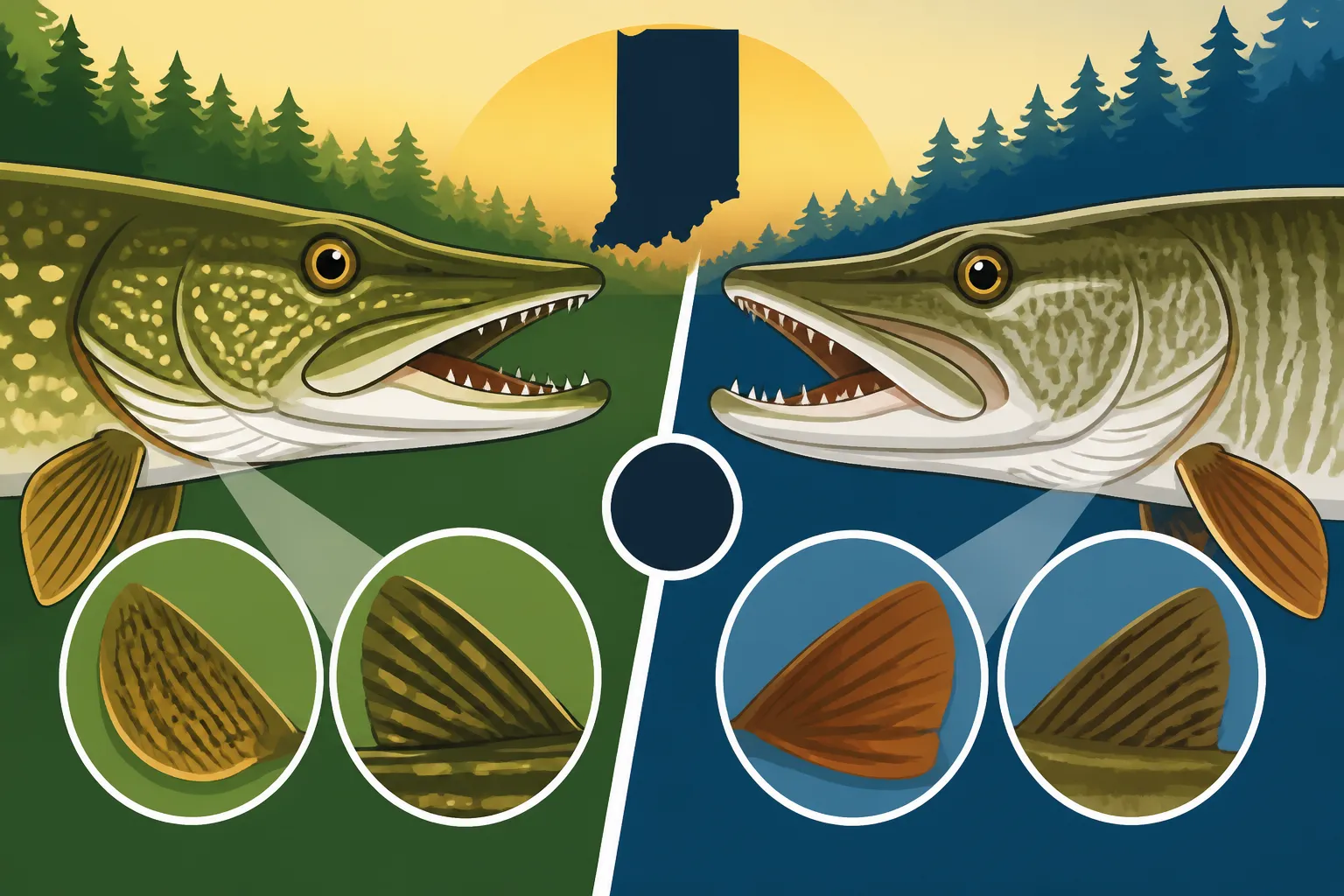
Northern Pike vs Muskie: Jaw and Fin Differences
Many Indiana anglers, especially those exploring our incredible glacial lakes or larger rivers for the first time, often find themselves captivated by a long, toothy fish only to wonder: is this a Northern Pike or a Muskie? These two formidable predators share a similar silhouette, making them notoriously tricky to distinguish, yet knowing the difference is vital for adhering to regulations and understanding the fish you've caught. This guide is here to demystify the identification process, focusing on the tell-tale jaw and fin characteristics that will help you confidently identify your catch in Indiana waters.
Why Accurate Identification Matters for Indiana Anglers
It's not just about bragging rights or being a know-it-all on the water; correctly identifying your catch is a fundamental part of responsible angling, especially when it comes to species like Northern Pike and Muskie. These two fish, while related, are distinct, and their differences have real-world implications for you and the fisheries.
Avoiding Misidentification and Legal Pitfalls
Imagine the scenario: you've spent hours on Lake Wawasee, battling a magnificent, hard-fighting fish. You finally land it, snap a picture, and release it, thinking you've just caught a Muskie. Only later, you find out it was a Northern Pike, or vice versa, and the legal length limits or bag limits for that specific body of water are completely different for the two species. This kind of mix-up can lead to unintended violations. Indiana has specific rules for Northern Pike Fishing in Indiana: A Complete Guide and Muskellunge Fishing in Indiana: What Anglers Need to Know, and these often include varying minimum length requirements and daily catch limits. Misidentifying your fish could mean accidentally keeping a fish that's undersize for its species, or unknowingly exceeding the legal bag limit. The conservation officers aren't looking to give you a hard time, but ignorance of the law is rarely an excuse, and penalties can be significant. Knowing the exact species helps you comply with regulations and contribute to the health of Indiana's fish populations.
Understanding Behavior and Habitat Differences
Beyond the legal aspect, accurate identification empowers you as an angler. While both are ambush predators, subtle physiological differences, including those in their jaws and fins, can correlate with their preferred habitats, feeding strategies, and even fighting styles. For instance, the muskie’s slightly different fin placement might contribute to its more explosive bursts of speed and agility, allowing it to navigate complex cover or chase down faster prey. Northern Pike, with their robust body and slightly different jaw structure, might be better adapted for certain types of ambush in weed beds. Understanding these nuances helps you refine your fishing techniques and choose the right spots. You might use different lures or baits if you're targeting Muskie in the deeper, clear waters of the Indiana's Glacial Lake District: Home to Muskie, Pike, and Walleye compared to chasing Northern Pike in shallower, weedy bays.
The Head and Jaw: Unlocking Primary Identification Clues
When you've got a toothy critter in your net, the first place to look for definitive answers is often its head, specifically the cheeks and gill covers. This is where Northern Pike and Muskie offer their most consistent and easily observable distinguishing features.
Northern Pike: Fully Scaled Cheeks and Gill Covers
One of the most reliable ways to tell a Northern Pike from a Muskie is by examining the scaling on its head. For Northern Pike, you'll notice that the entire cheek and the upper half of the gill cover are fully scaled. Think of it like a full beard and a fully covered ear. If you gently run your finger over the cheek area, it should feel consistent with the scaling on the rest of its body, extending all the way down to the jawline without any significant interruption. Similarly, the top portion of the gill cover will have clear, distinct scales. This complete coverage is a hallmark of the Northern Pike and is present on both sides of the fish's head. It's a key detail that, once you learn to look for it, becomes a quick identifier. If you're looking for a quick reference on the water, you might find some excellent laminated fish identification cards on Amazon that highlight this specific feature with clear diagrams.
Muskie: Partially Scaled Cheeks and Gill Covers
In stark contrast, the Muskie (often called "Muskellunge") has a more patchy, or "partially scaled," appearance on its head. When you examine a Muskie, you'll typically find scales only on the upper half of its cheek and the upper half of its gill cover. The lower half of both the cheek and the gill cover will be noticeably bare, revealing smooth, skin-like tissue rather than scales. It's like having stubble on the lower jaw and a shaved patch on the bottom of the ear. This absence of scales on the lower portions is a crucial identifier. If you feel hesitant about handling a toothy fish to check this, observing from a slight distance, perhaps with the help of a fishing net that keeps the fish submerged but visible, can also work. Remember, patience and a good eye will serve you well in Muskellunge Identification: Spotting Indiana's Toothiest Fish.
The Snout and Mouth Shape
While the scaling is paramount, the overall shape of the snout and mouth can also offer subtle clues, though these are less definitive and require a more experienced eye. Northern Pike tend to have a somewhat flatter, more "duck-bill" shaped snout, almost like the tip has been slightly compressed. Their mouths, when closed, often appear more uniformly streamlined. Muskie, on the other hand, can have a slightly more elongated, pointed, or even speckled snout, and their jawline might appear a bit more robust or powerful. Some anglers describe the Muskie's mouth as having a more pronounced "grin" due to its powerful jaw muscles. These subtle differences in profile, when combined with the scaling patterns, can reinforce your identification. Many anglers use heavy-duty long-nosed pliers, readily available on Amazon, to safely remove hooks from these fish, allowing for a closer inspection of their mouth without danger.
The Fins: Telling the Difference by Tail and Dorsal Placement
Beyond the head, the fins—particularly the dorsal fin (on the back) and the caudal fin (the tail)—provide another set of critical distinguishing features between Northern Pike and Muskie. Their placement and shape can give you instant confirmation.
Dorsal Fin Position Relative to the Anal Fin
This is perhaps the second most reliable visual cue after the head scaling. For a Northern Pike, if you look at the dorsal fin (the one on its back, closer to the tail) and the anal fin (the one on its belly, also closer to the tail), you’ll notice a distinct difference in their starting points. A Northern Pike's dorsal fin typically starts forward of the anal fin. This means if you were to draw an imaginary vertical line down the fish’s body from the front edge of its dorsal fin, that line would pass ahead of the anal fin. It’s a subtle but consistent feature, making the back half of the pike appear slightly less symmetrical in its fin placement. Many veteran anglers will tell you this is one of their go-to checks on a fish they suspect is a pike. Understanding this can greatly aid in Northern Pike Identification: Light Spots on a Dark Body.
Muskie's Dorsal and Anal Fins: Almost Mirror Images
Now, let's contrast that with the Muskie. For these impressive fish, the dorsal fin and the anal fin are almost mirror images of each other. This means the dorsal fin starts directly above or slightly behind the anal fin. If you draw that same imaginary vertical line down from the front edge of the dorsal fin, it would intersect the anal fin or fall just behind its leading edge. This creates a much more symmetrical appearance in the tail section of the Muskie. It gives the Muskie a longer, more streamlined look in its rear portion, a characteristic often associated with its powerful, explosive bursts when striking prey. This symmetry is a strong indicator you’re dealing with a true Muskie.
Caudal Tail Fin Shape
While less definitive than the fin placement or head scaling, the shape of the caudal, or tail, fin can also offer some clues, especially when comparing two fish side-by-side. Northern Pike tend to have a more deeply forked tail with somewhat more pointed lobes. The indentation or "V" shape at the center of their tail is typically more pronounced. Muskie, conversely, usually have a shallower fork in their tail and the lobes tend to be more rounded, giving the tail a broader, almost paddle-like appearance. While this difference can sometimes be subtle and vary slightly among individual fish, it’s another piece of the puzzle to consider. It’s important to remember that fishing gear, particularly specialized Muskie or Pike nets, available on platforms like Amazon, often have larger, rubberized mesh to protect these fins and the fish's slime coat during landing, which is critical for a healthy release.
Beyond Jaw and Fins: Other Distinguishing Marks
While jaw scaling and fin placement are the primary diagnostic tools, there are other characteristics that, when combined with the main identifiers, can help solidify your Northern Pike vs. Muskie identification. These are often related to coloration, body patterns, and even subtle anatomical features.
Body Markings and Coloration
The overall pattern and coloration of these fish can often provide additional clues, though it's important to remember that color can vary greatly depending on water clarity, habitat, and even the fish's mood.
- Northern Pike: Typically, Northern Pike have a dark body (often green, olive, or brownish) with distinct light, bean-shaped spots or bars running horizontally along their sides. Think of it as light markings on a dark background. Their fins often have dark spots or blotches. This pattern gives them excellent camouflage in weedy cover, allowing them to ambush unsuspecting prey. You can usually see this pattern even in stained water.
- Muskie: Muskie, on the other hand, usually exhibit a lighter body color (ranging from silver to greenish-brown) with dark vertical bars, spots, or blotches on their sides. So, for a Muskie, it's typically dark markings on a light background. Some Muskie can be unpatterned, appearing more uniform in color, especially larger ones, which adds to the challenge. Their fins typically have dark bars or spots. This contrasting pattern, whether barred or spotted, helps them blend into varied environments, from submerged timber to open water. When looking at photos online or even fish identification books from Amazon, pay close attention to whether the pattern is dark on light or light on dark.
Sensory Pores on the Underside of the Jaw
For those who want to be absolutely certain, there's a definitive, though often overlooked, anatomical feature: the sensory pores on the underside of the lower jaw. These small, pit-like openings are part of the lateral line system and are consistent between the two species.
- Northern Pike: Will generally have five or fewer pores on each side of the underside of their lower jaw. Sometimes it's exactly five, sometimes fewer, but rarely more.
- Muskie: Will almost always have six to nine pores on each side of the underside of their lower jaw. Six or seven is most common, but they can have up to nine.
To check these pores, you'd need to gently hold the fish's mouth slightly open and examine the smooth, fleshy underside of its jaw. This requires careful handling due to their sharp teeth, so make sure you have appropriate tools like a fish gripper and release tools, which can be found in various sizes on Amazon, if you plan on using this method for positive identification. For most casual anglers, the scaling and fin placement are sufficient, but these pores offer a foolproof method for those seeking absolute certainty.
Comprehensive Comparison Table
To help summarize these key differences, here's a handy table you can reference:
| Feature | Northern Pike | Muskie (Muskellunge) |
|---|---|---|
| Cheek Scales | Fully scaled on both upper and lower halves | Scaled only on the upper half; lower half is bare |
| Gill Cover Scales | Fully scaled on both upper and lower halves | Scaled only on the upper half; lower half is bare |
| Dorsal Fin Placement | Starts forward of the anal fin | Starts directly above or slightly behind the anal fin |
| Caudal (Tail) Fin | More deeply forked, often with pointed lobes | Shallower fork, often with more rounded lobes |
| Body Markings | Dark body with light spots or bars | Lighter body with dark spots, bars, or blotches |
| Jaw Pores (Underside) | 5 or fewer on each side | 6 to 9 on each side |
| Snout Shape | Often flatter, more "duck-bill" shaped | Can be more elongated, slightly pointed, or speckled |
By paying close attention to these details, especially the scaling on the cheeks and gill covers and the relative positions of the dorsal and anal fins, you'll be well on your way to confidently identifying whether you've landed an aggressive Northern Pike or a magnificent Muskie in Indiana's fantastic waters. Happy fishing, and remember to always handle these incredible fish with care for a healthy release!
Disclaimer
This article is for general informational purposes only and does not constitute professional advice. Laws, prices and regulations vary by location and change over time. Consult a qualified professional for guidance on your specific situation.