Best Marine Radios for Lake Michigan Boaters
When you're out on the vast expanse of Lake Michigan, that feeling of freedom is incredible. But that big water also comes with big responsibilities, and one of the most crucial pieces of equipment that many boaters unfortunately overlook until it's too late is a reliable marine radio. Cell phones are great, but they're simply not dependable offshore, leaving you vulnerable when you need communication most. This guide will walk you through everything you need to know about choosing and using the best marine radio to keep you safe and connected on Lake Michigan.
Why a Marine Radio Isn't Just an Option, It's a Lifeline on Lake Michigan
Imagine being miles offshore, a sudden squall rolls in, and your cell phone suddenly shows "No Service." It's a scenario that plays out far too often, and it's precisely why a dedicated marine radio isn't just a nice-to-have gadget; it's an absolute necessity for anyone venturing onto Lake Michigan. This isn't just about calling for help; it's about being part of a maritime community, receiving critical information, and ensuring everyone's safety.
Beyond Cell Phone Range: The Reality of Offshore Communication
The truth is, while cell phones are fantastic for catching up with friends or checking the weather from shore, their range is severely limited once you push past a few miles from the coastline. Those cell towers are designed for land-based communication, not for broadcasting across large bodies of water like Lake Michigan. You might get lucky with a signal close to a major city or specific towers along the shoreline, but the moment you head out on an extended fishing trip or a leisurely cruise across the lake, that reliance on your smartphone becomes a dangerous gamble.
A marine VHF (Very High Frequency) radio, on the other hand, is specifically designed for line-of-sight communication over water. While its range is also line-of-sight dependent, it transmits on frequencies reserved for maritime use, ensuring clear communication with the U.S. Coast Guard, other vessels, and marine facilities. When you're facing an emergency or simply need to check in, a marine radio vastly outperforms any cell phone once you're beyond sight of land.
Essential for Safety: Distress Calls and Weather Alerts
The primary reason for having a marine radio on Lake Michigan boils down to safety. In an emergency, your marine radio is your direct link to help. You can hail the Coast Guard directly on Channel 16, the international hailing and distress frequency. Unlike a cell phone call, which goes to a single dispatcher, a VHF distress call is broadcast to all vessels and shore stations within range, significantly increasing your chances of a rapid response from anyone nearby.
Many modern marine radios also feature Digital Selective Calling (DSC). This incredible technology, when properly connected to your boat's GPS, allows you to press a single button to send an automated digital distress signal that includes your boat's unique identification (MMSI number) and, most importantly, your exact location. The Coast Guard receives this immediately, even if you're unconscious or unable to speak. Beyond emergencies, marine radios also provide instant access to NOAA weather channels, giving you real-time updates on sudden changes in Lake Michigan's notoriously fickle conditions. Knowing about an impending storm or dense fog bank can be the difference between a pleasant day and a truly perilous situation. For more on what to carry, check out Indiana Boater Safety Gear Checklist.
Communicating with Other Vessels and Marinas
Beyond emergency use, a marine radio is invaluable for everyday communication on the water. It's the polite and professional way to talk to other boats. Need to coordinate with your fishing buddies about a hot spot for Lake Michigan's Salmon and Trout: A Complete Guide? A quick chat on a working channel is much easier than trying to get a cell signal or shout across the waves. Trying to navigate busy harbor traffic or need to inquire about dockage at a marina? A marine radio is how you do it.
Many commercial vessels, tugboats, and even swing bridges operate on specific VHF channels, and having a radio allows you to communicate with them, ensuring safe passage and avoiding potential collisions. It fosters a sense of community and mutual awareness on the water, something a private cell phone call simply can't replicate. It also lets you monitor chatter, picking up on local knowledge, fishing reports, or potential hazards other boaters might be discussing.
Understanding Your Options: Types of Marine Radios for Lake Michigan Boaters
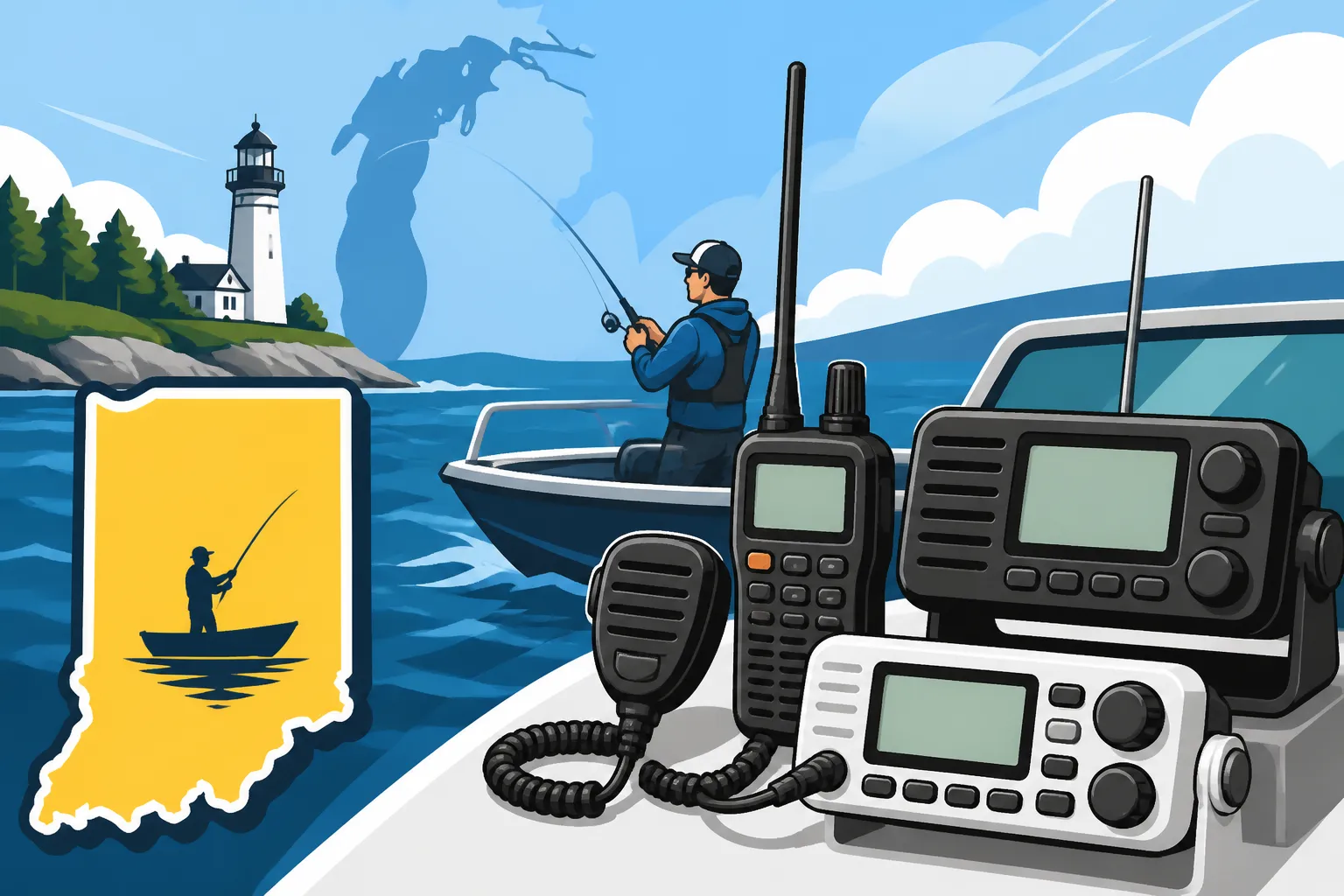
When you start looking at marine radios, you'll primarily encounter two main types: fixed-mount and handheld. Each has its own strengths and weaknesses, making one more suitable than the other depending on your vessel and boating habits on Lake Michigan. Understanding the distinctions will help you make an informed choice for your specific needs.
Fixed-Mount VHF Radios: The Backbone of Boat Communication
Fixed-mount VHF radios are what most people think of when they imagine a marine radio. These units are permanently installed in your boat, typically at the helm, and connected to your boat's 12-volt power supply and an external antenna. Their key advantage is their power output, usually 25 watts, which translates to the maximum legal transmission range. This higher power means your signal travels further, a critical factor on a large body of water like Lake Michigan. The external antenna, mounted high on your boat, also contributes significantly to this extended range, as VHF signals are line-of-sight. The higher the antenna, the further it can "see" and transmit.
These radios often come with larger displays, more robust features, and are generally built to withstand the rigors of a marine environment for years. Many fixed-mount units include advanced features like Digital Selective Calling (DSC) and can be integrated with your boat's GPS system via NMEA 0183 or NMEA 2000 connections. This integration is crucial for the DSC functionality to transmit your precise location during an emergency. For boats spending significant time offshore on Lake Michigan, a fixed-mount radio is practically non-negotiable.
Handheld VHF Radios: Portability and Backup Power
Handheld VHF radios offer a fantastic balance of portability and functionality, making them excellent choices for smaller boats, kayaks, personal watercraft, or as a crucial backup to a fixed-mount unit. They are self-contained, powered by rechargeable batteries, and include their own integrated antenna. Their main draw is their go-anywhere convenience; you can take them in a dinghy, onto a paddleboard, or even clip one to your life jacket.
However, handhelds typically have a lower power output, usually 5 or 6 watts, which limits their transmission range compared to fixed-mount units. Their smaller, internal antenna also reduces effective range. While they are usually waterproof (often to IPX7 or IPX8 standards, meaning they can be submerged for a period), their battery life is finite and requires regular charging. Many handhelds also offer DSC, but some might require manual GPS input or be paired wirelessly with a separate GPS device if they don't have built-in GPS. Despite these limitations, a handheld is an indispensable piece of gear for any boater on Lake Michigan, if only as a reliable emergency backup when the main system fails or if you need to leave the main vessel.
Features You Can't Afford to Ignore: DSC and GPS Integration
When it comes to marine radios for Lake Michigan, certain features move beyond "nice-to-have" into the "absolutely essential" category. Digital Selective Calling (DSC) is at the top of that list. This is not just a fancy button; it's a game-changer for maritime safety. With DSC, you can send an automated digital distress message to the Coast Guard and other DSC-equipped vessels with a single press of a button. This message contains your unique MMSI (Maritime Mobile Service Identity) number and, crucially, your precise location. This feature dramatically cuts down response times, especially if you're incapacitated or disoriented.
For DSC to work effectively, your marine radio must know your location. This is where GPS integration comes in. Many fixed-mount radios, and an increasing number of handhelds, have built-in GPS receivers. For those that don't, they will have NMEA 0183 or NMEA 2000 ports, allowing you to connect them to your boat's existing GPS plotter or external GPS antenna. This connection automatically feeds your position data to the radio, ensuring that any distress call you make immediately includes your coordinates. Never underestimate the importance of this feature; it's a fundamental pillar of modern marine safety.
| Feature | Fixed-Mount VHF Radio | Handheld VHF Radio |
|---|---|---|
| Power Output | High (25 watts max) | Lower (5-6 watts max) |
| Range | Excellent (due to high power & external antenna) | Good for short range/backup (lower power & internal antenna) |
| Installation | Permanent, wired to boat's power, external antenna | Portable, battery-powered, internal antenna |
| Primary Use | Main communication for offshore/larger boats | Backup, small craft, tenders, personal use |
| GPS/DSC Integration | Common, often built-in or NMEA connectivity for GPS | Increasingly common, may require external GPS for some models |
| Durability | Robust, designed for permanent marine exposure | Highly waterproof, durable for portable use |
| Battery Life | Unlimited (runs off boat's power) | Limited (rechargeable battery) |
Key Features to Prioritize When Choosing Your Marine Radio
When you're staring at a wall of marine radios, it can feel a little overwhelming trying to figure out which one is truly right for your adventures on Lake Michigan. Beyond just fixed-mount or handheld, there are specific features that will significantly impact your safety, communication, and overall experience. Let's dig into what really matters.
Power Output and Range: Reaching Further on Big Water
On a body of water as expansive as Lake Michigan, the ability to transmit and receive signals over long distances is paramount. This is primarily determined by your radio's power output and, crucially, the height of your antenna. Fixed-mount radios typically transmit at a maximum of 25 watts, which is the highest legal power for recreational vessels. This higher wattage, combined with an externally mounted antenna positioned as high as possible on your boat (think mast, cabin top, or arch), provides the best possible range for line-of-sight communication. Every foot of antenna height adds miles to your effective range, making your signal more likely to reach the Coast Guard or a distant fellow boater.
Handheld radios, in contrast, usually operate at a maximum of 5 or 6 watts. While some have a "high power" setting, this is still significantly less than a fixed-mount unit, and their integrated antenna is inherently lower to the water. This means their range will be shorter. For near-shore cruising or communicating with a nearby boat, a handheld is perfectly adequate. But for truly venturing out on Lake Michigan, especially if weather conditions degrade, the superior range of a 25-watt fixed-mount radio with a tall antenna becomes a critical safety asset. Don't compromise on this for serious offshore activity; it's literally about being heard when it matters most.
Waterproofing and Durability: Battling Lake Michigan's Elements
Lake Michigan is beautiful, but it can also be incredibly unpredictable and harsh. A marine radio needs to be able to withstand splashes, spray, rain, and even accidental submersion. This is where ingress protection (IP) ratings come into play. Look for radios with an IPX7 or, even better, an IPX8 rating. An IPX7 rating means the device can be submerged in up to 1 meter of water for 30 minutes without damage, which is excellent for a handheld that might take an accidental dunk. An IPX8 rating signifies it can withstand continuous submersion beyond 1 meter.
Beyond waterproofing, consider the overall build quality. Marine radios from reputable brands like Standard Horizon, Icom, and Cobra are designed with durable plastics, corrosion-resistant components, and sturdy controls to handle salt spray (even if Lake Michigan is fresh, boat environments are tough), UV exposure, and constant vibrations. While you might find some budget options, remember that a radio is a safety device. Investing in a robust, well-sealed unit will ensure it functions when you need it most, even after years of exposure to the elements. Durability here isn't a luxury; it's a necessity for boating on the Great Lakes.
User-Friendliness and Display Clarity: When Every Second Counts
In an emergency, or even just during routine communication, you don't want to be fumbling with complicated menus or squinting at a tiny, dim screen. User-friendliness is a surprisingly important feature. Look for a marine radio with intuitive controls, large, well-spaced buttons that are easy to operate even with wet hands or gloves, and a clear, backlit display. The display should be readable in bright sunlight, dim twilight, and complete darkness.
Many radios feature oversized channel numbers, a dedicated Channel 16 button for instant access to the distress frequency, and clear channel labels (e.g., "Weather," "Hailing"). If you're considering a fixed-mount unit, assess where it will be installed on your dash or console. Will the screen be easily visible from your typical operating position? Are the speakers loud and clear enough to be heard over engine noise or wind? For handhelds, does it fit comfortably in your hand, and can you easily reach all the necessary buttons? Ease of use reduces stress and ensures faster, more accurate communication, which can be critical when time is of the essence on the open water.
Installation, Maintenance, and Best Practices for Your Marine Radio
Having a top-of-the-line marine radio is only half the battle. To truly get the most out of it and ensure it's there for you when you need it, proper installation, diligent maintenance, and understanding best practices for communication are absolutely critical. These steps will ensure your safety device performs optimally on Lake Michigan.
Proper Installation for Optimal Performance
For a fixed-mount marine radio, proper installation is key to achieving its maximum range and reliability. First, choose a mounting location at your helm that is protected from direct spray where possible, but still easily accessible and visible. Ensure the unit has adequate ventilation, and that you can easily plug in the microphone. The power connection should be wired directly to your boat's 12-volt battery or a dedicated fuse panel, ensuring a clean, consistent power supply. Avoid tapping into circuits that might fluctuate or be overloaded, as this can affect performance and potentially damage the radio.
Most importantly, the antenna needs to be mounted as high as possible and in a clear line of sight, away from other antennas or obstructions. A poor antenna connection or an improperly matched antenna can drastically reduce your transmission and reception range. If your radio has DSC, make sure it's connected to your boat's GPS system (either built-in, or via NMEA 0183/2000 wiring). If you're not comfortable with marine electrical work or antenna tuning, it's always best to have a qualified marine electronics technician handle the installation. Investing in professional installation ensures your radio is correctly grounded, shielded, and optimized for performance.
Routine Checks and Battery Management
Like any critical piece of safety gear, your marine radio needs regular attention. For fixed-mount units, routinely check all cable connections for corrosion or looseness, especially the antenna cable. Clean the display and controls with a damp cloth and mild soap, avoiding harsh chemicals. Periodically test your radio by performing a radio check. You can typically do this by hailing the Coast Guard on Channel 16 and asking for a radio check, or by using a dedicated radio check service if available in your area. This ensures your microphone, transmitter, and antenna are all functioning correctly.
For handheld radios, battery management is paramount. Always ensure the battery is fully charged before heading out, especially for longer trips. If you have a spare battery, keep it charged and readily accessible. Batteries can lose their charge over time, so consider replacing older batteries if you notice a significant drop in holding capacity. Keep the charging contacts clean and free of corrosion. Even if you primarily use a fixed-mount radio, regularly check your handheld backup to ensure it's charged and operational; you never know when you might need it. You can find excellent marine radios and accessories at retailers like Bass Pro Shops or online through Amazon.
Understanding and Using Channels Responsibly
Knowing which channels to use and how to communicate effectively is just as important as having the radio itself. Channel 16 is the international hailing and distress channel; it's for initial contact and emergencies only. Once you've made contact, immediately switch to a working channel (like 68, 69, 71, or 72) for your conversation. Never tie up Channel 16 with casual chatter. Channel 9 is often used for hailing between recreational boats, and many marinas monitor it. NOAA weather channels provide continuous weather broadcasts, a must-have for Lake Michigan's unpredictable nature.
When communicating, always use clear, concise language. State your boat's name twice, the name of the station you're calling, and then your message. For instance: "Coast Guard, Coast Guard, this is fishing vessel The Walleye Wanderer, The Walleye Wanderer over." Then, once they respond, switch to a working channel. If you have a DSC-equipped radio, remember to obtain and program your unique MMSI (Maritime Mobile Service Identity) number. This is free and available through various maritime organizations. Without an MMSI, your DSC distress button won't transmit your identification or location, severely limiting its effectiveness. Responsible radio usage is a sign of a prepared and respectful boater. Understanding Lake Michigan Fishing Rules for Indiana Anglers is also key to responsible boating.
Disclaimer
This article is for general informational purposes only and does not constitute professional advice. Laws, prices and regulations vary by location and change over time. Consult a qualified professional for guidance on your specific situation.