Best Wire Leaders for Indiana Muskie Fishing
Oh, the thrill of muskie fishing in Indiana! There's nothing quite like the heart-stopping moment when one of those toothy critters decides to annihilate your lure. But that excitement can quickly turn to heartbreak if you're not properly prepared. Too many anglers have felt the devastating disappointment of a snapped line and a lost trophy fish, all because their leader wasn't up to the challenge of those razor-sharp teeth. This guide is all about preventing that crushing defeat by helping you understand and choose the best wire leaders for muskie fishing right here in the Hoosier State.
Why Wire Leaders Are Non-Negotiable for Indiana Muskie
Let's be real, you wouldn't go into a sword fight with a butter knife, right? So why would you go muskie fishing without a proper defense against those incredibly sharp teeth? It's a common mistake for newcomers, but once you understand the muskie, you'll know why a wire leader isn't just a recommendation – it's an absolute necessity.
The Toothy Predator Problem
Muskellunge, often called the "fish of 10,000 casts," aren't just big; they're built for ambush and destruction. Their mouths are like a miniature gauntlet of incredibly sharp, inward-pointing teeth designed to hold onto struggling prey. Imagine a piranha, but supersized and with a jaw strong enough to crush. When a muskie hits a lure, especially a larger one, they're not just nipping at it; they're engulfing it. That means your line, whether it's monofilament or even heavy fluorocarbon, is going to come into direct contact with those teeth. And guess what? Mono and fluoro simply don't stand a chance. They'll fray, weaken, and often snap almost instantly, sending your expensive lure and that once-in-a-lifetime fish to the depths. It's a devastating experience that can be entirely avoided with the right leader.
Protecting Your Investment and Your Catch
Let's face it, muskie fishing isn't exactly a budget-friendly hobby. Those big, beautiful bucktails, gliders, and crankbaits can cost a pretty penny, and losing one to a toothy maw is like throwing money directly into the water. A good wire leader acts as a protective shield, absorbing the shock and preventing direct contact between the muskie's teeth and your main line or leader material. Think of it as insurance for your lures. But it's not just about saving your gear; it's about successfully landing that fish you've worked so hard for. A snapped line is a lost fish, and for a species known for its rarity and fighting prowess, every hookup is precious. A robust leader significantly increases your chances of getting that fish to the boat for a quick photo and a healthy release, allowing it to grow even bigger for another angler someday. It's a win-win for your wallet and the fishery.
Minimizing Harm to the Fish
While Indiana regulations don't specifically dictate leader material, ethical angling practices strongly lean towards using gear that ensures a quick and clean fight, minimizing stress on the fish. Losing a muskie with a lure still stuck in its mouth due to a snapped line is a terrible outcome for the fish. That lure can impede its ability to feed, injure its mouth, or cause infection. By using a strong wire leader, you ensure that once you hook a muskie, you have the best possible chance of bringing it in efficiently, unhooking it quickly, and releasing it unharmed. This commitment to proper gear is part of being a responsible angler and contributes to the long-term health of Indiana's muskie populations, which are a valuable resource in lakes like Webster, Tippecanoe, and James Lake. Muskellunge Fishing in Indiana: What Anglers Need to Know highlights the importance of these fish.
Types of Wire Leaders for Indiana Muskie Fishing
When it comes to wire leaders, it's not a one-size-fits-all situation. There are several types, each with its own characteristics, strengths, and weaknesses. Understanding these differences will help you choose the best option for your specific fishing style and the conditions you encounter in Indiana's muskie waters.
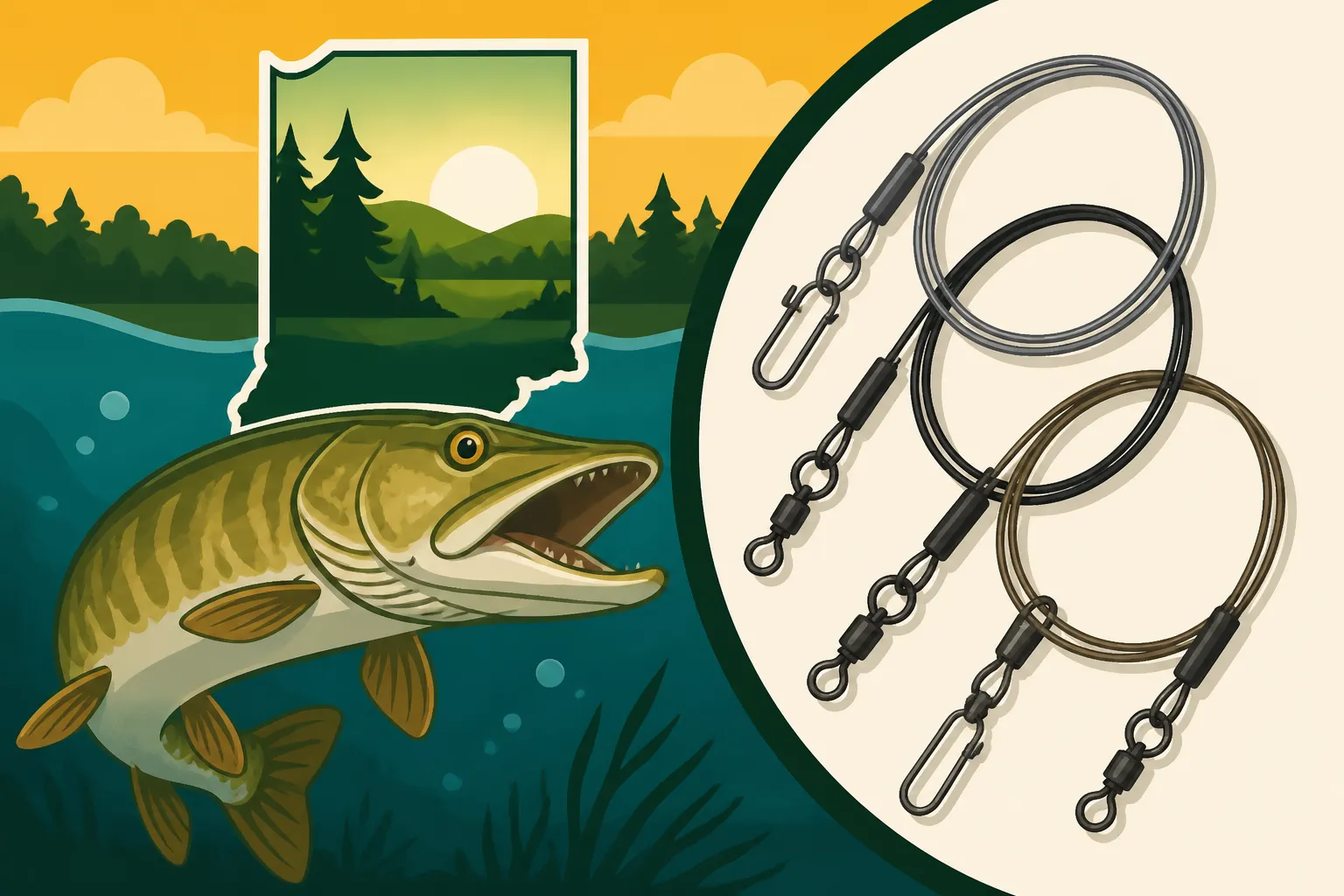
Single-Strand Wire Leaders
Single-strand wire leaders, often made of stainless steel, are exactly what they sound like: a single, solid piece of wire. These are traditionally very popular for pike and muskie fishing due to their simplicity and stiffness.
- Pros: Single-strand wire offers excellent abrasion resistance against sharp teeth and is generally very sensitive, allowing you to feel subtle bumps and changes in your lure's action. Its stiffness also helps prevent your lure from fouling (hooking itself on the main line), especially with larger, wobbling baits. They are also typically more cost-effective than some other options.
- Cons: The biggest drawback of single-strand wire is its propensity to kink. Once a muskie twists and turns at the boat, or even during a strong fight, the wire can develop a permanent bend. A severe kink significantly weakens the leader and necessitates immediate replacement. They also have a lot of "memory," meaning they retain the shape they were in, which can be annoying for storage.
- Best Uses: These are excellent for jerkbaits, glide baits, and other lures where a stiffer connection is desired to impart specific action. They are also a solid choice for anglers who don't mind frequently checking and replacing their leaders after each fish or every few hours of casting.
Multi-Strand (Braided) Wire Leaders
Multi-strand leaders are made up of several fine strands of wire braided or twisted together, often then coated with nylon or another polymer. This construction gives them a much different feel and performance than single-strand.
- Pros: Their main advantage is incredible flexibility and kink resistance. You can bend them, knot them (though most still use crimps for strength), and they'll spring back. This flexibility can be beneficial for lures that require a more natural, unimpeded movement, like soft plastic swimbaits or larger bucktails. They also tend to be less visible than bare single-strand wire, especially if they have a nylon coating.
- Cons: Because they are made of multiple strands, they can sometimes fray, especially after a lot of abuse or if a muskie's teeth manage to separate some of the strands. While flexible, they can still be cut by a direct hit from a very sharp tooth if the coating is compromised. They can also be a bit more expensive than basic single-strand options.
- Best Uses: Multi-strand leaders excel with spinnerbaits, bucktails, topwater lures, and any presentation where maximum lure action and flexibility are key. Many anglers find them more user-friendly due to their resistance to kinking and easier handling. They are widely available at fishing specialty stores and online retailers like Amazon.
Titanium Wire Leaders
Titanium leaders are the premium choice for many serious muskie anglers, offering a blend of strength, flexibility, and durability that's hard to beat.
- Pros: Titanium is incredibly strong for its diameter, highly resistant to kinking (often marketed as "kink-proof"), and has very low memory. It's also surprisingly lightweight, which can be an advantage for lure action. These leaders tend to last much longer than steel options, even through multiple fish.
- Cons: The biggest downside is the cost; titanium leaders are significantly more expensive than their steel counterparts. While flexible, they can be a bit more challenging to work with for DIY leader making, as they often require specific crimping tools or can be difficult to tie knots with if not designed for it.
- Best Uses: If you're looking for the ultimate in reliability and durability, especially when throwing expensive, large lures or targeting trophy fish, titanium is the way to go. They are fantastic for all lure types and are a favorite for anglers who don't want to worry about their leader after every fish. When you're fishing for those monster muskie in Indiana's Glacial Lake District, titanium can provide that extra peace of mind.
Fluorocarbon Leaders (The Debate)
It's worth addressing the use of heavy fluorocarbon leaders, as some anglers, particularly those targeting pike or other species, might suggest them. For muskie, however, most seasoned Indiana anglers will advise against them as a primary leader.
- Why the Debate: Fluorocarbon is known for its low visibility underwater and its abrasion resistance. In very heavy pound tests (e.g., 80-130 lb), it can resist some light abrasion.
- Why It's Risky for Muskie: The issue is cutting, not just abrasion. While heavy fluoro can handle some scraping, a muskie's teeth are designed to slice. A direct hit from one of those sharp teeth, especially during the violent head shakes common during a muskie fight, can easily cut through even very thick fluorocarbon. The risk of losing a fish and an expensive lure is simply too high when targeting such a formidable predator.
- Conclusion: For muskie fishing, stick with wire. While fluorocarbon has its place in other fisheries, it's not the reliable tooth-proof solution you need for a muskie.
Key Considerations When Choosing a Muskie Leader
Once you know the types of leaders available, it's time to fine-tune your choice. Several factors play into selecting the perfect leader for your Indiana muskie adventure. These elements work together to ensure your leader is effective, safe, and doesn't hinder your lure's action or your chances of success.
Leader Length: Finding the Sweet Spot
The length of your muskie leader is more critical than you might think. It's a balance between protecting your line and not interfering with your casting or lure presentation.
- Short Leaders (6-9 inches): These are often favored for very aggressive presentations or when targeting fish that are shy of longer leaders. They keep the lure close to your main line connection. However, a shorter leader offers less protection from accidental wraps or if a muskie rolls in the line.
- Medium Leaders (9-12 inches): This is arguably the most common and versatile length for muskie fishing. It provides ample protection from the fish's teeth, even if it thrashes or rolls, without being so long that it becomes cumbersome to cast or negatively impacts lure action. For general casting and retrieving, a 10-12 inch leader is a fantastic starting point.
- Long Leaders (12-18+ inches): Longer leaders are sometimes used for trolling or when fishing particularly large baits where a muskie might engulf the lure deeply or repeatedly roll during the fight. The extra length provides maximum protection. The downside is that they can be harder to cast accurately, especially with lighter lures, and might get tangled more easily.
- Safety Consideration: No matter the length, ensure your leader is long enough that when the muskie is boat-side, the fish's teeth cannot come into contact with your main line. This is crucial during the "figure-eight" maneuver How to Figure-Eight a Muskie at the Boat or when preparing to net the fish.
Leader Strength (Pound Test): Matching the Fight
Muskie are powerful fish, and your leader needs to be strong enough to handle their raw power, sudden runs, and violent head shakes. This isn't the time to skimp on strength.
- Minimum for Muskie: For serious muskie fishing in Indiana, you generally want to be looking at leaders in the 80 to 130-pound test range.
- 80-100 lb Test: This is a good starting point for most casting situations, especially with medium to large bucktails and crankbaits. It offers a good balance of strength and a slightly thinner diameter, which can sometimes aid in lure action.
- 100-130 lb Test: When you're throwing truly massive baits, trolling, or targeting known trophy waters like those found in Indiana's Glacial Lake District, bumping up to 100-130 lb test provides an extra margin of safety. Remember, a muskie's strike is incredibly forceful, and you want zero doubt about your leader holding up.
- Match Your Main Line: While the leader is crucial, ensure your main line (often heavy braid, 65-100lb) and rod/reel combo are also appropriately matched to the task. The leader is the last line of defense, but the whole system needs to be robust. Best Rods for Muskie Fishing explains how to pair your gear.
Hardware: Swivels, Snaps, and Crimps
A leader is only as strong as its weakest link, and often, that link is the hardware you use to connect it all. Don't overlook the quality of your swivels, snaps, and crimps.
- Swivels: High-quality ball-bearing swivels are essential. Muskie lures, especially bucktails and spoons, can twist line, leading to tangles and weakened line. Ball-bearing swivels rotate freely, preventing line twist, and are incredibly strong. Look for reputable brands that specify their breaking strength.
- Snaps: Quick-change snaps are invaluable for muskie fishing, allowing you to swap out lures quickly without retying. However, not all snaps are created equal. Choose heavy-duty, interlock snaps or coastlock snaps designed for muskie. Avoid cheaper, weak snaps that can bend open under the stress of a fighting muskie. Barrel snaps, for instance, are generally too weak for muskie.
- Crimps: If you're making your own leaders, investing in a good crimping tool and high-quality sleeves is paramount. Properly crimped connections are stronger and more reliable than poorly tied knots in wire. Ensure the crimps are appropriately sized for your wire diameter and that you apply even, firm pressure without over-crimping, which can weaken the wire. Many pre-made leaders will already feature excellent crimps. You can find quality components at stores like Bass Pro Shops or through online retailers.
- Table: Wire Leader Comparison
| Leader Type | Pros | Cons | Best For |
|---|---|---|---|
| Single-Strand | High sensitivity, stiffness, cost-effective | Prone to kinking, high memory, requires frequent checks | Jerkbaits, glide baits, specific lure action |
| Multi-Strand | Very flexible, kink-resistant, good durability | Can fray over time, slightly more visible than titanium | Spinnerbaits, bucktails, topwater, soft plastics, versatile casting |
| Titanium | Kink-proof, highly durable, strong, lightweight | Most expensive, can be tricky to work with for DIY | All lure types, ultimate reliability, trophy fishing, long-term use |
Pre-Made vs. DIY Leaders
You have a choice: buy leaders ready to go, or craft them yourself. Both have their merits.
- Pre-Made Leaders:
- Pros: Convenience is king here. You buy them, you use them. Quality control is usually excellent from reputable brands, ensuring strong components and proper crimping. This is a great option for beginners or those short on time. They are readily available in various lengths and strengths at most sporting goods stores and online via Amazon.
- Cons: Can be more expensive in the long run than making your own, especially if you go through a lot of leaders. You're limited to the sizes and styles offered by manufacturers.
- DIY Leaders:
- Pros: Cost-effective once you have the tools, and you can customize every aspect: length, wire type, swivel and snap choice. This allows for fine-tuning your setup for specific lures or conditions.
- Cons: Requires an initial investment in wire, crimps, swivels, snaps, and a good crimping tool. There's a learning curve to properly crimp and assemble leaders safely. A poorly made DIY leader is a recipe for disaster and lost fish.
For most Indiana muskie anglers, a mix of both often works best. Have a stock of reliable pre-made leaders, but consider dabbling in DIY if you enjoy the craft and want more customization.
Maintaining Your Muskie Leaders for Peak Performance
Your muskie leader is a critical piece of equipment, and like any critical piece, it needs attention. Ignoring leader maintenance is like driving your car without checking the oil – eventually, something's going to fail, and it's probably going to happen at the worst possible moment. A little care goes a long way in ensuring your leaders hold up when that trophy muskie finally decides to strike.
Inspecting for Damage After Every Fish
This might seem obvious, but in the excitement and adrenaline of landing a muskie, it's easy to overlook. Make it a routine: every single time you boat a muskie (or even after a vigorous retrieve if you suspect a short strike), give your leader a thorough once-over.
- What to Look For:
- Kinks: Especially critical for single-strand wire. Any severe bend or kink that won't straighten out by hand is a red flag. A kink dramatically reduces the leader's breaking strength.
- Fraying/Separation: For multi-strand leaders, check for any individual wire strands that have separated or frayed, particularly near the crimps or where the muskie's teeth might have scraped.
- Crimped Connections: Ensure the wire isn't slipping out of the crimp, and the crimp itself isn't damaged or loose.
- Snap/Swivel Integrity: Check your snap to ensure it hasn't bent or opened slightly. Make sure the swivel is still rotating freely and isn't seized up.
- Why It Matters: A small kink or a slightly bent snap might seem minor, but under the immense pressure of a fighting muskie, it will be the point of failure. It's much better to swap out a leader on the boat than to lose a fish because of a preventable issue. This quick check takes mere seconds but can save you from immense frustration. Best Time of Year to Fish in Indiana will tell you when these checks are most critical.
Proper Storage to Prevent Kinking
How you store your leaders when they're not in use is just as important as how you use them on the water. Improper storage can introduce kinks and memory into leaders, especially single-strand steel, making them less effective before you even cast.
- Leader Wallets/Pouches: Many anglers use dedicated leader wallets or clear plastic pouches designed to keep leaders flat and straight. These often have individual sleeves or compartments, preventing leaders from tangling with each other or getting bent.
- Coiling: If you're using more flexible multi-strand or titanium leaders, a loose coil can work well, but avoid tight, sharp bends. Secure the coil with a twist tie or Velcro strap to keep it organized.
- Avoid Overstuffing: Don't cram too many leaders into a small space. Pressure can lead to unwanted bends and kinks.
- Keep Them Dry: While wire leaders are generally corrosion-resistant, storing them in a damp environment can lead to rust on snaps or swivels over time, especially if they're not stainless steel. Ensure your tackle box or storage area is dry. Proper storage extends the life of your leaders and ensures they're ready for action when you hit the water, whether you're targeting Best Walleye Fishing in Indiana or the mighty muskie.
Knowing When to Replace: Don't Risk It
This is the golden rule of muskie leaders: if in doubt, throw it out. It's a hard lesson learned by many, but the cost of a new leader is always, always less than the cost of a lost trophy fish and a premium lure.
- Visible Damage: As mentioned, any visible kink, fray, bend, or compromise in the hardware means it's time for a new leader. Don't try to "bend it back" or "make it last one more cast." It won't.
- Fatigue: Even if you don't see overt damage, wire leaders can experience metal fatigue over time, especially after catching multiple powerful fish. If a leader feels "soft" or just doesn't seem as rigid as it once was, it's probably nearing the end of its reliable life.
- Proactive Replacement: Consider replacing leaders after a particularly intense battle with a big fish, or simply after a certain number of hours of fishing, even if they look fine. For serious muskie hunters, replacing leaders every few trips, or even daily if you're getting a lot of action, is just part of the game. It’s a small price to pay for confidence in your gear when that massive Muskellunge Identification: Spotting Indiana's Toothiest Fish hits.
- The Investment Mindset: Think of leaders as consumables, just like hooks or fishing line. They're designed to take abuse from a powerful, toothy predator. Embracing this mindset will save you a lot of heartache in the long run.
Ultimately, choosing and maintaining the best wire leaders for Indiana muskie fishing is about preparedness and respect for the fish. With the right leader, you're not just protecting your gear; you're maximizing your chances of a successful catch and release, making every encounter with these incredible fish a memorable one. Now get out there and chase those Indiana giants!
Disclaimer
This article is for general informational purposes only and does not constitute professional advice. Laws, prices and regulations vary by location and change over time. Consult a qualified professional for guidance on your specific situation.