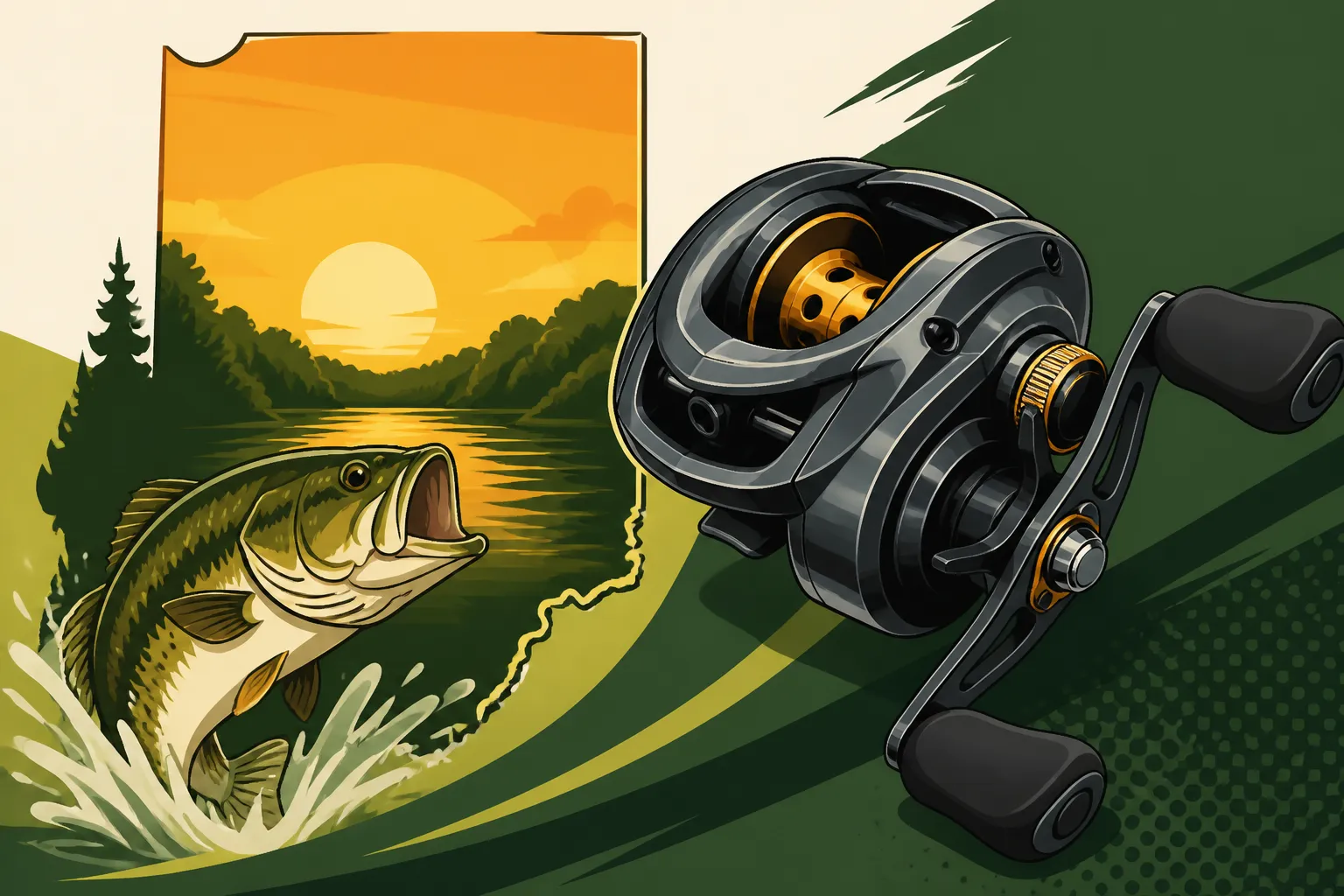
Best Baitcasting Reels for Indiana Anglers
Let's be honest, few things are more frustrating than a cast that goes awry because your reel just isn't up to snuff, or worse, a tangled mess that costs you precious fishing time on a beautiful Indiana morning. Whether you're targeting those elusive largemouth bass hidden in lily pads, or battling a hard-fighting channel catfish in the river, the right baitcasting reel can make all the difference. This guide is here to help you navigate the often overwhelming world of baitcasting reels and find the perfect match for your Indiana angling adventures.
Why Baitcasting Reels are a Game Changer for Indiana Anglers
For many seasoned anglers in our great state, baitcasting reels aren't just an option; they're a necessity. They offer a level of control and power that spinning reels often can't match, particularly when you're dealing with heavier lures, dense cover, or larger fish. If you've ever found yourself struggling to place a lure exactly where you want it or felt underpowered when a big one hits, you understand the appeal.
It’s about more than just brute strength, though. There's a certain finesse and connection you feel with your bait and the fish when you're using a well-tuned baitcaster. That intimate feel translates directly into more successful hooksets and fewer missed opportunities, which is what we all strive for when we hit the water. It’s an investment that truly pays off in performance and enjoyment.
Precision and Control for Pinpoint Accuracy
One of the biggest advantages of a baitcasting reel is the unparalleled control it gives you over your cast. Think about those tight spots on a small pond or a winding river like the Tippecanoe River, where you need to drop a lure precisely next to a log or under an overhanging branch. With a baitcaster, you can feather the spool with your thumb, slowing the lure down just before it hits the water, allowing for incredibly accurate and quiet presentations. This precision is invaluable when fishing for wary bass or crappie that spook easily.
Imagine you're trying to skip a jig under a dock on Monroe Lake, or gently place a frog bait onto a mat of thick weeds. A baitcasting reel, once you master it, allows for these delicate yet powerful maneuvers. It's the difference between merely throwing your bait and actively guiding it exactly where it needs to be to entice a bite. This level of control opens up a whole new world of techniques that are simply harder, if not impossible, with other reel types.
Power and Torque for Battling Big Fish
When a big fish hits, you need a reel that can handle the fight, and baitcasters truly shine in this department. They are designed with robust gears and stronger frames, which translates into more cranking power and torque. This is crucial when you're pulling a hawg largemouth out of heavy cover, or wrestling a powerful channel catfish out of a strong current in the Wabash River. The direct connection from the handle to the spool minimizes energy loss, giving you more leverage over the fish.
This inherent power means less fatigue for you and more control over the fish, ultimately leading to more successful landings. You're not just reeling; you're fighting the fish with confidence, knowing your gear can take the strain. For anglers who specifically target larger species, or those who find themselves in situations where a strong retrieve is essential, the power of a baitcasting reel is non-negotiable.
Versatility for Various Species and Lures
Indiana's waters are incredibly diverse, offering opportunities to catch everything from panfish to muskie. A good baitcasting reel can handle a wide array of lures and line types, making it incredibly versatile. You can switch from a heavy jig for deep-water walleye to a lightweight spinnerbait for bass without skipping a beat, simply by adjusting your braking system and potentially your line choice. This adaptability means you don't need a dozen different setups for every fishing scenario.
Whether you're fishing heavy braided line to rip a topwater lure through weeds, or a sensitive fluorocarbon for finesse presentations, a baitcaster can accommodate. This versatility is a major benefit, especially for anglers who explore different lakes and rivers across Indiana, encountering various species and conditions. It streamlines your gear, making your fishing trips more efficient and enjoyable.
Key Features to Look For in an Indiana Baitcasting Reel
Choosing the right baitcasting reel isn't about picking the most expensive one; it's about finding the features that best suit your specific fishing style and the types of water you’ll be exploring in Indiana. There are several critical components that differentiate one reel from another, and understanding them will empower you to make an informed decision. Don't be shy about asking questions when you're browsing at your local tackle shop or looking at reviews online at sites like Amazon or Bass Pro Shops.
It's easy to get overwhelmed by all the technical jargon, but once you break it down, it's quite logical. Focus on what you need for your fishing, not just what's popular or heavily advertised. A reel that's perfect for someone fishing offshore might be completely wrong for someone targeting smallmouth bass in an Indiana river.
Gear Ratio and Its Impact on Retrieve Speed
The gear ratio tells you how many times the spool rotates with one full turn of the handle. This number is expressed as X.Y:1. For example, a 6.4:1 gear ratio means the spool rotates 6.4 times for every single turn of the handle. This seemingly small number has a huge impact on your retrieve speed and, consequently, how effectively you can work certain lures.
- Low Gear Ratio (around 5.X:1 to 6.X:1): These reels are ideal for lures that require a slow, steady retrieve, like deep-diving crankbaits, large swimbaits, or even when you're pitching jigs into heavy cover and need maximum power to pull fish out. The slower retrieve helps keep your bait in the strike zone longer and gives you more torque to fight bigger fish. Think about those cold water days on Patoka Lake when a slow presentation is key to enticing sluggish bass.
- Medium Gear Ratio (around 7.X:1): This is often considered the most versatile gear ratio, a true "all-rounder" for many Indiana anglers. It’s great for a variety of techniques, from spinnerbaits and chatterbaits to Texas rigs. It offers a good balance of speed for covering water and power for fighting fish. If you're only getting one baitcaster to start, a 7.X:1 might be your sweet spot for general use on lakes like Lake Wawasee.
- High Gear Ratio (8.X:1 and above): These reels are designed for speed. They're perfect for techniques where you need to quickly pick up slack line, such as topwater fishing, flipping and pitching jigs into dense vegetation, or burning spinnerbaits across flats. If you're fishing a highly reactive bite or need to quickly retrieve your lure for another cast, a high gear ratio is invaluable. It lets you cover a lot of water fast, which can be critical during a tournament or when fish are scattered.
| Gear Ratio Range | Typical Speed | Ideal Indiana Applications | Target Species |
|---|---|---|---|
| 5.X:1 – 6.X:1 | Slow-Medium | Deep crankbaits, large swimbaits, heavy jigs, powerful retrieves | Largemouth Bass, Catfish, Muskie, deep Walleye |
| 7.X:1 | Medium-Fast | Spinnerbaits, chatterbaits, Texas rigs, general purpose | Largemouth Bass, Smallmouth Bass, Pike, lighter Walleye |
| 8.X:1 and above | Fast | Topwater lures, flipping/pitching, burning baits, quick retrieves | Largemouth Bass, Smallmouth Bass, quickly covering water for any species |
Bearings and Smoothness
Reel bearings are small, circular components that allow parts of the reel to move smoothly against each other. Generally, more bearings are associated with a smoother operating reel, but it's crucial to remember that quality often trumps quantity. A reel with fewer, high-quality stainless steel or ceramic bearings will almost always outperform a reel with a higher number of cheap, low-grade bearings.
- Purpose of Bearings: Bearings reduce friction, which makes cranking the handle feel effortless and helps the spool spin freely during a cast. This smoothness is not just a luxury; it reduces wear and tear on the reel's internal components, prolonging its life.
- What to Look For: Aim for reels with at least 5-7 quality bearings. Beyond that, the improvement in smoothness might be marginal for most anglers. Pay attention to the material; stainless steel is a good standard, while ceramic bearings offer superior corrosion resistance and smoothness, often found in higher-end models.
- Maintenance: Even the best bearings need care. Regular cleaning and lubrication, especially after exposure to dirt or water, will keep your reel performing at its best. Neglecting them can lead to grinding, stiffness, and ultimately, a breakdown.
Braking Systems to Prevent Backlashes
Ah, the dreaded backlash! If you're new to baitcasting, you've likely experienced this tangled mess of line that looks like a bird's nest. Baitcasting reels employ braking systems to help control the spool's rotation during a cast, preventing the spool from spinning faster than the line is peeling off, which is the root cause of backlashes. There are two primary types:
- Centrifugal Braking Systems: These systems use small pins (usually 4-6) inside the reel that move outward due to centrifugal force during a cast. As they move outward, they rub against a brake drum, creating friction and slowing the spool.
- Pros: Generally offer a more consistent, linear braking force throughout the cast. Excellent for experienced casters who value precision and long-distance casting.
- Cons: Often require opening the side plate to adjust, which can be inconvenient, especially if conditions change (e.g., wind picks up on Lake Michigan).
- Magnetic Braking Systems: These systems use magnets that apply varying degrees of resistance to the spool. An external dial on the side of the reel allows you to easily adjust the braking strength.
- Pros: Extremely easy to adjust on the fly, making them very user-friendly, especially for beginners or when switching between different lure weights or facing changing wind conditions.
- Cons: Some anglers feel they don't offer the same linear braking as centrifugal systems, and very light lures can still be a challenge.
Many modern baitcasting reels, especially those from reputable brands, now incorporate dual braking systems that combine both centrifugal and magnetic brakes. This offers the best of both worlds: the consistent control of centrifugal brakes with the on-the-fly adjustability of magnetic brakes. This can be a huge advantage for anglers fishing diverse Indiana waters and changing conditions. For example, if you're fishing a breezy day on Brookville Lake, being able to quickly dial up the magnetic brake can save you a lot of headache.
Spool Capacity and Line Type
The spool capacity tells you how much fishing line of a certain diameter the reel can hold. This is a crucial consideration depending on the size of the fish you're targeting and the environment you're fishing in. You wouldn't use the same line on a tiny creek as you would on Lake Michigan!
- Line Types:
- Monofilament (Mono): Affordable, good knot strength, and some stretch, which can be forgiving. Good for topwater and crankbaits where stretch can be beneficial.
- Fluorocarbon (Fluoro): Nearly invisible underwater, low stretch (better sensitivity), and sinks. Excellent for finesse techniques and clear water conditions.
- Braided Line (Braid): Extremely strong for its diameter, no stretch (maximum sensitivity and hooksetting power), and floats. Ideal for heavy cover, punching, and long casts. Many anglers use a braided main line with a fluorocarbon leader for stealth.
- Matching Capacity to Needs:
- For most bass and general freshwater fishing in Indiana, a reel that holds 100-120 yards of 12-15 lb monofilament (or equivalent braid) is usually sufficient. This allows for good casting distance and enough line to handle a strong run from a fish.
- If you're targeting bigger, harder-fighting fish like muskie or heavier catfish, or fishing very dense cover, you might want a reel with a larger spool capacity to accommodate heavier line or more braided line, providing extra insurance. For instance, when fishing the Glacial Lakes for muskie, having enough line to handle a long run is essential. Muskellunge Fishing in Indiana: What Anglers Need to Know highlights the kind of power you're up against.
Always check the manufacturer's specifications for recommended line capacities. Remember that using a line significantly heavier than the reel is designed for will drastically reduce your casting distance and capacity, while too light a line might not perform well with the reel's braking system.
Matching Your Reel to Indiana's Fishing Scenarios
Indiana offers a fantastic variety of fishing opportunities, from vast reservoirs to winding rivers and small farm ponds. The "best" baitcasting reel really depends on what kind of fishing you're passionate about. Tailoring your reel choice to specific scenarios will significantly improve your success and enjoyment on the water.
It's tempting to think one reel can do it all, and while some are certainly more versatile than others, having a couple of different setups optimized for specific techniques can really elevate your game. Think about what your primary targets are and where you spend most of your time fishing.
Bass Fishing on Lakes and Ponds
Largemouth bass are arguably the most popular sportfish in Indiana, and baitcasting reels are almost synonymous with bass fishing. Whether you're exploring the sprawling waters of Monroe Lake or a quiet farm pond, the demands on your reel are similar: a balance of casting accuracy, power, and sensitivity.
For general bass fishing, a medium to high gear ratio (6.X:1 to 7.X:1) is often preferred. This allows you to work a wide range of lures effectively, from jigs and soft plastics to spinnerbaits and crankbaits. A versatile braking system, especially one with dual brakes, will be your best friend as it allows you to adjust to different lure weights and wind conditions quickly. Look for a reel that feels comfortable in your hand, as you'll be making many casts throughout the day. Features that contribute to lightness and ergonomics will reduce fatigue. If you want to dive deeper into techniques, check out Best Bass Fishing Techniques for Pre-Spawn and Post-Spawn.
When you're pitching and flipping into heavy cover, like dense lily pads or brush piles, you'll want a faster gear ratio (7.X:1 or 8.X:1+) to quickly retrieve your bait and move on to the next spot, or to get a hooked fish out of the cover before it snags you. Combine this with a powerful reel capable of handling heavy braided line, and you'll be well-equipped to tackle the biggest bass that Indiana's lakes and ponds have to offer.
River Fishing for Smallmouth and Catfish
Indiana's rivers, like the White River or the St. Joseph River, offer excellent opportunities for smallmouth bass and various catfish species. These environments demand different qualities from your baitcasting reel. For smallmouth, you often need precise casting to hit pockets of current or rock structures, and enough power to fight fish that leverage the current against you. For catfish, it's all about brute strength and line capacity.
For river smallmouth, a medium gear ratio (around 7.X:1) is a great starting point, allowing you to work jigs, crankbaits, and topwaters. The key here is a smooth retrieve and a robust drag system to handle the fighting power of a smallmouth in current. You'll also want a reel that casts well with slightly lighter lures, as smallmouth often hit smaller presentations.
When it comes to catfish, especially larger channel cats or flatheads, your reel needs to be a workhorse. Look for a durable reel with a lower gear ratio (around 5.X:1 to 6.X:1) for maximum cranking power. Crucially, you'll need ample spool capacity to hold heavier monofilament or braided line, as these fish can make powerful runs. A strong, reliable drag system is non-negotiable. Many dedicated catfish anglers might opt for specific heavy-duty baitcasting models designed for maximum pulling power. To learn more about targeting these powerful fish, read Channel Catfish Fishing in Indiana: The Complete Guide.
Heavy Cover and Finesse Applications
One of the true tests of a versatile baitcasting reel is its ability to transition between heavy cover applications and more delicate, finesse presentations. This is where a reel with a highly adjustable braking system and a well-engineered spool comes into its own.
- Heavy Cover: When you're fishing in thick weeds, submerged timber, or dense brush, you need a reel that can handle heavy braided line and has the power to rip fish out before they can bury themselves. A fast gear ratio helps you get that fish moving quickly. Look for reels with strong, robust frames and gears that won't flex under extreme pressure. This is also where a powerful drag system becomes critical – you need to be able to lock it down and physically pull a fish out of its hiding spot.
- Finesse Applications: While spinning reels are often associated with finesse, a skilled baitcaster can achieve incredible sensitivity and control with lighter lures and lines. This often involves using lighter fluorocarbon lines and lures like weightless worms or small jigs. The key here is a reel with an extremely free-spinning spool and a very light-setting brake system to allow for effortless casting of lighter baits without backlash. This requires more skill from the angler to thumb the spool, but the reward is unparalleled feel and accuracy.
The ability to switch between these two extremes on a single outing, perhaps from punching a mat on Salamonie Lake to throwing a shaky head on a nearby open point, is what makes a good baitcasting reel truly indispensable for the serious Indiana angler.
Understanding Brands and Budget for Your Next Reel
When it comes to baitcasting reels, the market is flooded with options, from entry-level workhorses to high-performance machines. Understanding where to invest your money and what to expect at different price points will help you find a reel that meets your needs without breaking the bank. You’ll find options from well-known manufacturers at retailers like Bass Pro Shops and readily available models online from Amazon, offering a wide spectrum of choices.
Don't feel pressured to buy the most expensive reel right away. It's often better to start with a solid mid-range option and upgrade as your skills and understanding evolve. A well-chosen budget reel can still deliver excellent performance if you know what to look for.
Entry-Level vs. High-Performance Reels
The difference between an entry-level baitcaster and a high-performance model isn't always obvious at first glance, but it becomes clear on the water.
- Entry-Level Reels: These reels (often found in the lower price tiers) are fantastic for beginners or anglers on a budget. They typically offer simpler braking systems, fewer (or lower quality) bearings, and heavier construction materials.
- What to expect: They'll cast, retrieve, and catch fish. You might experience more backlashes initially, and the retrieve might not be as buttery smooth. They might also be a bit heavier and less ergonomic.
- Best for: Learning the ropes of baitcasting, occasional fishing trips, or as a backup reel. They are durable enough to take some abuse while you master the casting technique.
- Mid-Range Reels: This is often the sweet spot for many Indiana anglers. These reels offer a significant jump in performance and features without the premium price tag. You'll start to see more advanced braking systems (often dual brakes), better quality bearings, lighter materials, and more refined ergonomics.
- What to expect: Much smoother casting and retrieving, better backlash control, and generally lighter feel. They can handle a wider range of techniques and lures more effectively.
- Best for: Anglers who have mastered the basics and are looking for a reliable, versatile reel that performs well across various fishing scenarios. Many dedicated anglers have several mid-range reels for different techniques.
- High-Performance Reels: These are the top-tier models, featuring the latest technology, lightest and strongest materials (like magnesium or carbon fiber), the highest quality bearings, and extremely precise braking and drag systems.
- What to expect: Unmatched smoothness, incredible casting distance, superb sensitivity, and extremely lightweight designs. They are designed for competitive anglers or those who demand the absolute best in performance.
- Best for: Tournament anglers, professionals, or passionate hobbyists who fish frequently and want every possible advantage on the water. They are investments in peak performance and longevity.
Remember, a reel's price often reflects the materials, manufacturing precision, and advanced features it offers. However, sometimes a slightly older model from a premium brand can offer incredible value if you find it on sale at a place like Bass Pro Shops.
Maintenance Tips for Longevity
No matter what baitcasting reel you choose, proper maintenance is key to ensuring its longevity and consistent performance, especially with all the dust, grit, and water an Indiana fishing trip can throw at it. A well-maintained reel will last for years, while a neglected one will quickly degrade.
- Wipe Down After Each Use: After every trip, take a moment to wipe down your reel with a damp cloth to remove any dirt, dust, or fish slime. Pay special attention to the line guide and spool.
- Rinse (Carefully): If you've been fishing in muddy water or saltwater (though less common in Indiana, it's relevant for Lake Michigan trips!), a light rinse with fresh water is beneficial. DO NOT blast your reel with a high-pressure hose. A gentle stream from a faucet is sufficient. Dry it thoroughly immediately afterward.
- Lubrication: Periodically, apply a tiny drop of high-quality reel oil to the moving parts, such as the spool shaft, handle knobs, and worm gear. Use reel grease on the main gears if you're comfortable opening the reel. Less is more – over-lubricating can attract more dirt.
- Line Maintenance: Regularly check your fishing line for fraying, especially the first few feet near the lure. Cut off any damaged sections. Consider replacing your line every season or two, depending on how often you fish.
- Annual Cleaning and Servicing: For avid anglers, consider a more thorough annual cleaning and lubrication. If you're not comfortable disassembling your reel, many tackle shops offer professional servicing. This ensures all internal components are clean and properly lubricated, extending the life of your reel significantly.
By taking a few minutes to care for your baitcasting reels, you’re protecting your investment and ensuring that they’re always ready for your next fishing adventure, whether it's on the placid waters of a farm pond or battling the elements on Lake Michigan. Don't let a poorly maintained reel ruin a perfect day on the water.
Disclaimer
This article is for general informational purposes only and does not constitute professional advice. Laws, prices and regulations vary by location and change over time. Consult a qualified professional for guidance on your specific situation.